Saturday, June 10, 2006

Albuquerque, New Mexico

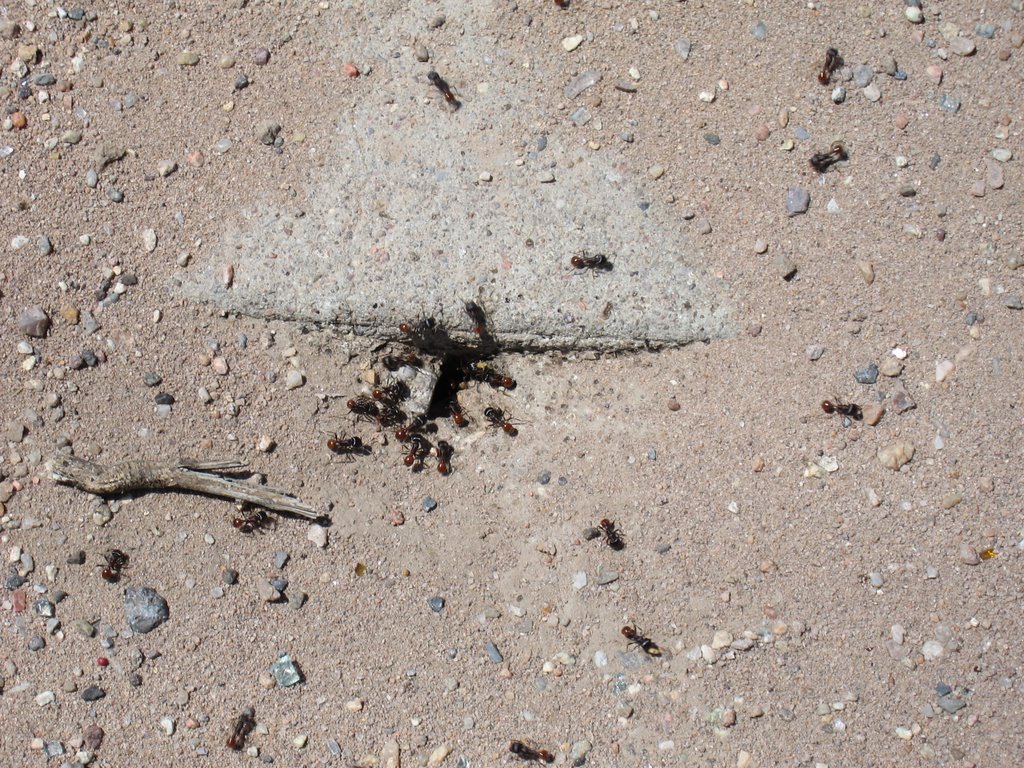
I don't know how many different species or subspecies of ant live in Albuquerque, but not because I didn't ask. I count at least four: small red, small black, large red, large black. The large black ants are as long as my thumbnail.1 The carry away anything: bread crumbs, scraps of paper, bits of tobacco from cigarette butts, feathers. From these objects, it is hard to know if they are building farms, warehouses, factories, barracks.

If you are an ant you can find something to do on every yard on every block. Half the city is building upwards, toward the stars, and if you wish you can climb the metallic skeletons and glass-and-granite skin to great heights. The view here is quite something, though safely returning to the ground can be difficult. Your half of the city is building downwards, toward the center of the earth, and if you wish you can travel there as well. The tunnels are dark and you have to navigate by smell and touch alone.

Where do your tunnels lead? How many of you are there? Something is going on below the surface. If only you'll tell us just what.


1 Trimmed.


Chilili, New Mexico

Idon't know the story of the town of Chilili, and based on the welcome sign—which declares Chilili a self-governing community based on the Chilili Land Grant and asks for no photographs of town, among a long list of nos—I didn't want to stop and ask. Chilili's a town full of photogenically dilapidated buildings, as well as a yard for older yellow school buses and, of course, that sign, and even with only a hundred or so residents it seems that you could spend a few happy hours walking around and watching.

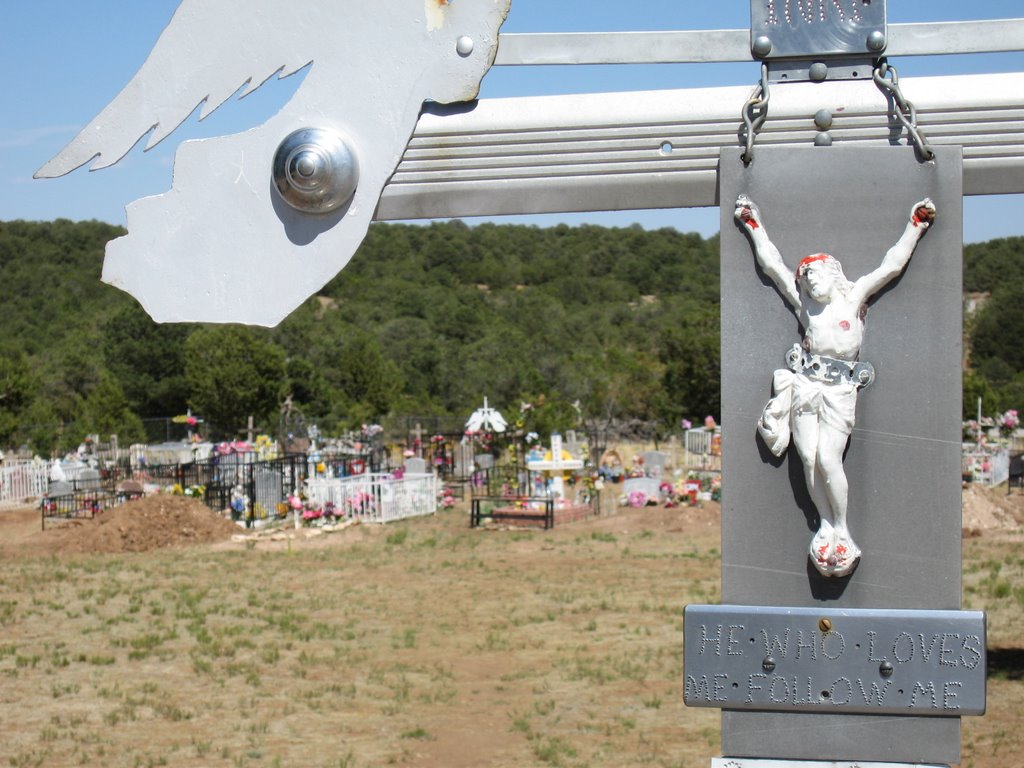
The cemetary is just outside of town. Unlike the town of Chilili, the cemetary has a sign that says visitors are welcome and photos allowed. You can't see the sign from the road, though, so you might spend a few minutes avoiding the Chililians if you don't know you can go in.

It's safe to say that the graves prior to Horace McAfee aren't particularly interesting; the same is true for the graves after his death. They're just crosses and rounded stones.

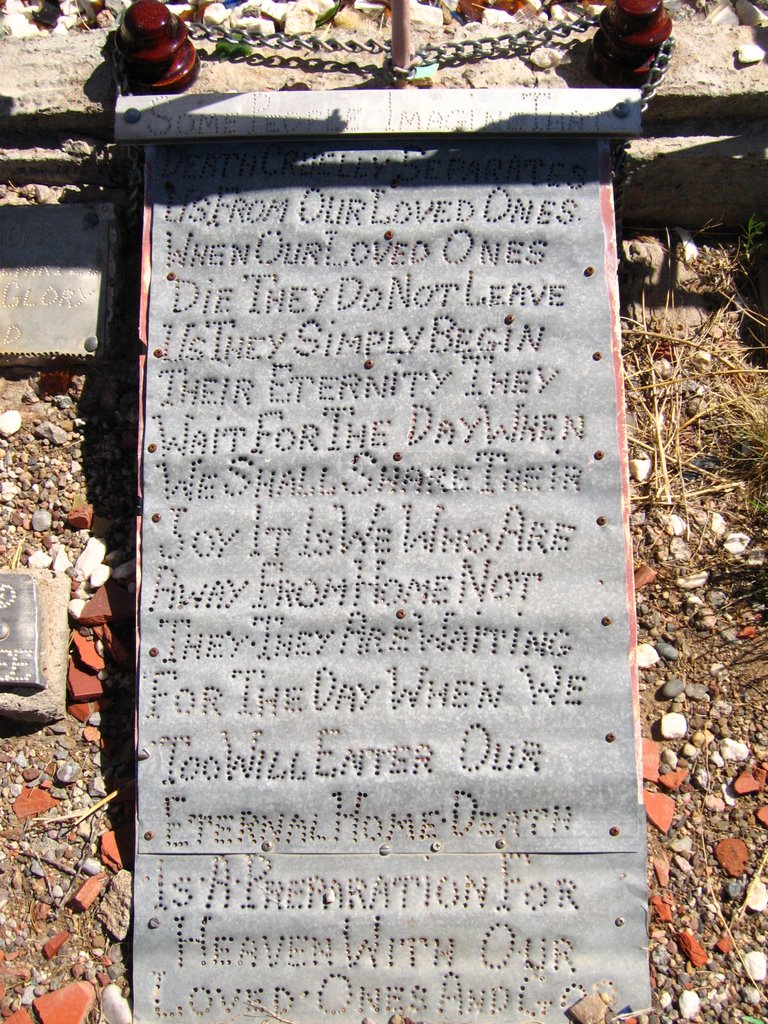
McAfee's, though, are special. You can identify them both by style and by the large "Made by H. McAfee" sign on each one. The text on the grave markers is a tin sheet pounded with a nail, often on a cement base. The metallic rails often describe the coffin aboveground.

As I watch, lizards scuttle across, around, and over McAfee's graves. Did he plan for this? But this is true of the newer graves as well.

A regret: If only I had asked someone for McAfee's story, to disclose his motivation beyond the religious conviction spelled out on the larger tin sheets. Some of the more recent graves are now mounds rather than pits, without true markers, markers that will last. This could have been true in McAfee's day as well, and he has been dead 50 years. Are the people too poor for proper graves? Was this McAfee's way of enriching his people? The answers lie with him, here, in Chilili.

Wednesday, June 07, 2006

Santa Fe

The Georgia O'Keeffe Museum in Santa Fe is surprisingly small, only eight rooms, if I remember correctly, and it's easy to think that there must be more to it, especially for eight dollars. (Indeed, as I was leaving, a man with a broad drawl asked an attendant, "Darlin', is there more someplace?") That the most arresting pieces in the museum were Alfred Steiglitz's photos of O'Keeffe only added to the disappointment.

I tired of Santa Fe after about six hours, so I left. I couldn't find the real town among the Navajo blankets and ceramics and women's clothing stores. The Jean Cocteau Theatre is closed. The Ghost Ranch Presbyterian complex had cut-rate Klaus Oldenburg imitations outside, complete with bright red cherries. The river had no water, but the promenade was still picturesque.

It occured to me that Santa Fe is a honeymoon city, a beautiful place for quiet self-indulgence in a shaded courtyard or hotel room with a breeze on the curtains.

Let me tell you what the city felt like: a traveling carnival, a movie set, Southwestland. Like a paper-maché city; or a computer simulacrum. As if I could find a special door to take me to Florence, or Tomorrowland, or Cinecittà, where the actors may be dressed differently and speak differently, but the soil beneath is all the same.


Bernalillo, New Mexico

Ahem.

Tuesday, June 06, 2006

Farmington, New Mexico

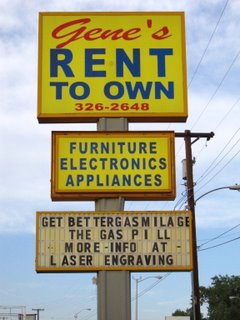
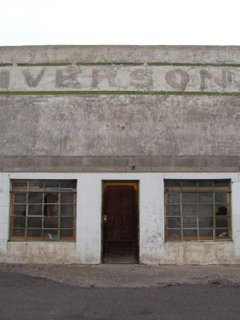
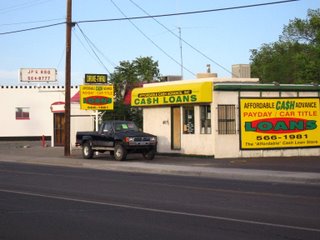
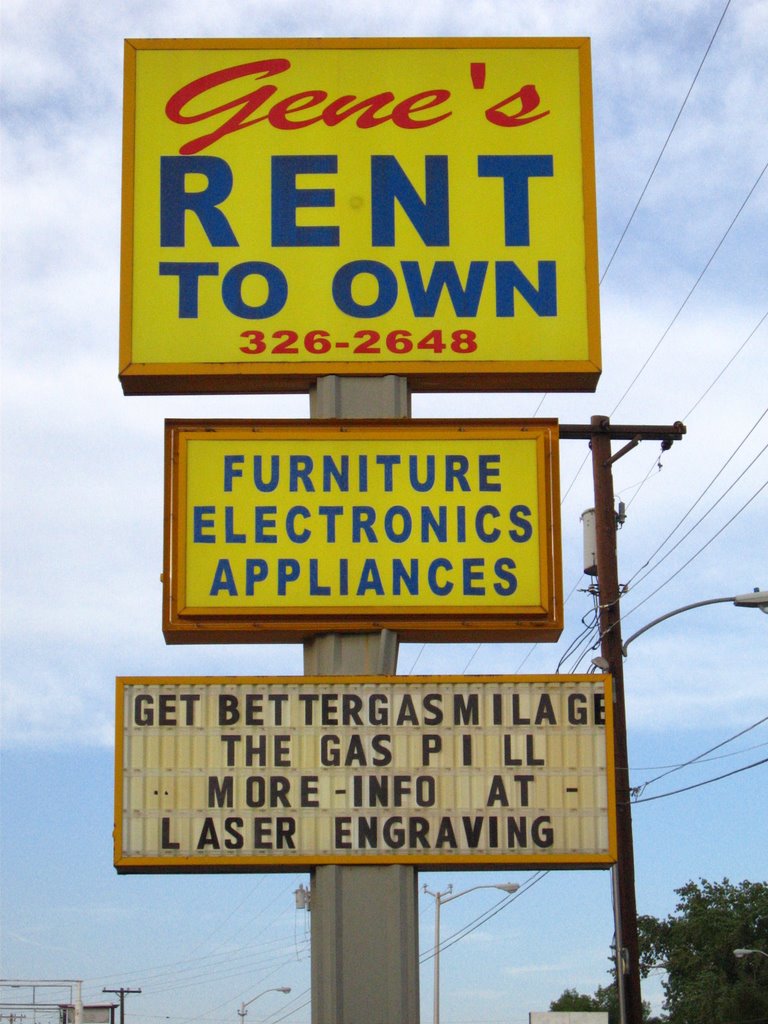
It would be easy enough to disparage Farmington. The same strip mall with a "permanent makeup" store has a marqee that advertises a "gas pill" that will suddenly grant you tens, if not hundreds, of extra miles per tank. Teenage boys lean out the passenger windows and yell at you—"What's uuuupppp?"—then circle back around to do it again. Sometimes they shout "Jesus!"—well, "gee-zuss"—but it's unclear whether that's some sort of ecumenical call to arms or just the sort of thing the teenage boys of Farmington shout from cars at 25 mph.

It would also be easy to defend Farmington in a lazy, faux-populist, David Brooks sort of way, where these are salt-of-the-earth people and as a big city interloper I just don't get it. I could even cite Farmington's two brewpubs as evidence of rural sophistication and belief in craftsmanship.
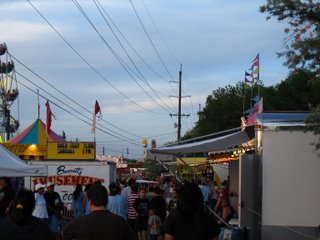
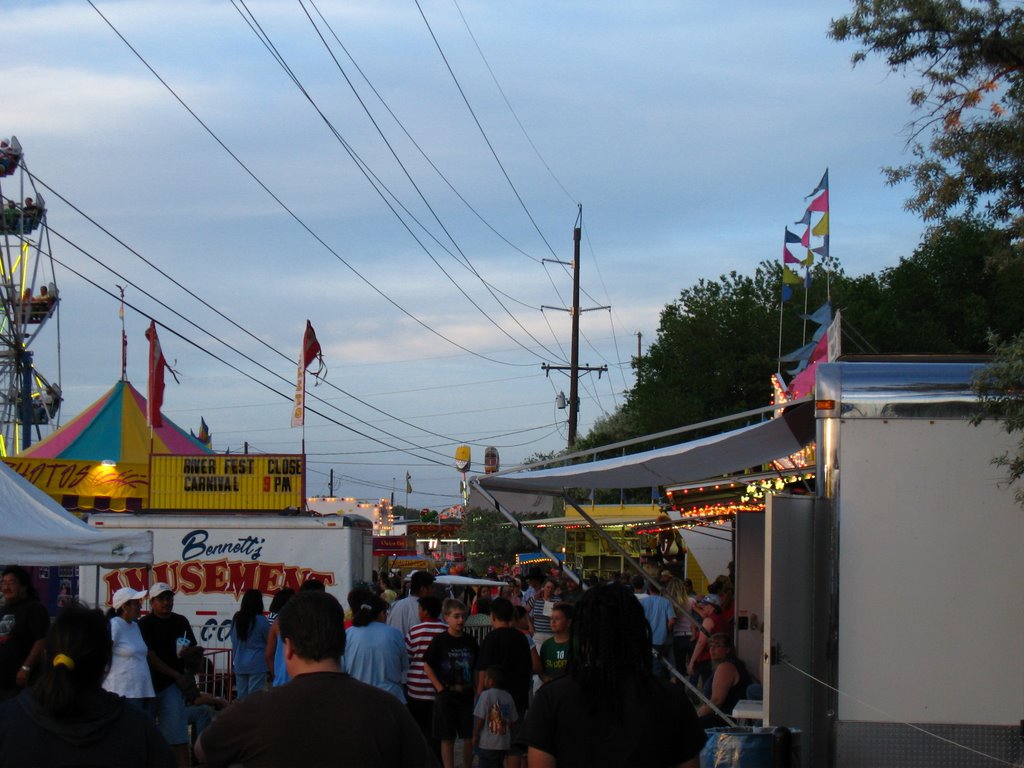
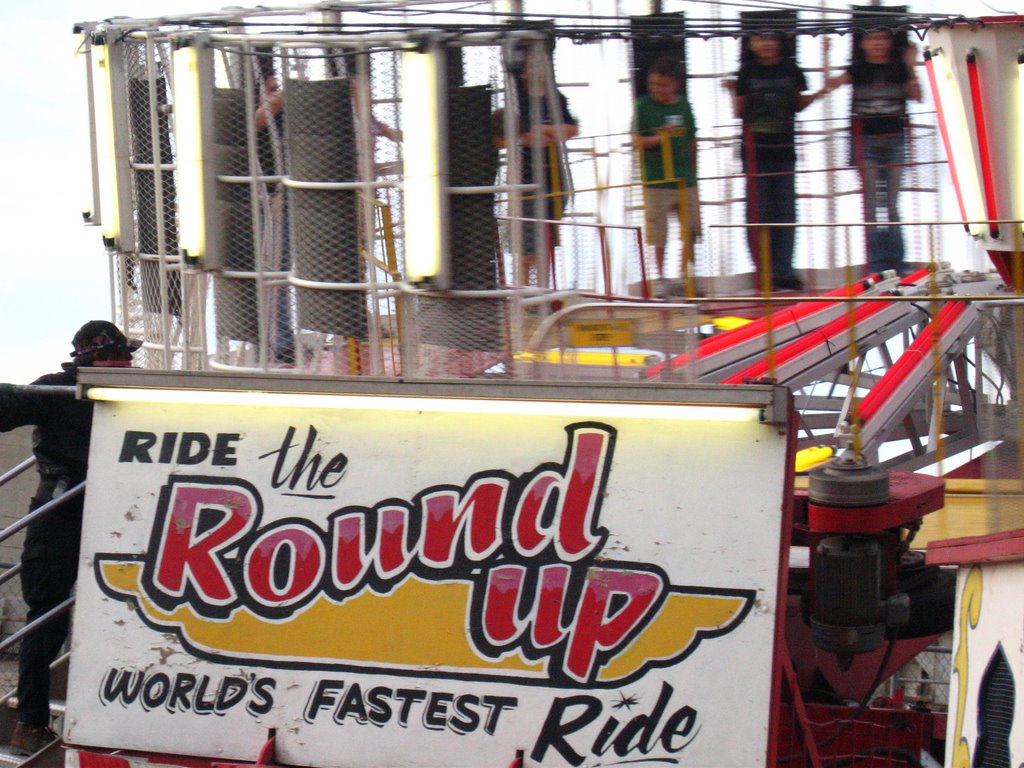
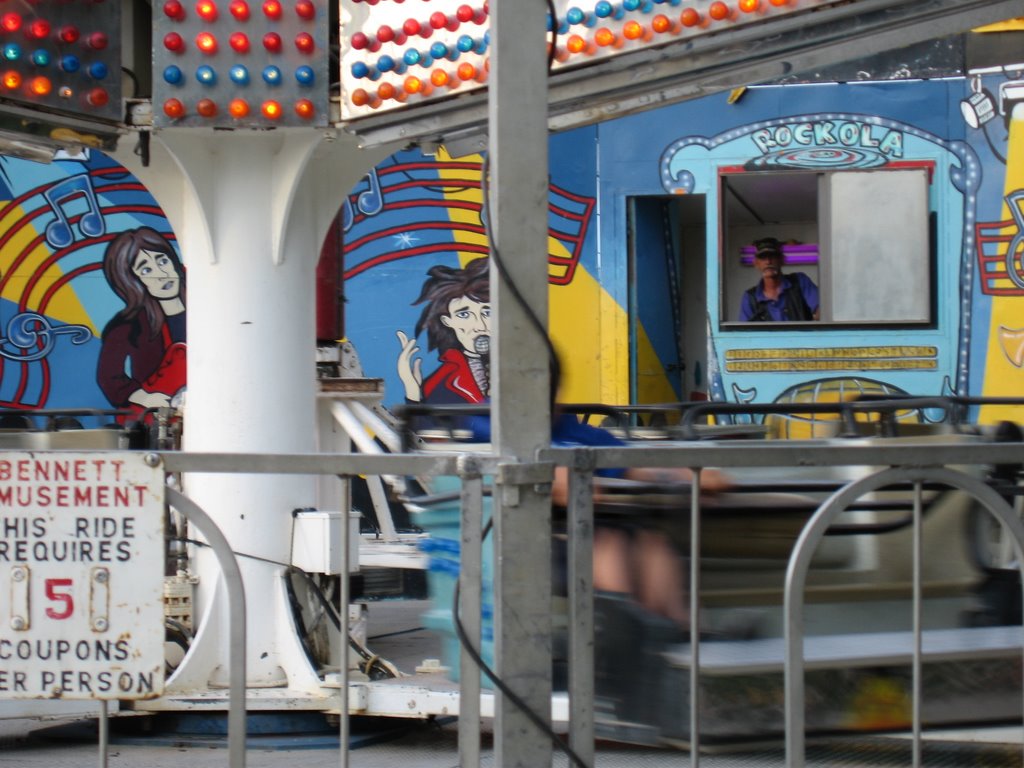
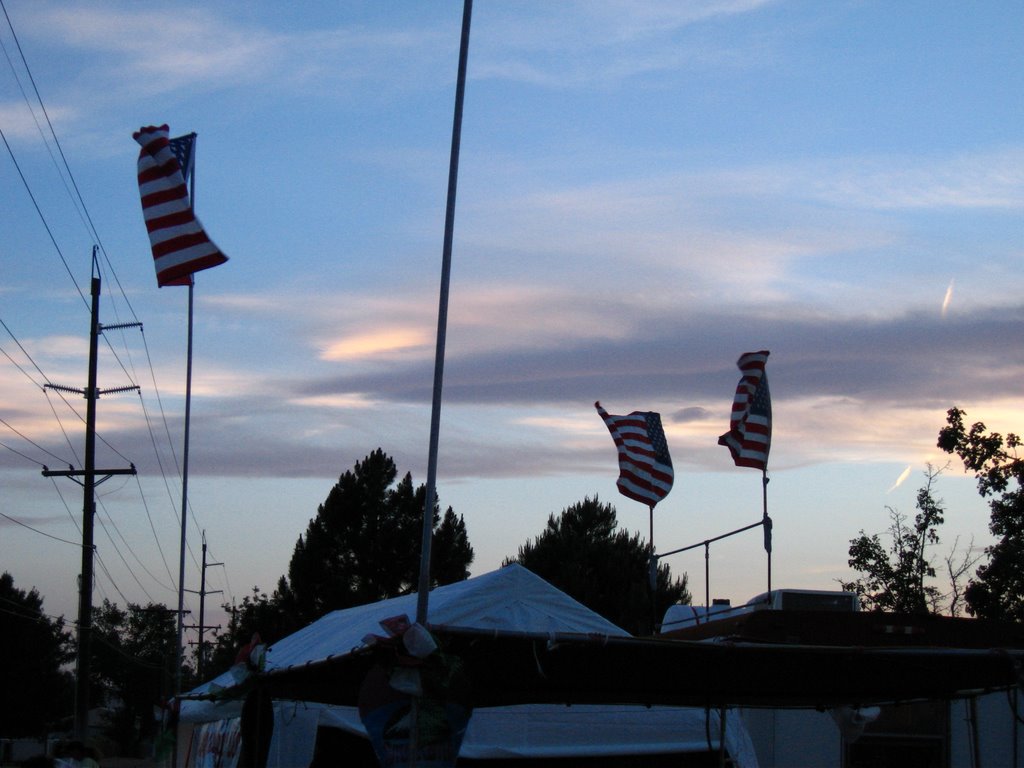
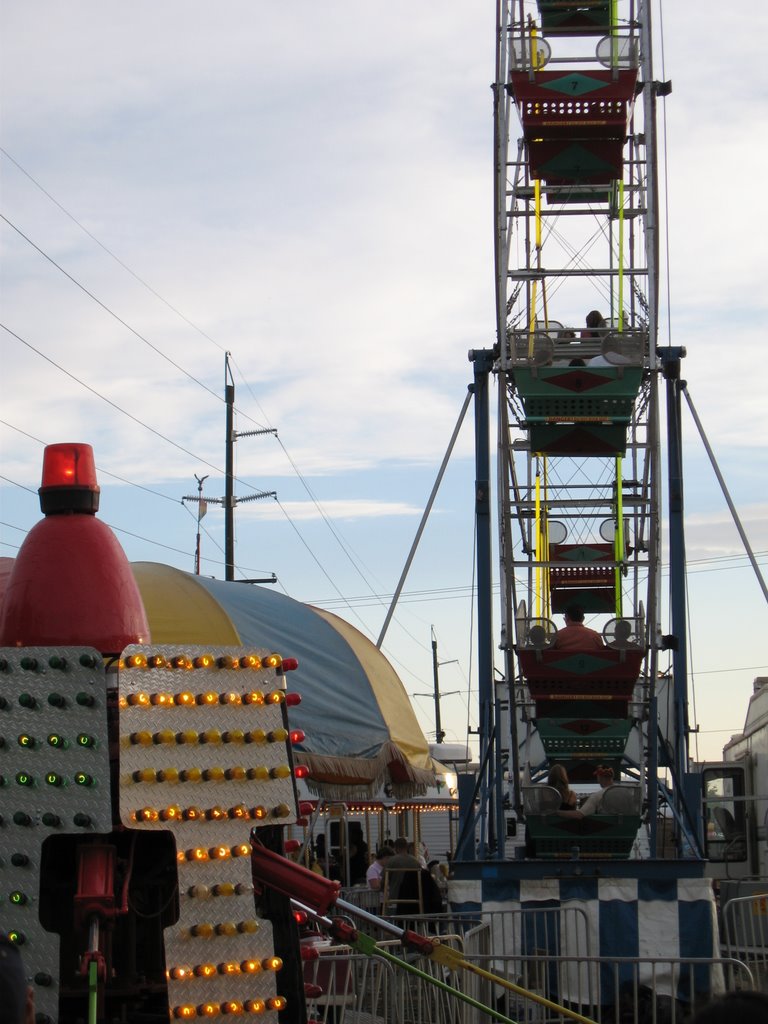
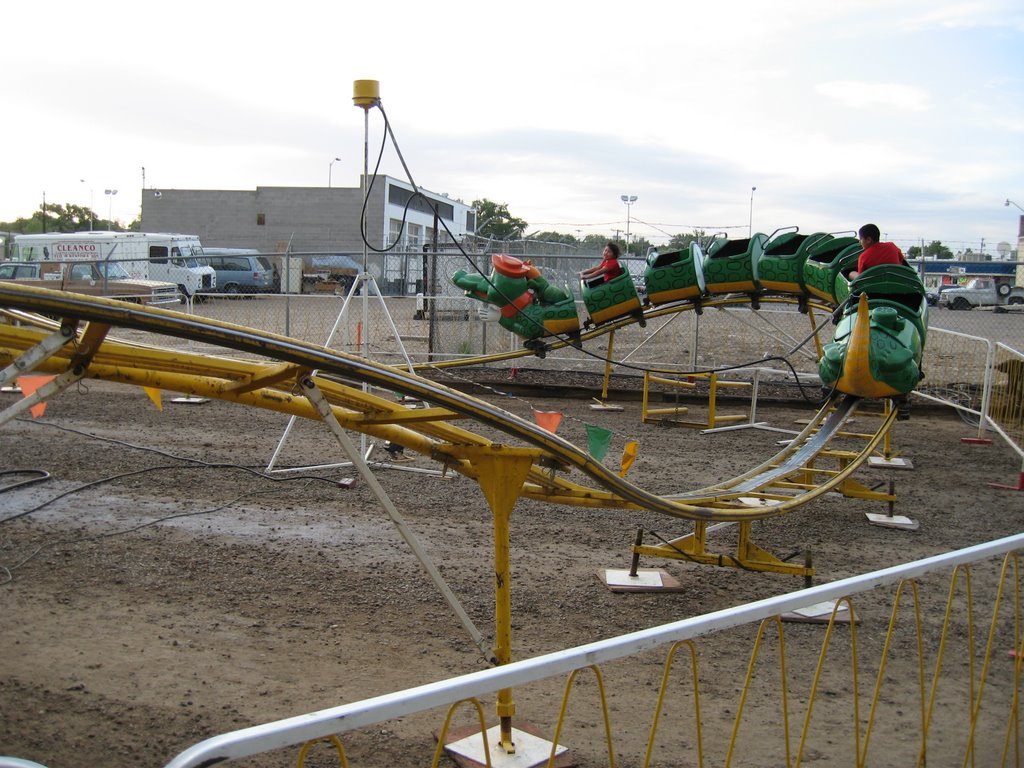
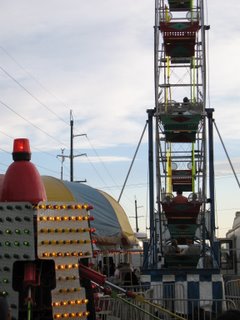
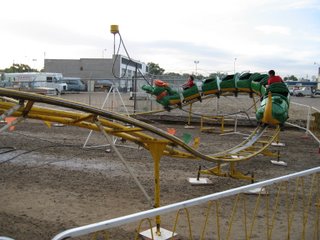
Instead, I stumbled upon the Riverfest Carnival, which was on a downtown creek. And the carnival was just so, well, earnest.

Carnivals are like that. They feel almost anachronistic now, not just because cars, jets, and computers have shrunk the world but also because, really, who gets their kicks from skeeball? Even the prizes (inflatable alien, cap gun, giant stuffed The Roadrunnertm) aren't particularly worth it.

Which is why carnivals are greast, especially carnivals in smaller towns like Farmington (population: 37,844) where the four teenagers with eyeliner and dyed black hair hang out with a Navajo cowboy and a red-headed kid in a "Dance for Him" sweatshirt ("Him" meaning the crucified Jesus in the picture). Everyone above the age of 10 knows the games are fixed, but that's okay, it's a carnival. As if everyday judgements of who to associate with and what to avoid are altered in the hypnotic call of the carnival barker.
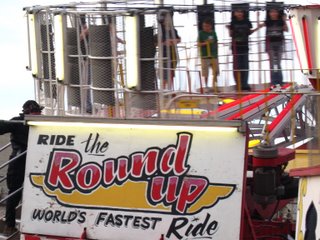
Perhaps the most uncomfortable thing I saw was a man wearing a t-shirt that read "Bull riders ride anything horny" while holding the hand of his daughter or granddaughter.

Perhaps the most disturbing thing everyone else saw was me, taking pictures of the children as they ran out of fun houses and were twirled by the Tilt-A-Whirl.
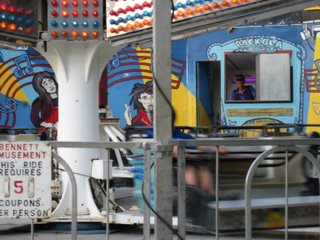
In "A Ticket to the Fair," David Foster Wallace theorized that rural folk go to fairs precisely for the crowds, the lines, the hucksters. Fairs are a little bit of city bustle, for them, a change of pace. A carnival, like a fair, is a city created overnight, an empty field that suddenly has bright neon lights and confusion and extreme density.

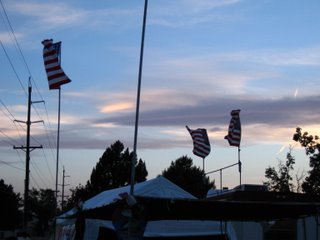
But it's a city of the rural imagination, of the same people at the Ben Franklin or the Sonic Drive-in, a city that is small and familiar and easy to navigate. A city where the band plays not something new and perhaps difficult to like but instead covers Lynyrd Skynyrd and George Strait and Santana. A city where the food is fried and easy to pronounce, even if a funnel cake runs $5. A city where you can go back home and not be changed.
Monday, June 05, 2006

Navajo Nation, Northwest New Mexico

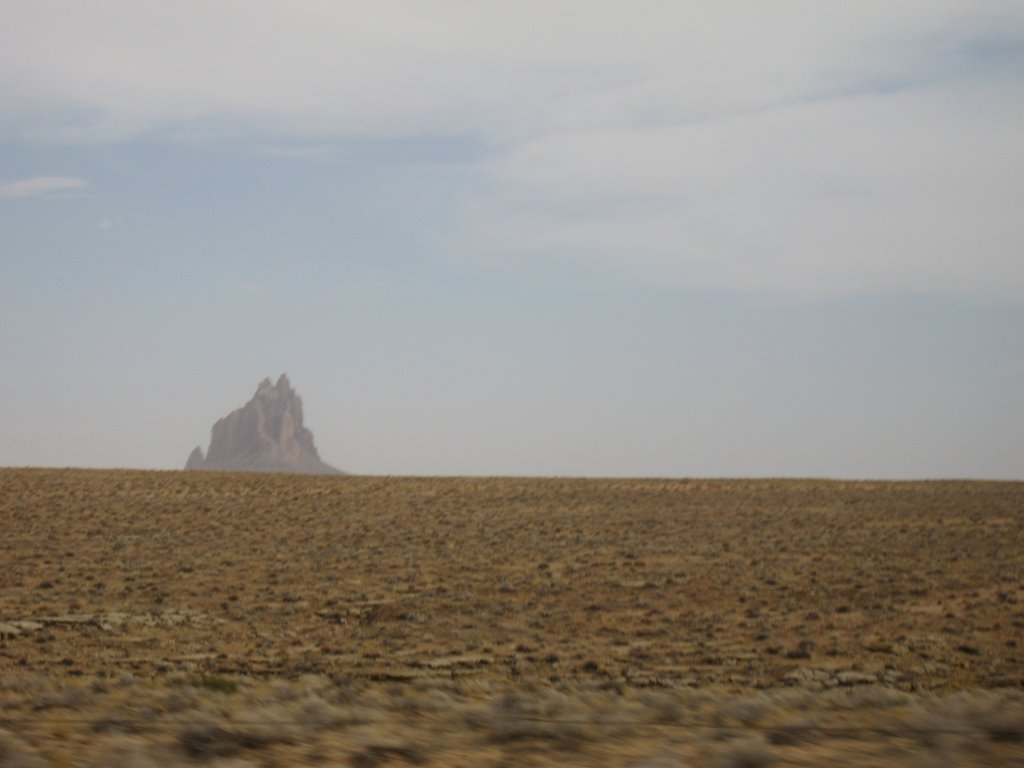
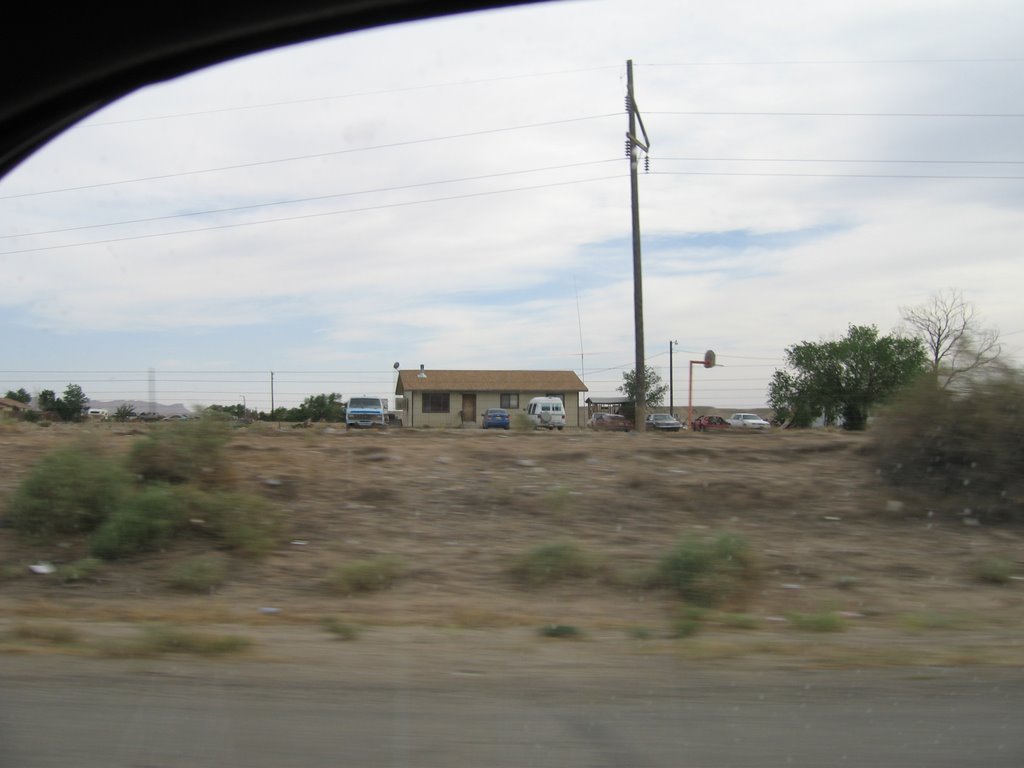
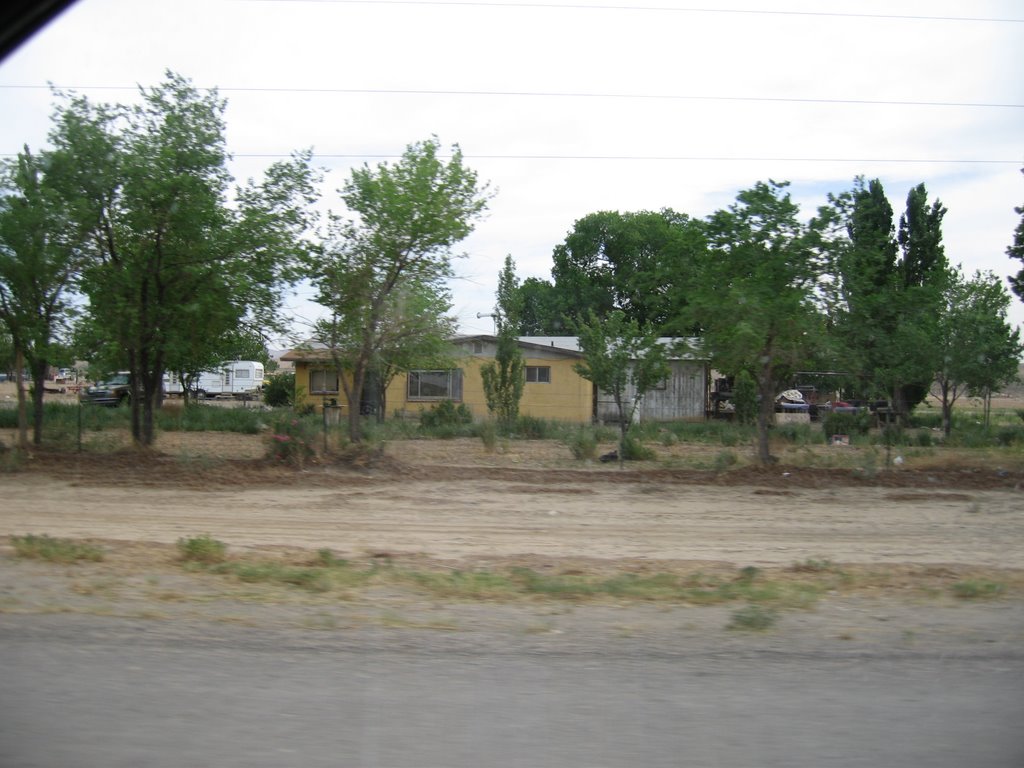
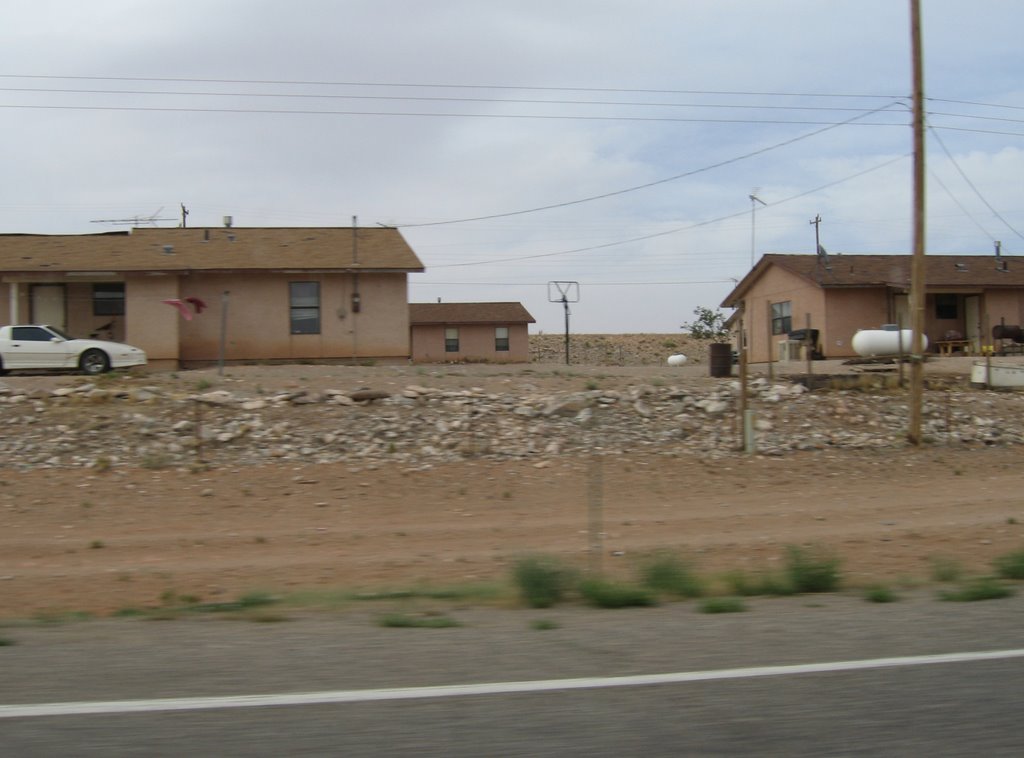
The pictures are blurry because I can't bring myself to stop the car to take them. These are people's homes, and here more than ever it seems like stopping would come off as disrespectful, as exaggerating the difference between my life and that of those whose house I'm driving by. Especially with my beater car and California plates. Especially with my point-and-shoot camera.

Driving through the Navajo Nation is like driving through another country, and not just because of the Navajo language AM station. It's dusty and arid, and there are trailers and prefab houses everywhere. A woman herds sheep on a hillside, but there's no cattle and no agriculture in sight.

The scrub continues around the curvature of the earth.


Four Corners

A dust storm in the southwestern sky. A closed "monument."

Wind.

Sunday, June 04, 2006

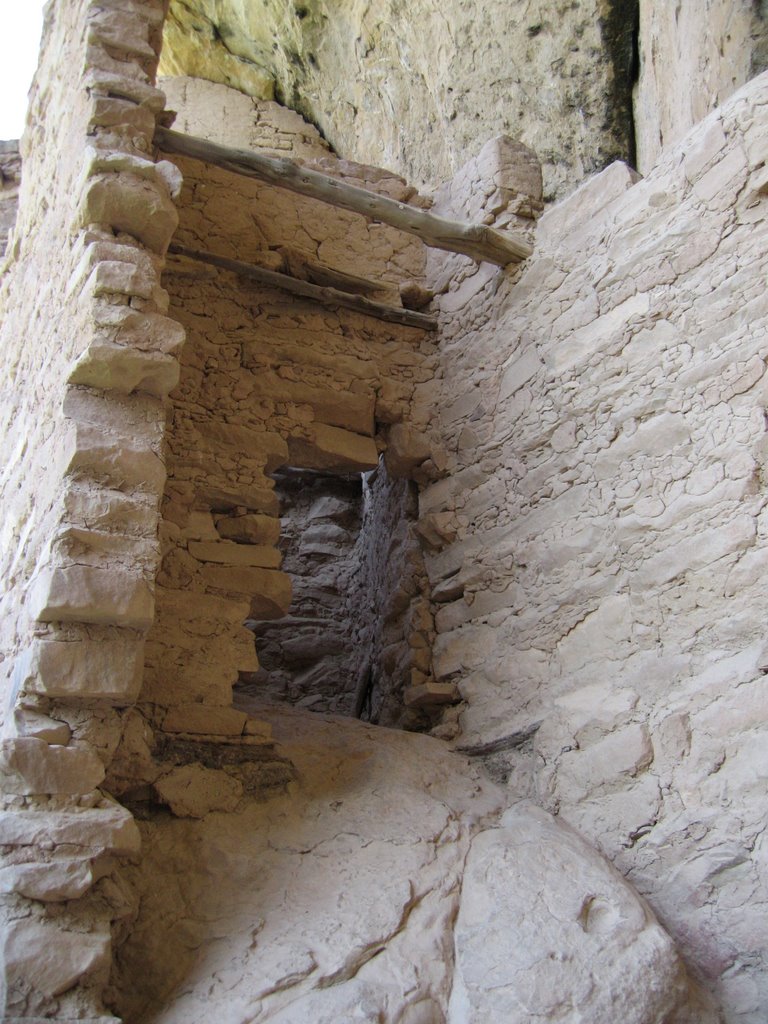
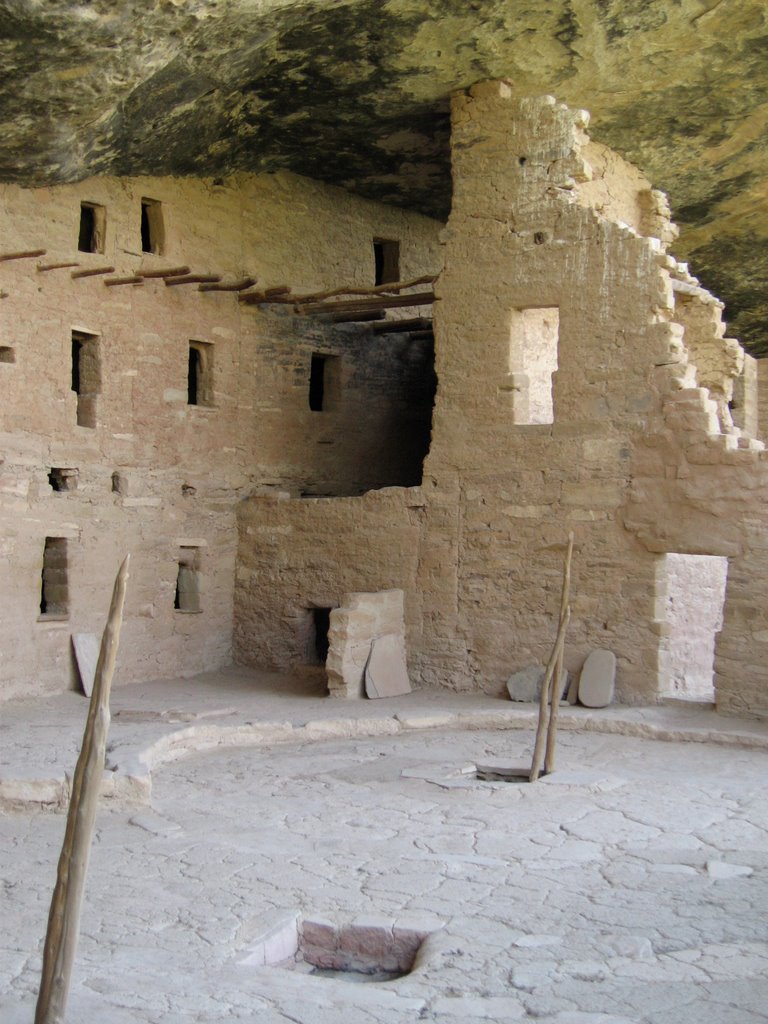
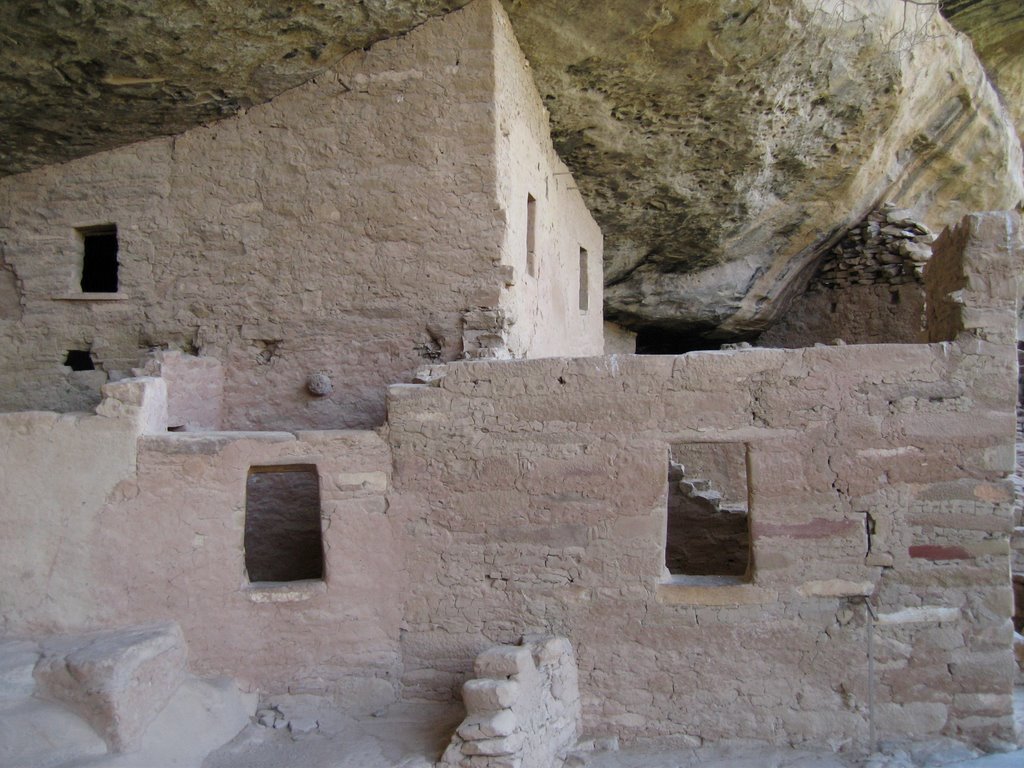
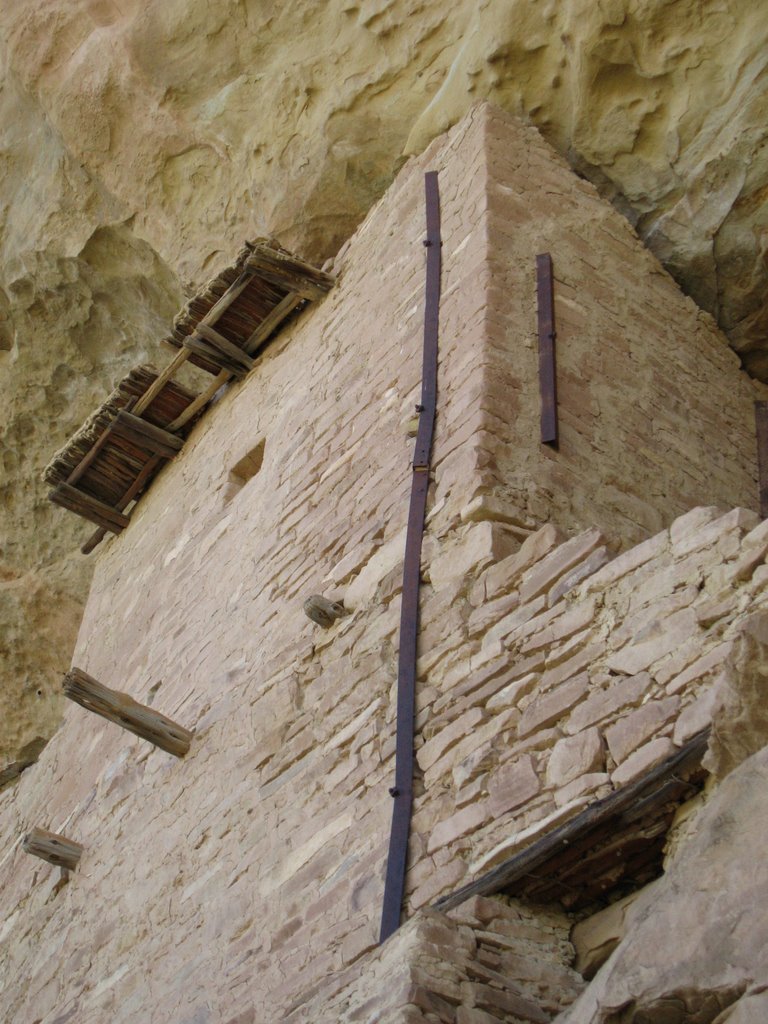
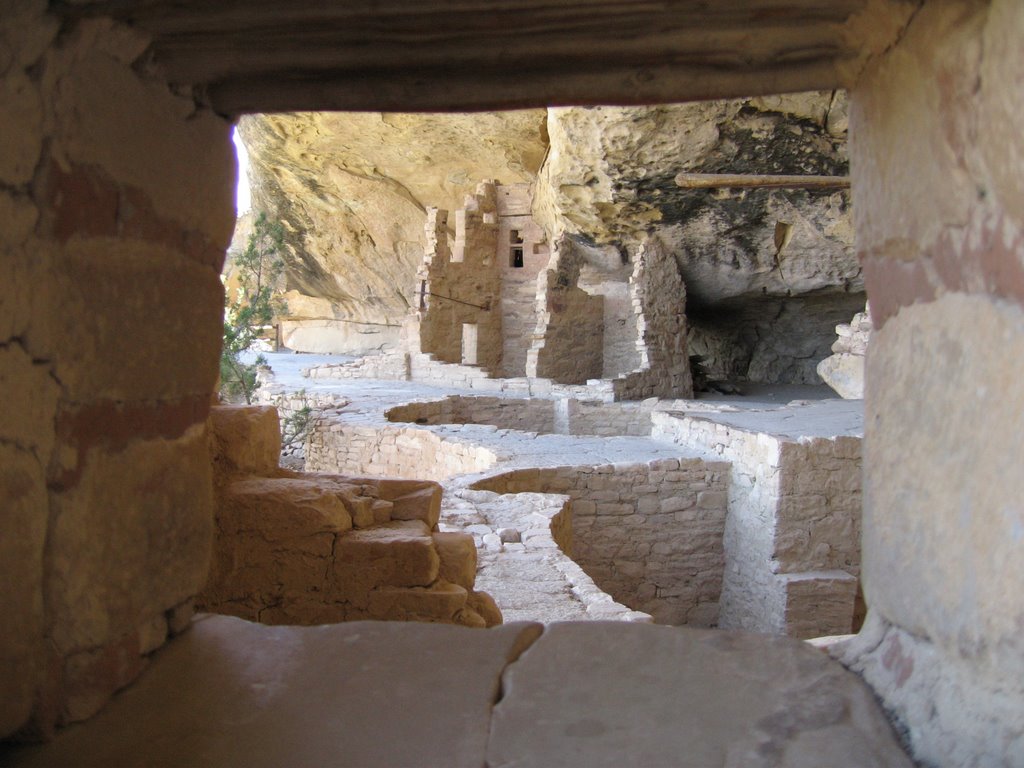
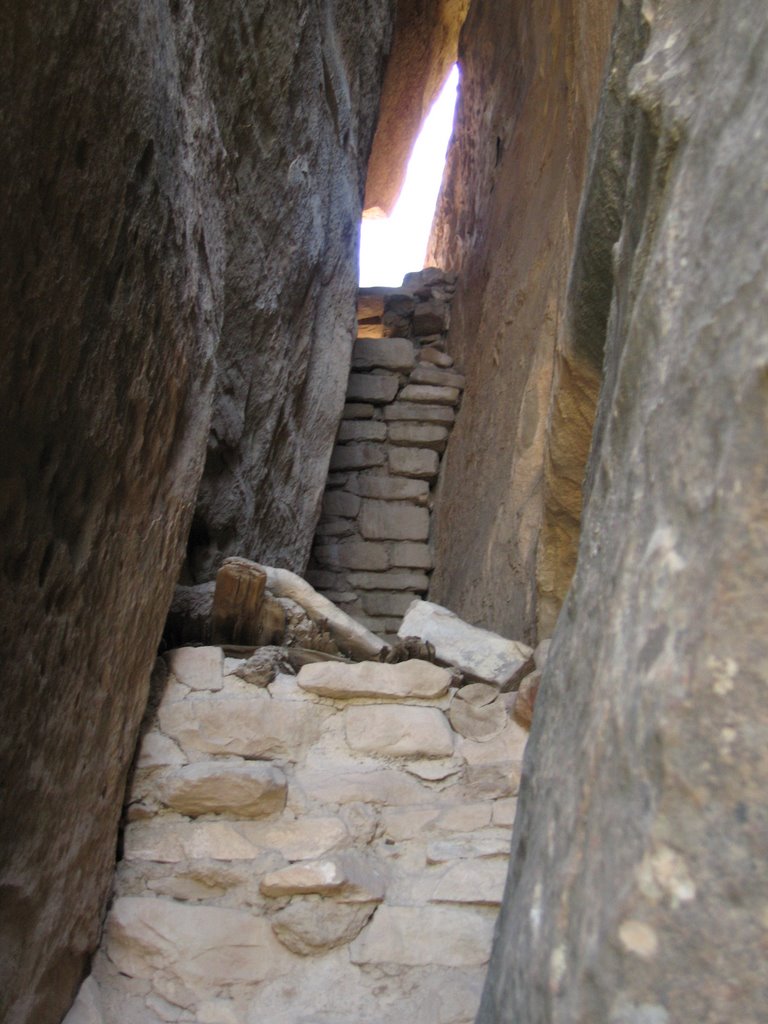
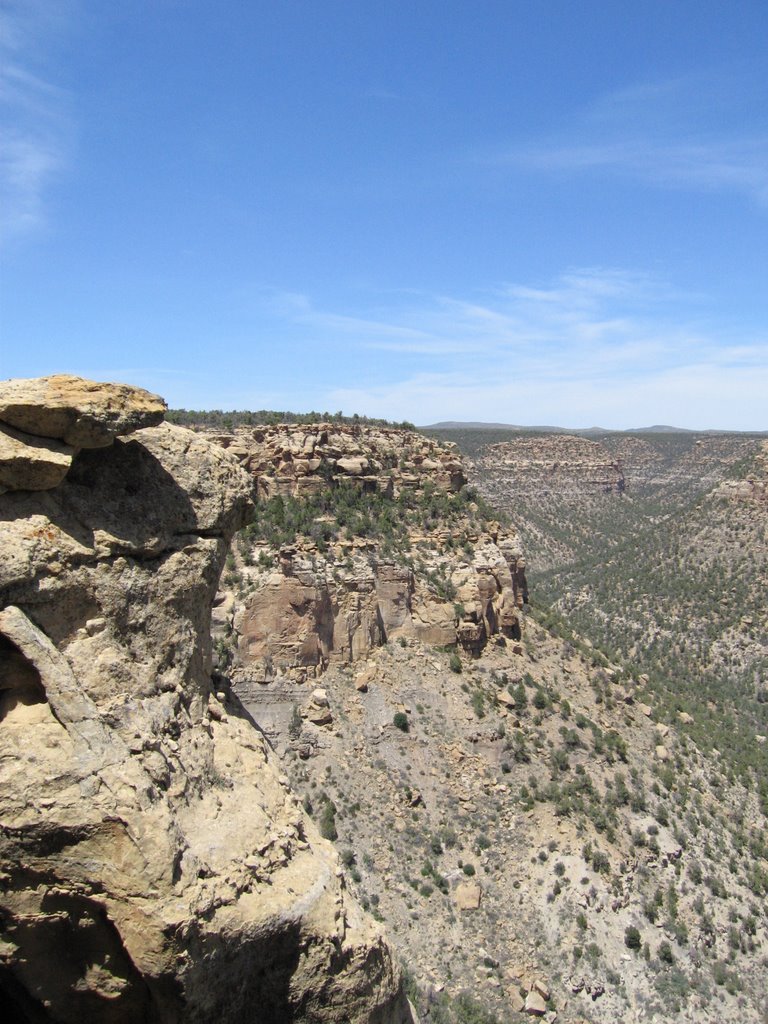
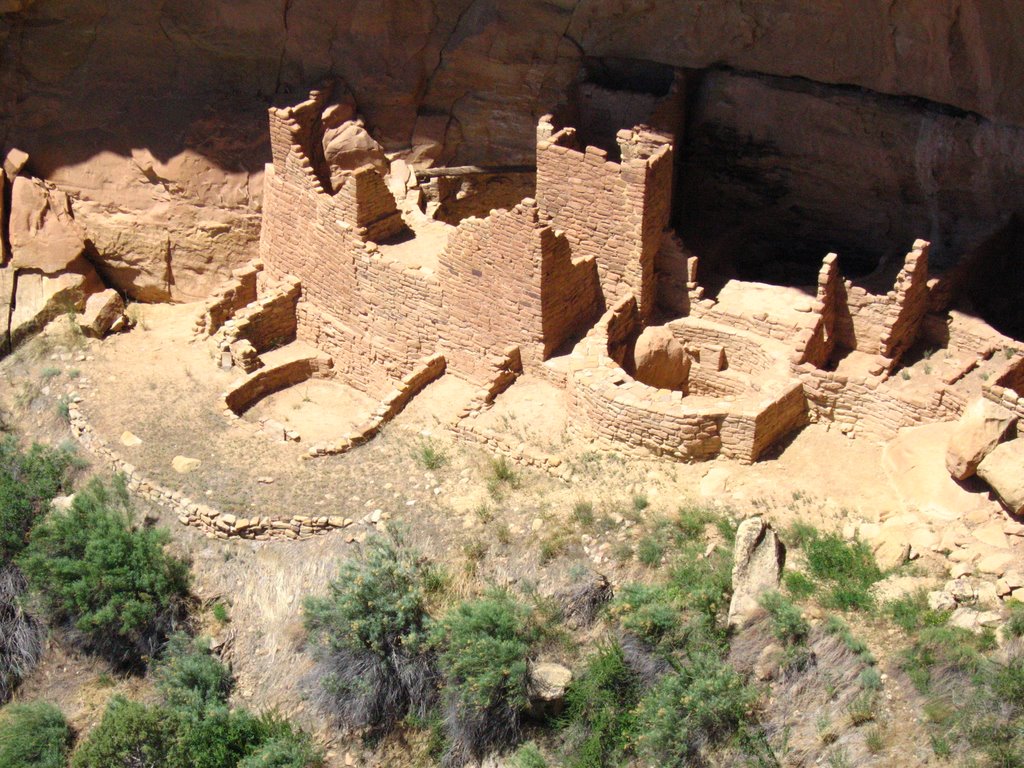
Mesa Verde National Park


Saturday, June 03, 2006

Monticello, Utah


Cortez, Colorado

I think the most awesome thing about Cortez, Colorado—possibly the only awesome thing about Cortez, Colorado—is that the town has a police car with flames painted down the sides.

I arrived in Cortez on graduation day for the high school, and to celebrate the dorky kids and mostly their parents came to Cortez City Park to hear Ralph's Dinosaurs1 play the classics: "I Feel Good," "Born to be Wild," "Jenny (867-5309)," "Fortunate Son," "Turning Japanese" (by request). The cool kids were up the street, idling their cars in front of Gecko's Sport & Night Club and waiting for nothing to happen.

But about that car: This same weekend was the Cortez Classic Car Show2, also in Cortez City Park, in which lots of cars were parked on the grass, detailing examined, leather fingered, and hoods popped. The Cortez Police Department entry is not an appropriate car for the show—it's a modern Ford or Chevy—but it sits there anyway, perhaps to show that Cortez is "cool" and "with it." As they are, as only a town of 6,000 can be.


1 Name has not been changed.
2 Name has been made up.


Friday, June 02, 2006

Driving (I)

Sometimes along a long lonely highway I'll imagine I'm traveling with someone, her bare feet leaving smudged toeprints on the windshield. It keeps me sane, this fantasy, I think.
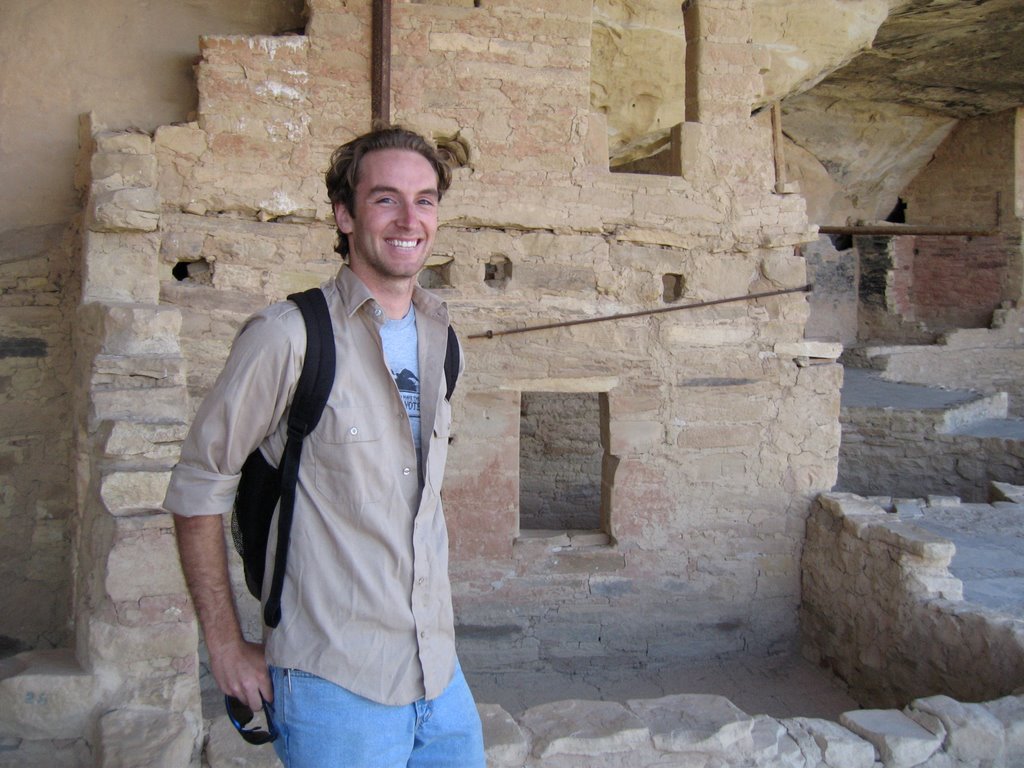
But I don't talk to this companion of mine. Instead we are the type who can be silent and content, together, forever.

Thursday, June 01, 2006

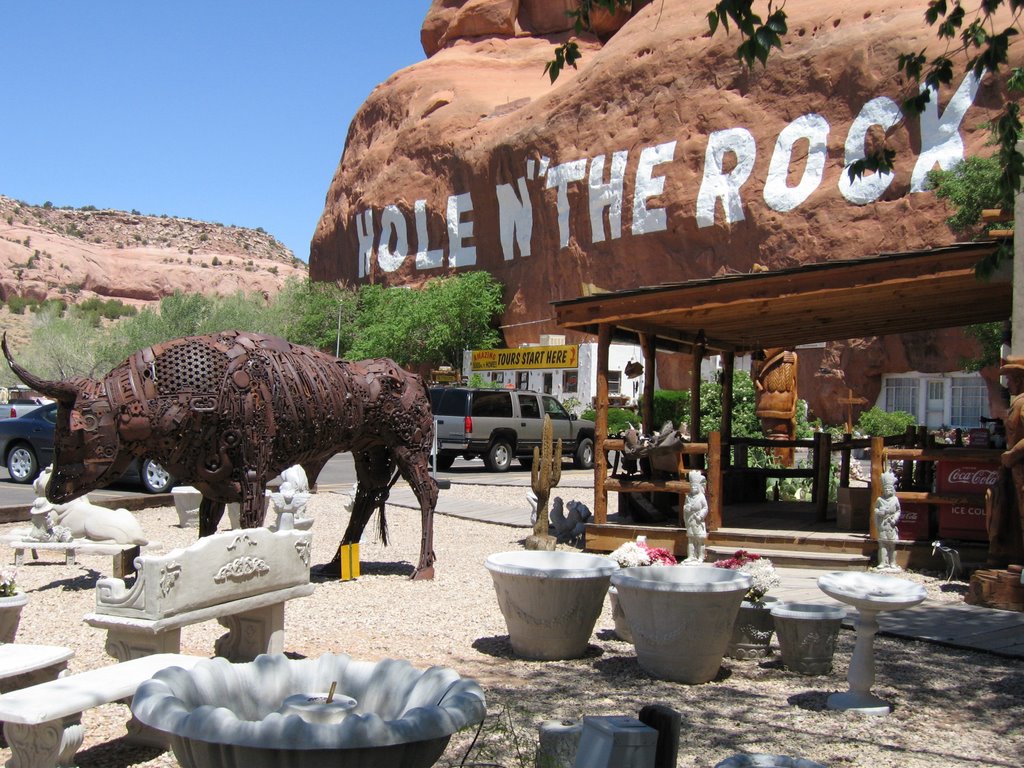
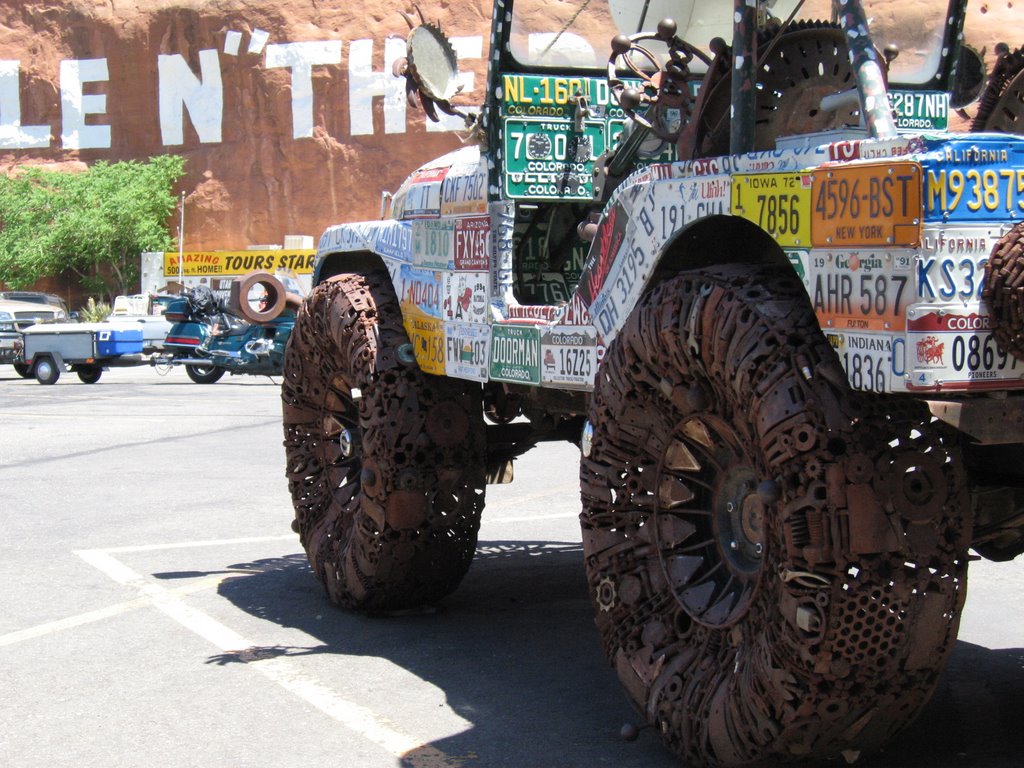
Hole N" the Rock

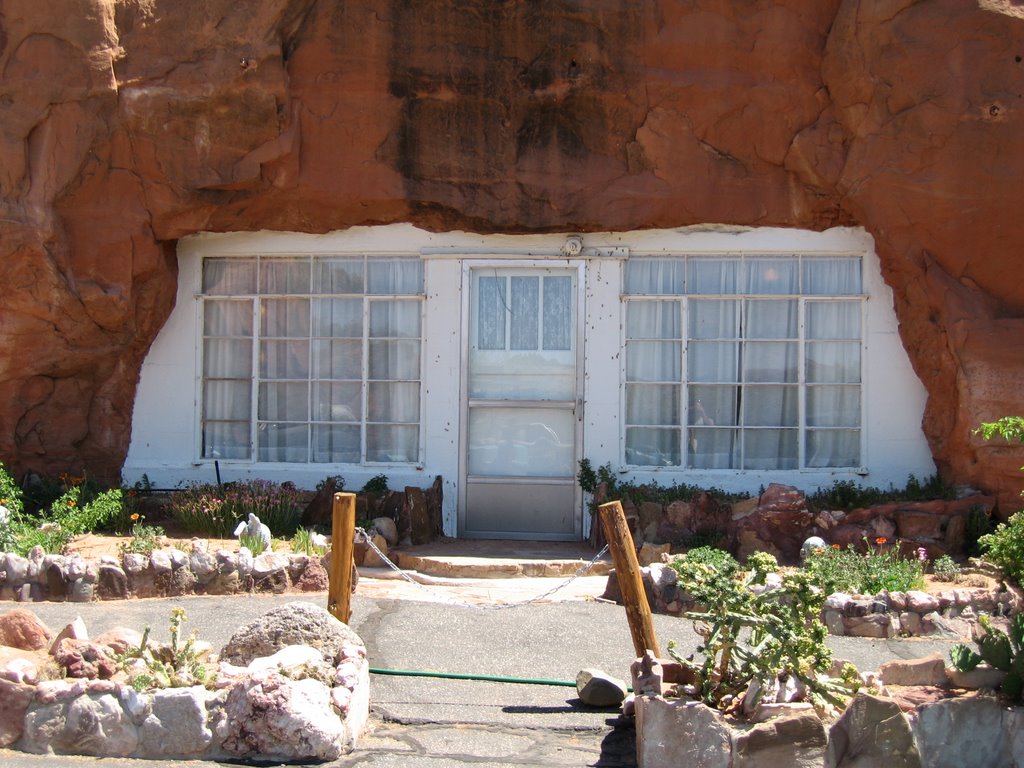
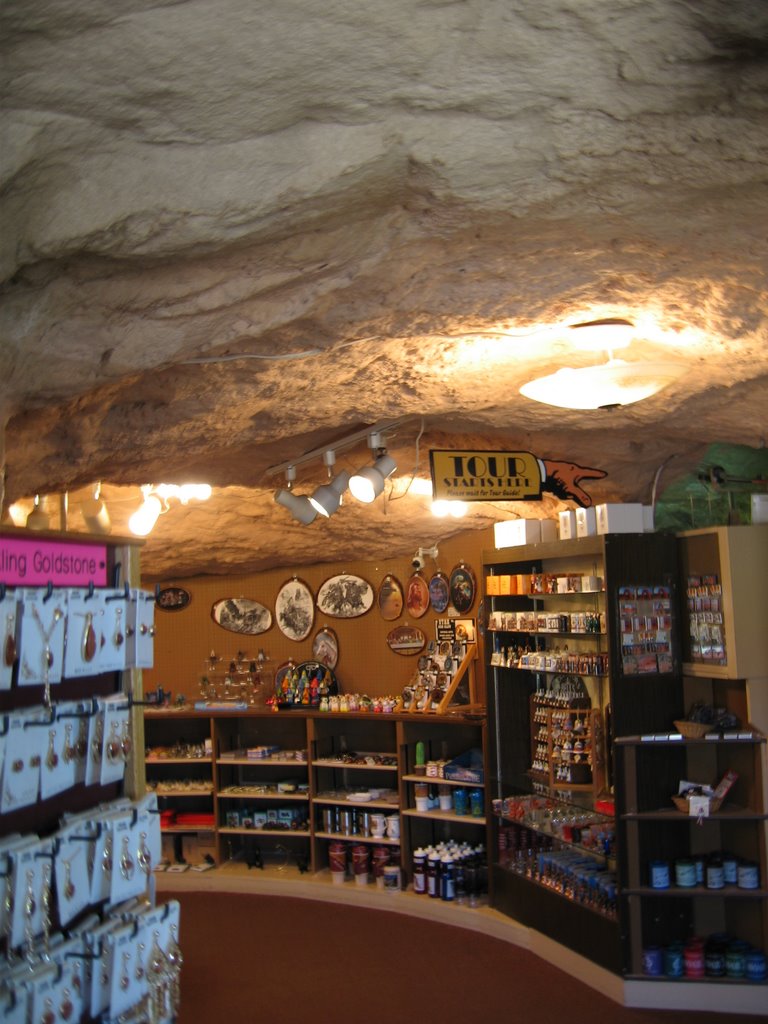
I have my first Confederate flag sighting 12 miles south of Moab. This is at the Hole N" the Rock (sic) gift shop, on a shot glass examined by a man wearing a "Live to Hunt—Kill More...Than Time" hat. He doesn't buy it, just sets it back in place, the flag no longer centered on the shelf.

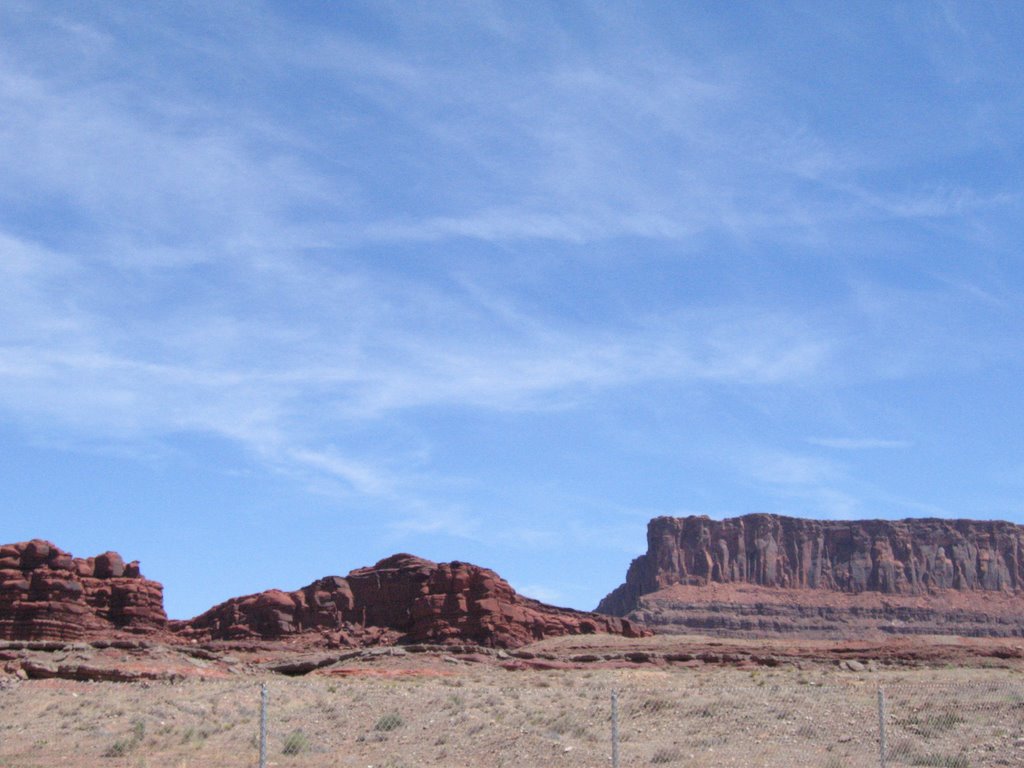
I missed the Hole N" the Rock the first time, pulling off instead at a rest stop with picnic benches and Kentucky bluegrass in the middle of the desert. I was on the wrong side of the rock, it turned out. The rest stop was empty, though there were other cars parked with no drivers, as near as I could tell.

My tour group for the Hole N" the Rock comprised myself, Mr. Live to Hunt, his wife, and a young couple who might or might not have been with them. Mr. Live to Hunt was a miner who hunched over when he walked and had taken the tour before, which he demonstrated by saying, "That's the flue" just before the guide—a bored, dumpy woman who had clearly given too many tours— would say, "This is the flue."

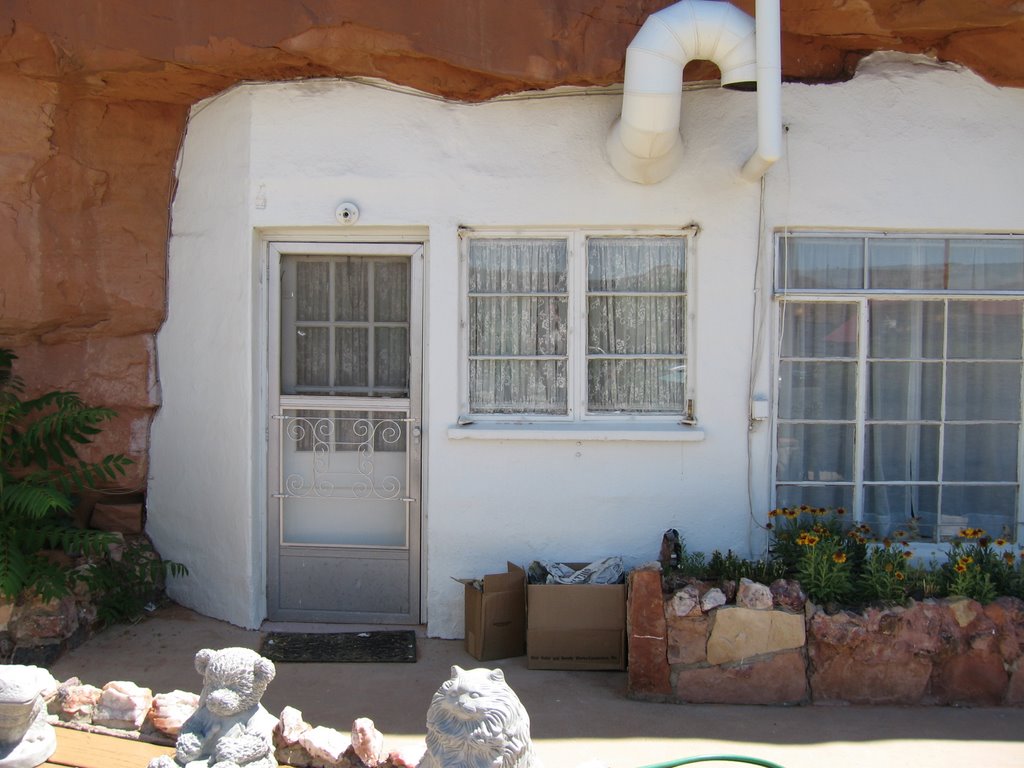
The Hole N" the Rock is, for the most part, the creation of Albert Christiansen, a cook, miner, and part-time taxidermist. (His wife, Gladys, was responsible for most of the decoration and for the bathroom.) At first, Hole N" the Rock was a roadside diner; as Albert blasted more rock, it became a house, of sorts, as well. The restuarant closed after Albert's first heart attack in, I believe, 1953. 1 He died of a second heart attack in 1957, just as he was beginning a staircase to a new patio level. Gladys lived there until her death in the 70s; they have a burial site under a rock overhang a short ways away.

The thing about Hole N" the Rock is that it's the strange fantasy of a 10 year old brought to life. "It would be so cool! You could make a house in the rock!" Well, Albert Christiansen did.

Outside, there is a large bust of Franklin Roosevelt carved into the sandstone. "Christiansen was a great admirer of Roosevelt's," the guide says. The bust is enormous, and hard to miss when approaching the gift shop. Still, Mr. Live to Hunt snickers. The guide ignores him and dutifully continues on.

1 But I could have made that up.


Wednesday, May 31, 2006

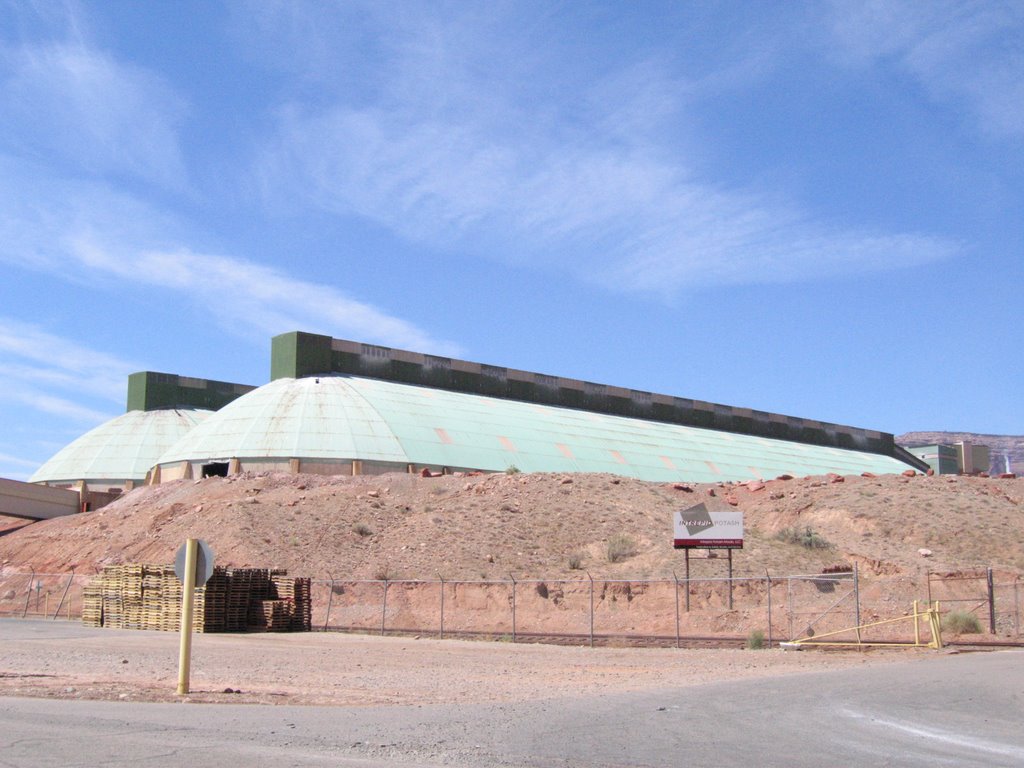
Potash, Utah

Coming from the south, cross the Colorado and take the first left. There is not another left for 12 miles, so don't miss it. You will approach Potash from the north, because the only way to approach Potash is from the north.

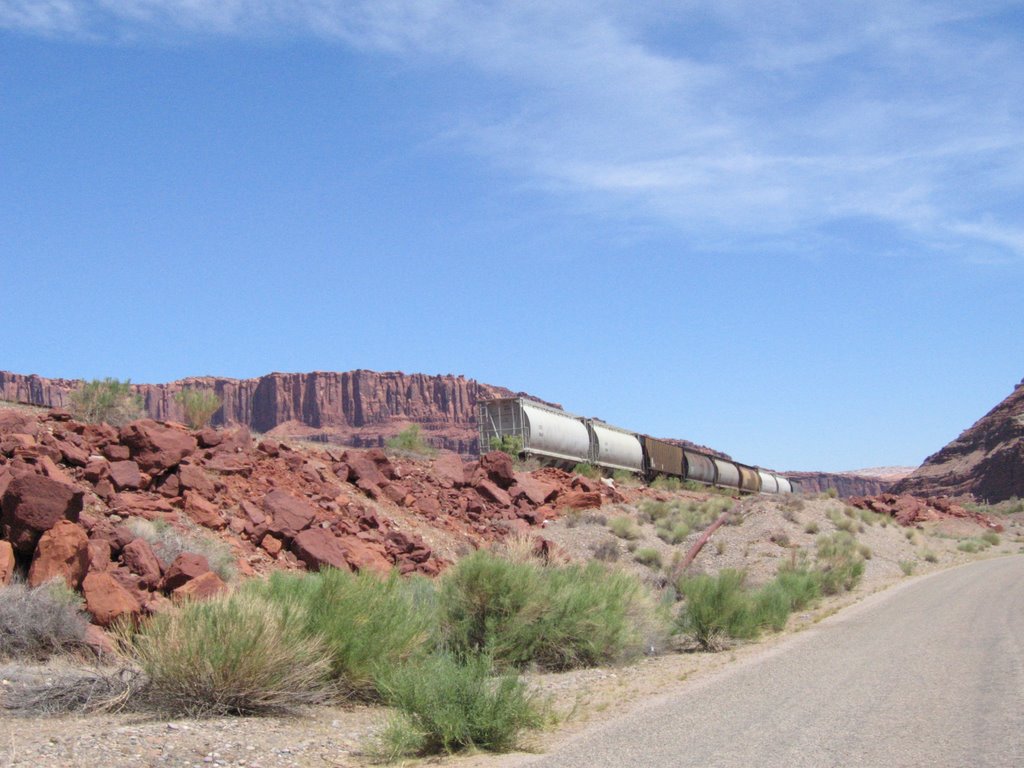
Continue for 16 miles. The road will hug the sandstone cliffs and sometimes seem cantilevered out over the water. It's not. Stop at the petroglyphs, or not. Stop at the dinosaur footprint, or not. The speed limit is 50, but driving that fast is not recommended, as it is easy to miss these monuments and making a u-turn is often difficult.

You will see a man with poles and long bladed roller skates. This is normal; he is training for cross country skiing in the winter. Pass him. A dirt bike will overtake you, crossing over the double yellow lines in a blind curve, but this is also normal. Don't take it personally.

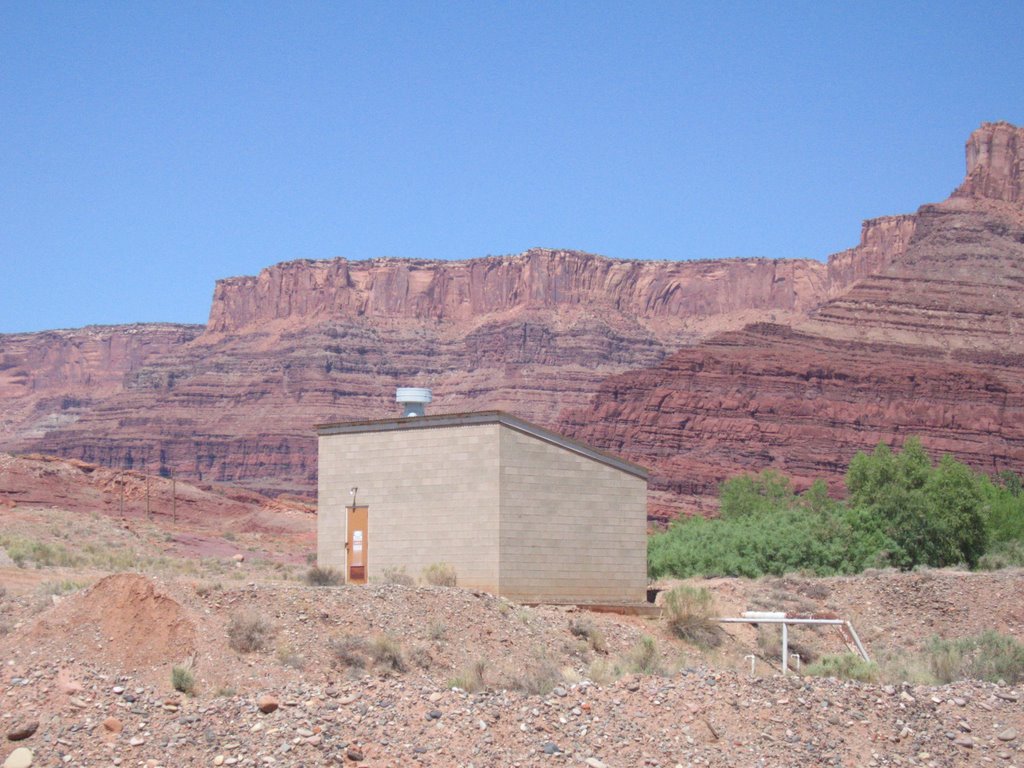
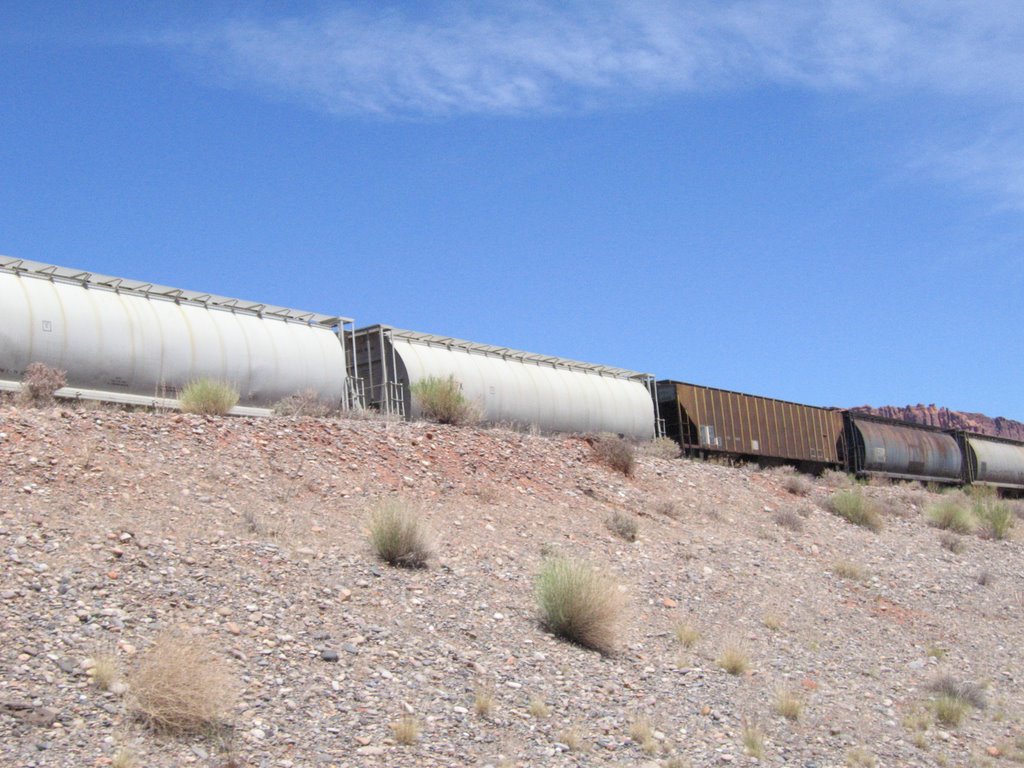
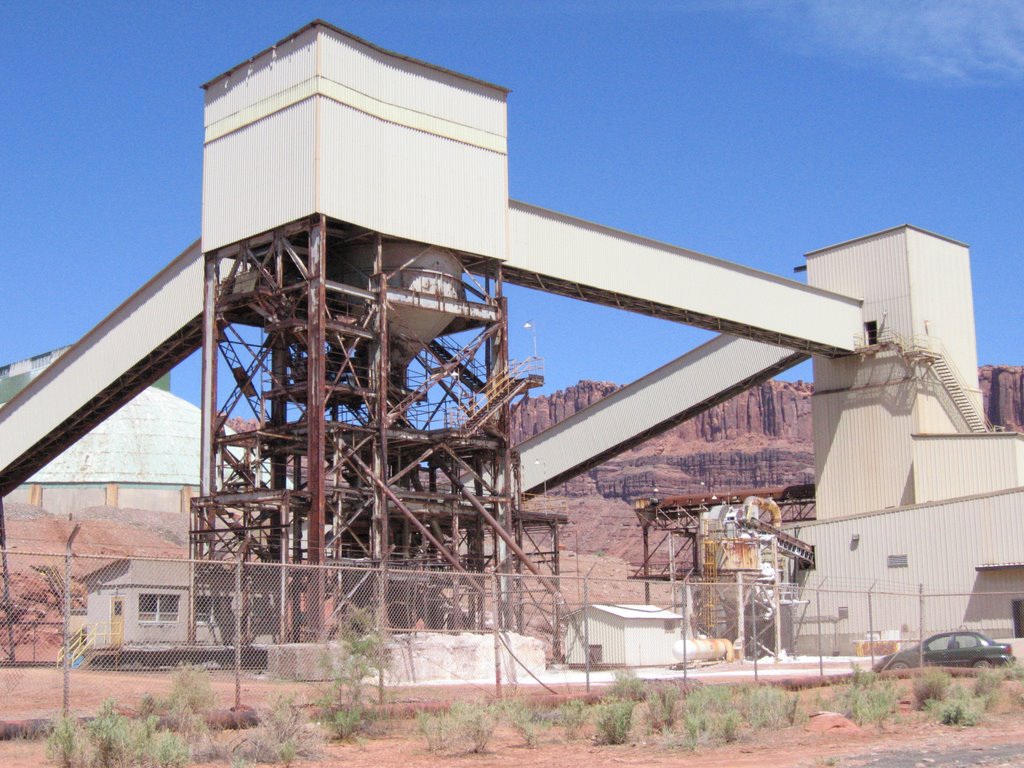
When you get to Potash, don't be surprised that there is nothing there, because there is nothing there. It's just a salt factory and a railroad spur, and the road turns to dirt where the tracks end. Rock climbers love this area, but you won't see them.

Take pictures. Get shooed away by a security guard. Keep taking pictures anyway, because it is a public road. He won't challenge you, and you have the law on your side.

Get back in the car and head toward the crossroads. Pass the man on rollerskis, now headed the other direction. Get passed again by the dirt bike. As you drive, watch the gas need drop farther and farther, faster and faster. The gas light might or might not work, and you don't know how big the tank is.

Drive slow, don't stop, and pray you won't have to walk.