


"I'm going to post Montana next, for my own reasons. Then, perhaps, the rest of the driving trip.
And then, perhaps, I think I'll rest a little.
By making my brother write for me.
"
I can't believe it's been a month since I posted here...it's shocking, really.
In any case, I placed a review in the Chronicle way back in October that I thought I'd link to:
Detective from central casting investigates a suspect from same place
I just saw this, honestly, and I've only skimmed it, but I can say that it was definitely edited...I don't mind that, but it's good to note.
Zander, who is driving to the airport, is 5 minutes early, and it's 4:40 in the morning. I've been up since 4:15, and Dad's been up since even earlier, but neither of us is what you would call cheery.
Cheery, however, is exactly how you would describe Zander. He's a contractor and a mountain climber, and his joie de vivre—when he's excited and things are going well—is often infectious.
But infectiously cheery is not necessarily what I want at any time before 5 am. Or 6 am. Or 8 am, really. Nonetheless I bite my tongue, stuff the last of my clothes into a duffel bag, and Dad and I climb into the back seat of Zander's pickup, with Wendy, Zander's wife, in front.
We pick up Bob and Dawn a few minutes later, maybe a mile east. I've never met them before, and now we are all crammed together in Zander's truck, speeding down the mostly empty freeway to SFO.
*
Traveling like this often ends up as a series of boxes—first the cab of the pickup, then the halved and squared off cylinder of the airplane cabin, and now the box of our SUV, which cruises south from Calgary toward Glacier National Park. We're stopping first in the Alberta town of Waterton, the terminus of our trip, to drop off clothes at the Prince of Wales hotel.
The approach from the high plains of Alberta to the Canadian Rockies is nothing short of spectacular. The plains stretch out right to the base of the range—no foothills, no minor ranges, just a flat vista that without warning spikes upward four and five thousand feet.
And so the mountains loom ahead as you approach from the north. Or perhaps loom is the wrong word. No, the mountains lure you from the north, away from the open, domal sky to an environment of shifting aspect, one where, unlike the plains, you can't always see the weather approach, where the weather is not created elsewhere but is instead built right there.
Blogs are odd, and to post this in sequential order, things move out of succession. This is part one; I will post link to the other parts as I post them.
So I've been having to actually, you know, work, which hasn't been any fun. It's almost like I forgot this was here...
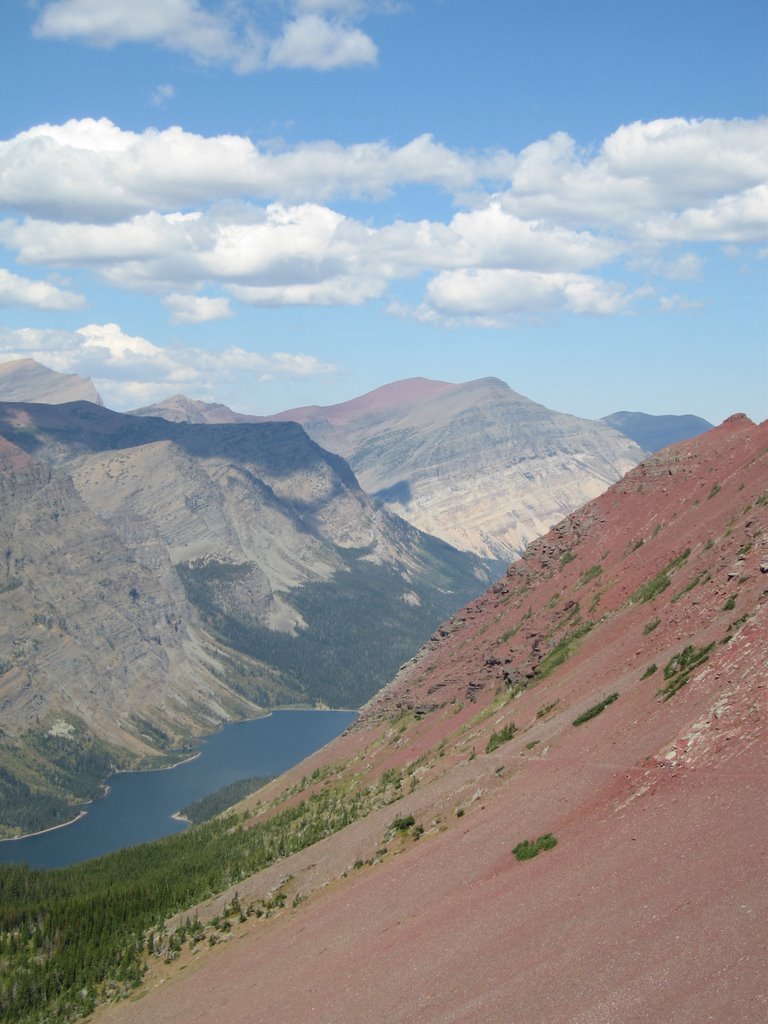
But, for now: to bed. Here's a few pictures from Montana:


Note: This is the entire first draft of this entry. Pictures still to come.
The tree trunk and the wall of the pit toilet are only four feet apart, and the pit toilet is only 8 feet tall, and yet I'm the only one who can't wedge himself up the space onto the roof.
I've got a variety of rationalizations for this, of course: I'm dressed improperly for real climbing—in a brown pair of canvas pants that, as a child of the Bay Area, I wear everywhere, all the time; and I'm wearing hiking boots with thick rubber soles that leave a disconnect between foot and underfoot; and I'm not a climber.
This test is not intentionally a test, however, and I'm only trying to get up top because that's where our backpacks are. Our packs are on the roof because we put them there. We put them there, I think, to laugh at me when I couldn't climb onto the roof.
But no matter. I'm not a climber, as I said before, and to tell the truth, I think I'm a little too risk-averse to sheer, thousand-foot drops to ever truly be a climber. Still, I did a fair bit of tree climbing and general boyish mischief to know, deep down, that I should be able to get up there.
*
Here's the plan for the day: 6.3 miles by backpack to the base camp, where we are now; another mile or so to the base of the Cathedral Peak, with only light gear; a thousand (vertical) feet of scree; and then about 800 more (vertical) feet of class 3 and 4 ascents. I think. I haven't really been privy to the plan, since I am close to totally inexperienced as a mountaineer.
Cathedral Peak (elev. 9041') is the only peak on our little 4-day backpacking excursion in the Climbers' Guide to Glacier National Park, which has been and is the only guide we have, other than our eyes, to the mountain. My two partners for this expedition are Bob and Zander, who have taken me along out of the goodness of their hearts and not, as is obvious, due to some sort of innate wilderness talent or USGS 7.5 minute map, which I am wishing we had. Zander and Bob are climbing partners, and though Zander's only been at this for about 3 years, Bob's been at it for 30. Oh, and he's completed 3 ironman triathlons as well.
In theory, we'll be back in camp sometime between 4 and 8 pm, but you have to pack to come down in the dark or, at worst, survive the night on the mountain. Not to be happy, but to survive, which means a set of polypro in the bag, a Goretex jacket, food, 2 liters of water, and a flashlight. It's clear I'm the weak link from the beginning, but hey, they invited me.
*
We leave Flat Top, where we spent the night, at 8:15 in the morning. This is somewhat of a late start for mountaineers—Zander tells a number of stories about having to get up before 4 to summit peaks in the Sierra—but we're traveling in a larger group of six, and getting up at 6 and out by 8 is a little more reasonable for those not ascending Cathedral Peak. Also, we're carrying much of the heavy gear—tents, food, and the like, the things that all six of us need before we split into two groups.
I am indeed ready to go at 7:58. This surprises Zander a little, I think, because I am the last to actually get out of the tent, and almost the last to leave the cooking area for breakfast. I'm always slow to move in the morning, especially when it's cold out, and this morning the temperature hovers around 40 degrees just before dawn.
We're on the trail just after 8:15, moving north at a brisk pace, and Zander and Bob speculate on where the notch to the top actually is. The description says that we cross a “snow field,” but there's no snow to be seen, save for a tiny patch, about 10 feet by 8 feet, just under the striped band of rock at the top of the scree. Bob's betting on a hidden notch with a couvoir behind; Zander's money is on a visible notch further right. As an utter novice, I am left out altogether.
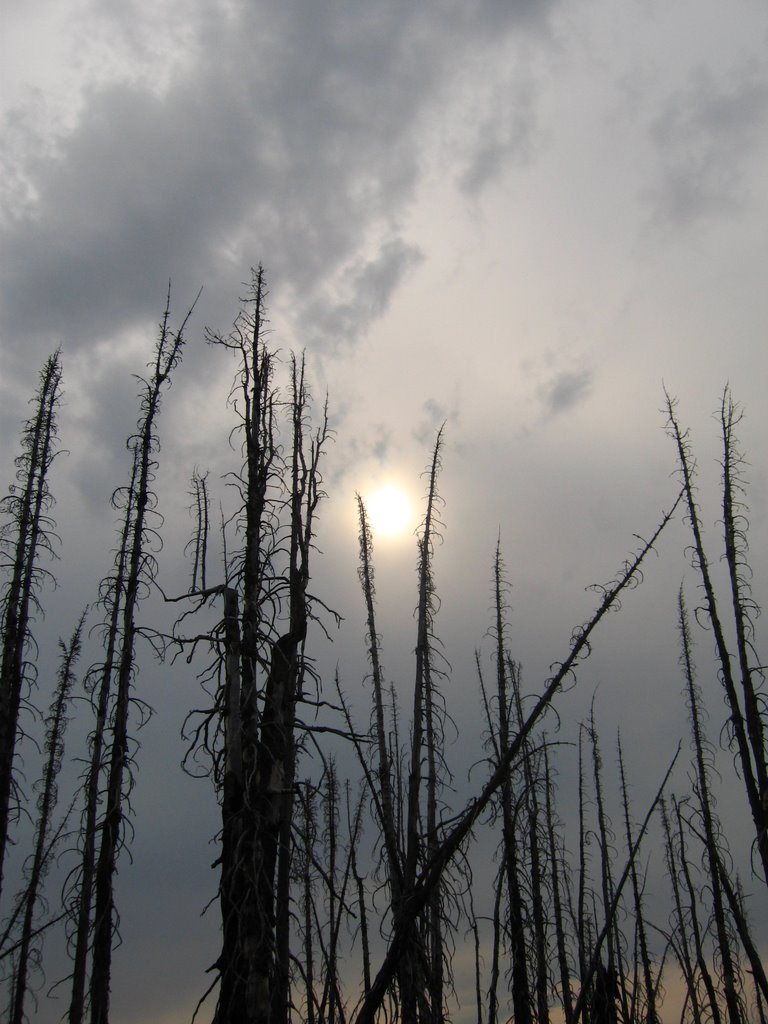
The walk is often spectacular, but not in a photogenic sort of way: We cross from fire zone to forest and back through a long stretch of charred trees and vibrant fireweed. Through the trees, both dead and living, Flat Top falls away and we are encircled by beautiful mountains that float above the haze and low creek beds. It's not the type of thing you can really take an accurate picture of; but, to be fair, you could say the same about most of Glacier.
All along the path lies evidence of a vibrant animal community though we see little fauna besides ourselves: bear scat; coyote and mountain goat droppings; and at one point, a field mouse's head, teeth to the sky, and its nearby internals, but no body otherwise. Bob figures we interrupted a coyote's breakfast, and I figure he might be right.
We make Fifty Mountain Camp just before 11 a.m., my fingers splotched purple from the blueberries and huckleberries we've stopped to eat along the way. Even if there is a fair bit of jollity—and, Bob and Zander being climbers, morbid humor—we are all business. Bob sets up his tent to reserve a camp site; we pack day packs for the climb; eat lunch, which for me is PB&J on a slightly stale cinnamon and raisin bagel; put our food in the bear box on site; and put the aforementioned packs atop the even more aforementioned toilet.
*
The haze finally breaks around noon, and we leave camp just after. We trek through a beautiful meadow with red and yellow grasses, yellow flowers, what appear to be red clovers, and boulders scattered about like children's toys. Zander and Bob now agree where we're aiming for: a small notch, barely visible, climber's left of the snow patch. We mount a small rise and start off trail.
It's not far from the trail to the base of the scree, just a small walk across a pile of loose rock that's come down from the mountain, across a couple of creek beds and a small stream, and then upwards.
Where the scree is still mostly steady with the roots of some small, hardy plants, I'm the fastest moving up the hill. It's easy, I think, though I've always seemed to excel at going up things, both on my feet and my bike. The goat paths aren't hard to spot if you follow one, then find the next, and I find goat droppings three times before the plants disappear, the slope grows steeper, and I begin to falter.
This is about 40% of the way up the thousand feet of scree. I'm no good at this, not naturally: you've got to kick step, Zander coaches me, kick your toes into the rocks and then repeat again as you climb the hill. Leaning forward to scramble, which for me is instinctual, is counter-productive: it loosens the scree, and even when it doesn't, it takes more energy than climbing on two feet alone.
My instinct, on the other hand, is the dash-and-gasp, and it leads only to trouble. The elevation isn't a problem when I'm moving steadily, but here, clambering directly up the slope as rock falls away behind my feet, I have to rest every 35 feet or so upslope to catch my ragged breath. You should stand up straight, but I don't yet have the self-control for that, and crouch low, which pushes more rocks downward.
Finally Zander crosses my path, zigzagging across the scree about 40 feet in front of me. I'm stuck where I am, on a slope that's just too steep for what I'm trying. You just can't go up it straight; there's no purchase. “See if you can just push your toes in and stand,” Zander calls down. I feel very small.
I'm laying prone on the mountain, looking upwards, with my limbs all spread to spread the weight. “There's no way,” I say brusquely. “There's just nowhere to go.” One of my faults, obviously, is that I don't like not being good at things.
Whether intentional or not, Zander slows his ascent, and I am able to angle over to the area he came from, only sliding about 10 feet down to get there. Since I know where he's been, Zander's footsteps are easy to follow. Even better, he's already compacted the rocks where he's stepped, so there's very little slippage as I climb. The last 150 vertical feet are marked by a series of exposed rock to where Bob is already waiting, at the bottom of the striped band of vertical sedimentary rock.
*
After a short break, we traverse across the bottom of the band to the notch where we will climb in. Above us is a large brown rock wall, marked most notably by almost perfectly square cleavage. It almost seems that, if your legs were long enough, that you could walk up parts like a staircase—a staircase with what climbers call exposure, which is your “exposure” to the risk of falling off the mountain entirely.
I have a small amount of difficultly with the traverse as well, but do fine when I make exactly the same steps as Zander, who's mostly making the same steps as Bob. Every so often I ask a stupid question about why we're going here and not there, why this route and not that one.
I get two answers: One is, in essence, that Bob is following his mountaineer's instincts, with 30 years of experience. When they get tired of this answer, it changes to another: “You can go any way you like.” As one might expect, the other routes I see always seem to get me in a little bit of trouble, the rocks fall away too much, or else are just more work than the routes that Bob and Zander choose.
When we get to the couvoir, we find yet more loose rock. I make them stop so I can get water and retape my toes, which are beginning to blister on top, as they lack even the slightest callouses necessary for the type of upwards rubbing that comes with walking up scree.
We advance into the notch, Bob first, then me, then Zander. We don't get far before we hit a section that requires chimneying—a technique involving propping yourself between two walls and climbing. It's like trying to climb a chimney, hence the name.
It takes a long time for Bob and Zander to talk me through the climb. They say nothing, but that brown canvas pair of Dickies pants1 inhibit movement, which makes things harder.
After I get to the top, Zander comes up and says hat the climb is a little more technical than he thought from watching Bob: the footholds are small, loose rock is everywhere, and the hand holds all slant downwards. Bob goes up ahead to scout the next bit, but he thinks that we might have to have the “difficult talk.”
Bob returns, and at this point I am voted off the mountain. Things don't get any easier from here, and the crux—the hardest part of any climb—looms near the summit. Bob and Zander are unequivocal that I shouldn't continue.
Now, I know that I have to trust their judgment and experience, as its what brought me this far; still, I am not happy. It's 2:20 in the afternoon, and with me along, who knows how long it would take to get up, if I could even make it. The last thing these guys want is to take me back in the dark—or worse.
My say is only that where we are is a bad place for me to stop, because if something happens to Bob and Zander, I'm stuck on there. When I say it I'm thinking about continuing 30 more vertical feet to what I think is the top of the striped band, for two reasons: first, and most important, so I can say I got somewhere; and second, so that if I need help I'm not stuck somewhere difficult to spot and with restricted visibility for me.
Zander, though, understands it differently, and, truth be told, better: that I need to return to the scree before they can continue up. He tells me not to feel bad, and that I've just completed my first Class 5 ascent unroped.2 I'm frustrated and mad, partially because I wanted to summit and partially because it feels like I failed. Zander will later give me a rundown of big climbs he's attempted more than once and has yet to summit, including three attempts on Mt. Shasta. Honestly: It doesn't really help.
The thing you tend to forget when climbing rocks: going down is often more difficult than getting up. So Zander climbs back down to help me as I climb back down, making climbing moves I've never done before. Bob puts me on belay, More for confidence than anything else, he says. As I try to make the moves, I feel like I've just been dead weight, which is never a good feeling.
*
The hardest part of the downclimb, for me, is trusting the footholds. I'm wearing boots—though Zander is as well—and because they're not really in the shape of feet, I'm not sure I can trust them, not sure I can center my weight properly. Slippers, in a way, would actually be easier. Bob says, You don't trust your legs yet, but the honest truth is that I trust my legs—just not my feet.
Bob actually offers to just belay me down but I decline. He may want to get rid of me, I think, but I'm going to learn something. Zander helps every foot- and handhold of the way, making sure I don't lean too far forward. It's incredibly helpful to have him there, coaching me, saying, Look down and left, look over, you've almost done it.
It takes me an hour to get back down the scree on my own. Bob tells me to go back down the way we came up, but looking at it, I realize that the exposed rock is present if I just scramble straight down as well, with no traverse. This is an easier descent, but still a mistake—if there's a landslide, no one will know where to look for my body. Or will be looking in the wrong place.
But there's not, and even though I seem to nearly start an out-of-control slide on the way down, I jump aside before it reaches critical mass. Once I return to the stabilized area, I just trample on the plants—I feel guilty about it, a little, but I need to get back and I'm still frustrated.
*
Back at camp, the other members of our party have found the site and the packs, but can't retrieve them. I couldn't get up there either, I say, so I guess we'll just wait till Bob and Zander get back. The stoves and tents are up there, stuck.
But I wander over to the pit toilet building anyway, and look over the space between the tree and the building. I can do this, think: And I can. It's just an easy chimney, a step on the side of the building, another on the trunk of the tree, and then a hop over to the roof. I call, hand the packs down, and am proud of myself.
It's the first time I've been proud of myself all day.
1 You may wonder why someone who indeed has a fair bit of outdoor experience is improperly dressed. Where are my zip-away nylon pants?
I didn't plan on climbing a mountain, so I didn't plan for climbing a mountain. It's as simple as that.
2 Later Bob calls it a “4 plus,” but both agree that the classification is higher than the listed Class 3.
Essays, John D'Agata writes, are costly things. I couldn't agree more.
From today's NY Times editorial on the fifth anniversary of the September 11th attacks:
When we measure the possibilities created by 9/11 against what we have actually accomplished, it is clear that we have found one way after another to compound the tragedy.
The tree trunk and the wall of the pit toilet are only four feet apart, and the pit toilet is only 8 feet tall, and yet I'm the only one who can't wedge himself up the space onto the roof.
I've got a variety of rationalizations for this, of course: I'm dressed improperly for real climbing in a brown pair of canvas pants that, as a child of the Bay Area, I wear everywhere, all the time; and I'm wearing hiking boots with thick rubber soles that leave a disconnect between foot and underfoot; and I'm not a climber.
This test is not intentionally a test, however, and I'm only trying to get up top because that's where our backpacks are. Our packs are on the roof because we put them there. We put them there, I think, to laugh at me when I couldn't climb onto the roof.
But no matter. I'm not a climber, as I said before, and to tell the truth, I think I'm a little too risk-averse to sheer, thousand-foot drops to ever truly be a climber. Still, I did a fair bit of tree climbing and general boyish mischief to know, deep down, that I should be able to get up there.
Here's the plan for the day: 6.3 miles by backpack to the base camp, where we are now; another mile or so to the base of the Cathedral Peak, with only light gear; a thousand (vertical) feet ofscreee; and then about 800 more (vertical) feet of class 3 and 4 ascents. I think. I haven't really been privy to the plan, since I am close to totally inexperienced as a mountaineer.
Cathedral Peak (elev. 9041') is the only peak on our little 4-day backpacking excursion in the Climbers' Guide to Glacier National Park, which has been and is the only guide we have, other than our eyes, to the mountain. My two partners for this expedition are Bob and Zander, who have taken me along out of the goodness of their hearts and not, as is obvious, due to some sort of innate wilderness talent or USGS 7.5 minute map, which I am wishing we had. Zander and Bob are climbing partners, and though Zander's only been at this for about 3 years, Bob's been at it for 30. Oh, and he's completed 3 ironman triathlons as well.
In theory, we'll be back in camp sometime between 4 and 8 pm, but you have to pack to come down in the dark or, at worst, survive the night on the mountain. Not to be happy, but to survive, which means a set of polypro in the bag, a Goretex jacket, food, 2 liters of water, and a flashlight. It's clear I'm the weak link from the beginning, but hey, they invited me.
*
(More to come in a few hours...)
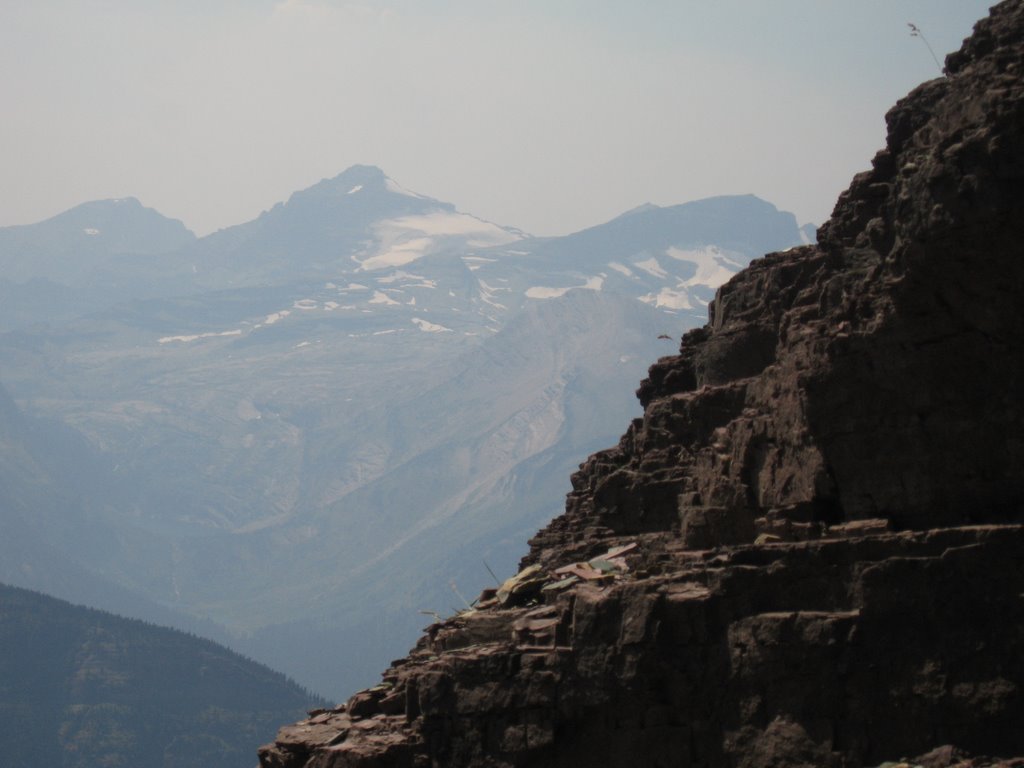

Yep, another preview post. I'm busy hustling work, what else can I say?
But soon, there will be all sorts of goodness about a littl eadventure up Cathedral Peak in Glacier National Park.
Cheers!
So I have returned from the wilds of rural Montana, just for the 3.18 of you regular daily visitors I've had since I said I was leaving.
Just so we're clear, here is the itinerary of my life since, say, early May:
And then back to San Francisco for a week. Followed by...
I'm going to post Montana next, for my own reasons. Then, perhaps, the rest of the driving trip.
And then, perhaps, I think I'll rest a little.
By making my brother write for me.
This will probably kill the readership once and for all, but I'll be away from the computer until approximately August 30th.
I'll be in Montana, in Glacier National Park, backpacking around and, I hope, not getting eaten alive by grizzly bears.
~Mario
My travelogues are now indexed for easy browsing on the left hand side. Thanks for reading!
Mention the State of Florida to my uncle Lincoln—who is, in the end, a New Yorker— and he'll reply, “Oh, the State of Waiting?” This is not exactly his best joke, but still, you do an awful lot of waiting in Florida.
An awful lot.
Especially if your car is broken and no one quite knows how to fix it.
So my eventual arrival in St. Augustine was something of a miracle, if only because it meant that some sort of waiting had ended. If the car broke again, at least it would break somewhere new, somewhere far from the lonely sprawl of Gibsonton, and if it didn't, well, I could finally get on with my vacation. While driving in absolute fear that the car would indeed break again, of course.
In total I spent three weeks in Florida, and, in all honesty, I'll probably never go back. Florida is for the most part a vacuum of culture, the place people go precisely when they want to go somewhere where there is no pressure to see or watch or do or participate in anything. Gainesville and Tallahassee are home to the University of Florida and Florida State, respectively, but both schools have better track records in football and Playboy's yearly party rankings than in educating students.
And, of course, there are the retirees, who have relocated to what Lincoln also calls Florida “God's Waiting Room.” If you go to Sun City Center, for instance, you'll see retirees driving golf carts around town, to the supermarket, to their friends' houses, and so on, which is all a social design so that those who have lost the ability to drive legally are still mobile. Noble, in a way; but also miserable, because they, and everyone else, should be able to walk. Not that anyone ever does, even the able bodied; and if you do, you are prone to abuse from passing cars.1
So without a car of your own, life can be unpleasant, if not miserable, in Florida, as mine was for much of those three weeks, and as much as one can say miserable when all the necessities—things like food and shelter and water—are available and you're staying with a friend. But even now the car trouble colored my trip ever since, made me travel differently from how I would have liked made me more skittish than the person I wanted to be.
*
After Michael meets me in Arcadia, he is nice enough to buy me dinner at The Clock, a Florida chain of diners that caters mostly to the elderly or the almost-elderly. (Apparently the name of the restaurant is not ironic, as delicious as that might be.) It's the place recommended by the tow truck driver, himself creeping up on retirement age, and while my grilled cheese on squishy white bread is stunningly acceptable, I am thankful that now, with Michael here, the day is just about over.
This sense turns out to be the one thing in the entire car saga that I sense correctly. Outside the garage, a tenth of a mile away, Michael and I transfer everything in my trunk into the trunk of his goldish Camry, which is most everything I've brought along: a pile of books, small blue duffels filled with socks and underwear, a cd case, a plastic tool box of cone wrenches and chain whips and other heavy bicycle tools. The drive takes an hour and fifteen or twenty minutes, and at Michael's we unload everything into a wobbly pyramid in his living room, and plan to get up early the next morning.
The next morning we return to Arcadia to visit the mechanic, who says he's very busy but agrees to check out the problem. The interior of his shop is a rectangular concrete floor with large toolboxes wheeled about, and it appears not to have any lifts, which I find disconcerting. He tends to wander away when I'm talking to him; and makes absolutely no effort to keep me appraised at all of, well, anything, which is okay with Michael since it means he has a legitimate reason for not showing up to work. Still, we show back up at 4:30, and he tells us that he hasn't been able to replicate the problem, and so there will be no charge.
And neither can the mechanic, recommended by Michael's coworkers, in Ruskin, even though the car bucks on the road from Arcadia and on I-75 as Michael tails me back to his work, where we leave the car for the night. Waiting for the mechanic in Ruskin costs three days; and waiting for an appointment at the Nissan dealership in Bradenton, 20 miles south, takes until Monday, which brings my total time without the car to a week, and my time in Florida to 12 days.
The car bucks strongly on the way to the Nissan dealership, and, finally, I am able to demonstrate to a mechanic—well, a technician—the problem. He recognizes it immediately. “The distributor,” he says in a thick Boston accent. He's from Brookline, as it turns out, so for the rest of his ridealong we talk about Massachusetts, where I lived for a few years as a kid.
He tells me that they can only replace the distributor as one unit, which will cost $400 or $500, but he's going to run some tests to make sure first. As Michael drives me home, I am relieved that, even if it's going to be a stupid amount of money to fix the car, it's going to be fixed and I can leave. Soon.
*
According to Hesiod, the ancient Greek poet, hope is the last, and possibly worst, of the sorrows of mankind that Pandora let loose upon the earth. Hope is a comfort but also a delusion, a belief that one can control the future when the future is in the control of the gods alone.
I mention this because, on this particular point, I am inclined to agree with Hesiod. Hesiod may never have been stuck for three weeks in the pretty-much-completely-miserable state of Florida, but I'm sure that he encountered his own troubles among the “thousand or so other horrors spread out among men.” For the next 10 days my life is a cycle of hope, disappointment, and slowly escalating frustration: The car, eventually is fixed, according to the dealer; but I get it, and it doesn't work. Repeat. And repeat. And repeat.
So, like I said, the approach of St. Augustine was something of a miracle, even if I had intended to make it all the way to Savannah but decided instead not to push the car or my own nerves, which made me jump at ever patched seam in the road and every pothole, worried that the car was bucking again.
The most important feature of St. Augustine, obviously, was and is that it is not Tampa. Indeed, it's about 4 hours from Tampa, which is a long time in a car you can't trust. At this point, I think the best I can offer is a text messaging conversation with my mother, whom I had introduced to “texting”2 maybe a week earlier.
MARIO
St. Augustine!
MOM
(RE:) At least it is pretty there .
MARIO
I noticed!
MARIO
Who knew there was something in Florida worth seeing?
MOM
(RE:) You are not out of the woods yet ! When do you leave the state?
MOM
(RE:) You are not out of the woods yet ! When do you leave the state?
MARIO
Tomorrow, I think.
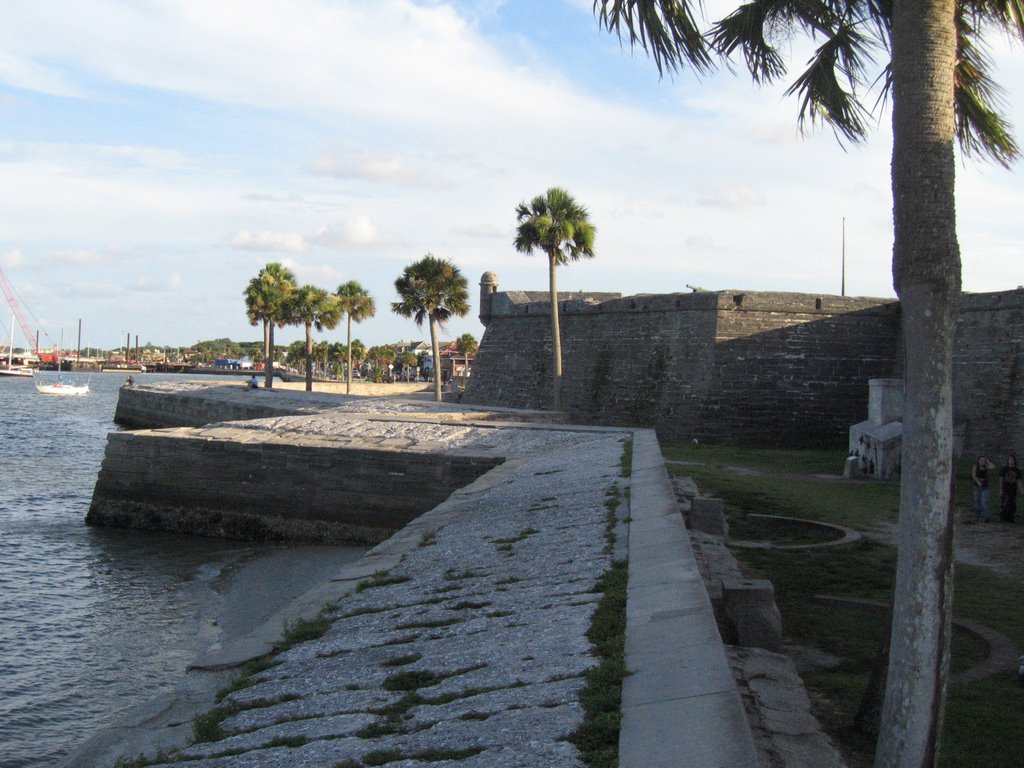
And I did, even giving out a little roller-coaster whoop of joy at the state line. But even though in St. Augustine I walked around the old fortress at dusk and sat to watch the sailboats motor along the intercoastal; and was hit on by the gay bartender at a pizza restaurant, who told me that this is the one safe place for Family in Florida; and took a ghost tour narrated by a disaffected and bored tour guide who kept playing with her lantern while she was talking; and stood next to a family of four from somewhere in the South, who wouldn't stop talking about Tony Stewart all throughout the tour; and the next morning finally dipped my feet in the Atlantic, thus somehow symbolically completing my journey across the country, even if I didn't actually did my feet in the Pacific at the beginning; and toured the oldest house in country with a contractor who gave both myself and the tour guide an explanation of the historical methods of planing wood; I felt listless, like I didn't do anything, didn't see anything, and that, if asked, I wouldn't have anything to say about St. Augustine.
And this, I think, is the best description, best explanation I can give about what the car trouble cost me. More than time, and money, and my ephemeral happiness, what was lost was my sense of humor in unexpected places, and that calmness that let me wait, and wait, and wait for the right detail about a place to reveal itself. It's as if my car—which did, to be fair, give me the right kind of freedom for my trip—replaced joie de vivre with a teenage ennui, the sense that unless I get what I want right now, everything is boring.
But I wasn't bored with St. Augustine; I certainly found enough to see and do. Instead, St. Augustine couldn't offer what I was looking for, what I needed: Calm; safety; some sort of assurance that I didn't have to worry about my car or the trip any longer. This is not a fair criticism, I know, but life were fair we'd all be thousandaires.
To be fair, I doubt anywhere, on that day, could give me what I was looking for.
1 “Why are you walking?!? Asshole! Get a car!”
2 This is a terrible word, and I promise never to use it again. I apologize for using it here. In fact, I apologize for even thinking it.

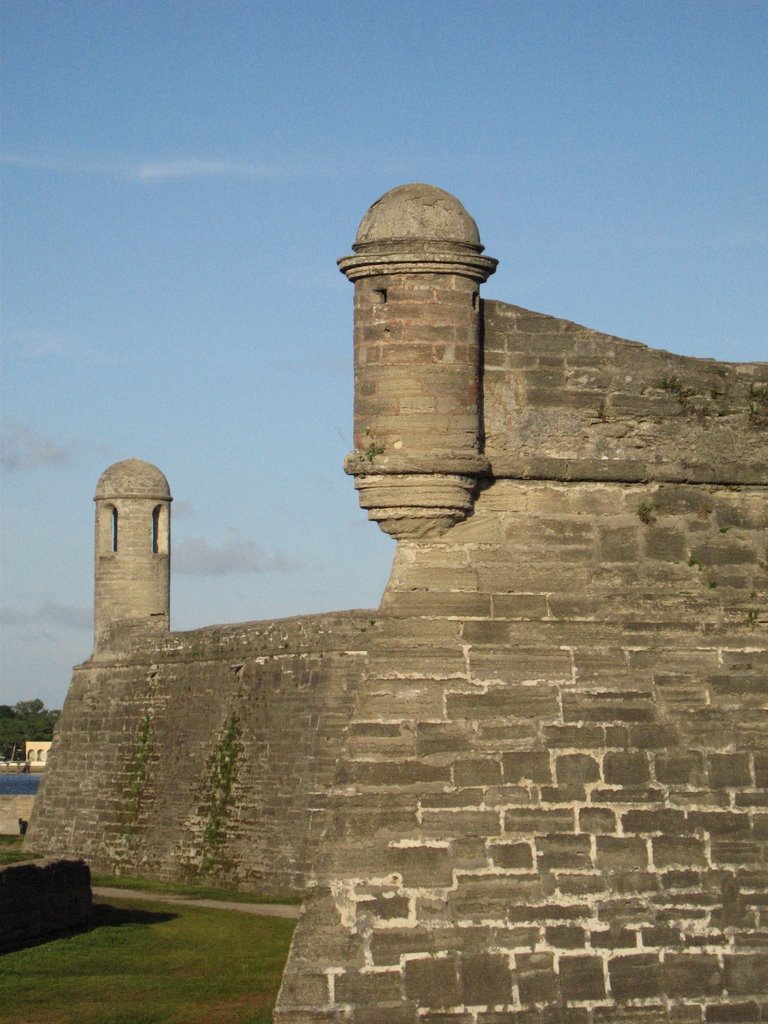


Sorry for the lack of posting, folks—I've got a little bit of paying work, so I have to put that first, for obvious reasons. The St. Augustine post is more or less ready to go, but I need to take an hour or so at some point to read back through.
I swear, later today, I'll actually have a new posting about both my car and St. Augustine, Florida. But probably not for a few more hours.


