Thursday, July 06, 2006

Houston (IV)

Houston is home to a guerrilla marketing campaign whose slogan—"Houston. It's Worth It."—means exactly what you think it might mean but aren't completely sure. It makes sense, though. Most of the young people you meet in Houston are from Houston, or from somewhere where Houston is somewhere: Huntsville, Liberty, Pasadena, China; towns named after other places. The idea is more to keep talent from leaving Houston than attracting it from elsewhere. At least, attracting it to Houston as a destination city; the oil wealth has always brought some people here.

In the marketing materials there's even a list of 20 things that are worth it:

  • The heat
  • The humidity
  • The hurricanes
  • The flying cockroaches
  • The mosquitoes
  • The traffic
  • The construction
  • The sprawl
  • The refineries
  • The ridicule
  • The pollen
  • The air
  • The billboard
  • The flooding
  • The image
  • The property taxes
  • The short springs
  • The long summers
  • The potholes
  • The no mountains
  • The idea, at least partially, is to create goodwill through this sort of self-deprecation. For it's easy to like anyone, or any place, that doesn't take itself too seriously. "I like places with low self-esteem," says Benji Mason, whose couch I sleep on for a few nights after I show up at Third Ward Bikes, one of Workshop Houston's workshops. Benji's an artist-in-residence at DiverseWorks and an employee at Workshop Houston, which runs a number of programs for teenagers in the Third Ward. He's smart and interesting, and seems to enjoy his life here. More importantly, Benji's a transplant: he's a Vermonter.

    There are good things about Houston that are obvious to outsiders. The Menil Collection, for one, all of which is free. This includes the Rothko Chapel, a small, non-denominational building “inspired by the paintings of American abstract expressionist Mark Rothko,” whose has a number of canvases therein; the main Menil collection; a collection of Cy Twombly's work; and the Byzantine Chapel, which contains the fresco of a small Cypriot chapel with the blessing of the Church of Cyprus and the Turkish government.

    Likewise, the medical care in Houston is reputed to be first rate, and Rice University also has a good reputation. (Rice students have a reputation in Houston for being spoiled and impractical, however.)

    At lunchtime at Third Ward Bikes, Benji drives first to a taco stand, which is closed, and then to a Vietnamese sandwich shop. “There's a lot of money in Houston and not that much, compared to places like New York or San Francisco, to spend it on,” he says to explain Workshop Houston's funding success. Their annual budget is around $120,000. “You go to San Francisco and try to start a new program, and there's already so many other good programs out there.”

    This I already know. The community bike shop where I volunteer, the Bike Kitchen, has an annual budget of around $10,000 and no paid staff members. The shop has been around for almost as long as Benji's—by our calculations, about six months less. This opportunity, perversely, is one of the things Benji likes. “It's wide open here,” he says, and gestures toward the cluster of larger high-rises that comprise downtown. “The cool thing is, if you want to start something cool, you can get a lot of support.”

    I don't think Benji has a skewed view of Houston. One of his acquaintances, Jeff, is a musician and computer programmer at NASA. He has offered to give the shop whatever money it needs. “I told them, 'Just let me know,'” Jeff says. “If they need ten thousand, I could probably come up with it.” Jeff's not particularly wealthy either, but he wants to give back to his community. Oh, and he's 30.

    Still, Benji can't imagine staying indefinitely. "I've been here since graduation" from college in 2002, he says. "I'll probably leave in another year or two." Where to? “Maybe Philadelphia,” Benji says. It's another city with low self-esteem.
    At the sandwich shop, everything costs $2.50. I consider buying two, because I am not sure of the size. As we wait, I mention to Benji that I'm so impressed you can buy a 24 oz. Shiner Bock at a liquor store for $2. “The thing is, in Texas, that's not a cheap beer,” he says. There's a bar near him that serves Pabst Blue Ribbon—PBR, popular because it's inoffensive and inexpensive—for 85 cents. Shiner Bock wouldn't even come up as a cheap beer here, where at home in San Francisco, generally, a six-pack of cans is $6 and bottles is $8 or so.

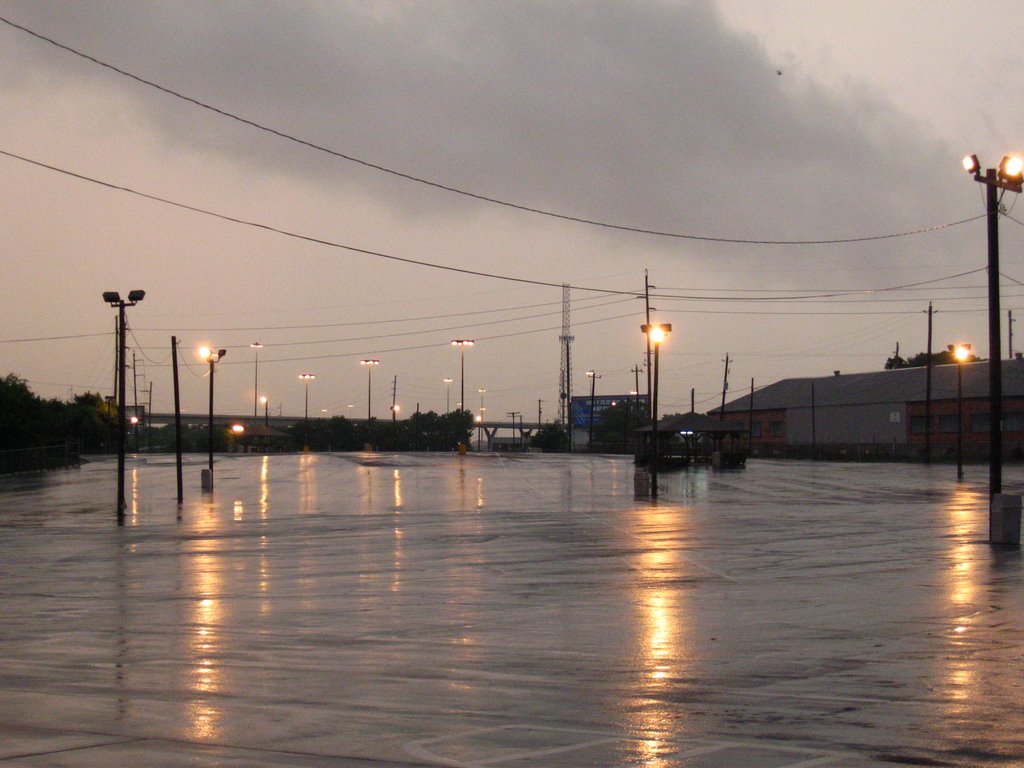
    The sandwiches are good, and large enough, certainly much larger than I expect. We drive through a “little” storm on the way back to the bike shop. The day I leave Houston, three days from now, I-45 will essentially be shut down from flooding from this same storm system, and I-10 will be marked by inaccurate signs that say the highway is closed just ahead.

    “When I first got here, Zach”—one of the other founders of Third Ward Bikes—“had to teach me flood driving,” Benji says. “Try to stay to the center of the road. Don't drive too slow, but don't drive too fast either, because that's an asshole move that makes waves.” I look at him, but he's concentrating on driving. “Basically go where you need to go,” he says.
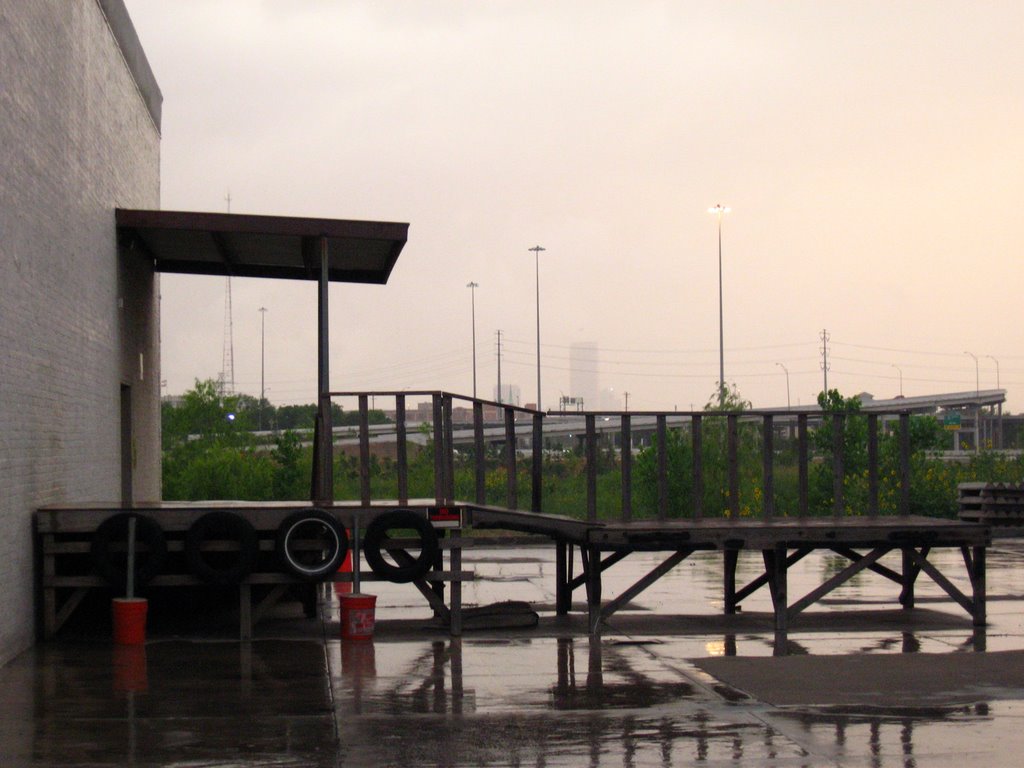
    Because of the rain the shop is quiet. There's one small kid fiddling with his brakes. “Do you get Vietnamese sandwiches in San Francisco?” one of the mechanics asks. His mouth is full, so the words come out in a rounded jumble. He's a graduate of the University of Houston and a native of the city. Indeed, he's never lived anywhere else.

    I tell him that's there's at least one shop I can think of, and maybe more, but you have to seek them out, mostly. Not this cheap, though.

    He nods, happy that Houston wins out somewhere, somehow.
    Wednesday, July 05, 2006

    Houston (III)

    Man jumps from Houston skyscraper, dies

    HOUSTON (AP) - A university student scaling the southwest corner of one of Houston's best-known skyscrapers jumped about 30 stories to his death Monday morning.

    The student, identified by police as Ryan Hartley, 20, was about halfway up the 901-foot, 64-story Williams Tower when he leaped about 7:45 a.m., Houston Fire Department spokesman Jay Evans said.

    Police recovered a driver's license and a note containing a message of a political nature. Authorities have declined to reveal details of the note, other than to say it did not mention plans to jump. The Harris County Medical Examiner's Office ruled his death a suicide Monday.

    Hartley attended the University of Houston, having transferred from the University of Texas this fall semester, said Michael Cinelli, a spokesman for the Houston school.

    Authorities said it did not appear that Hartley used any harnesses, belts or suction cups.

    "He did not have any of the normal professional equipment you'd normally see on someone trying to climb a building," Evans said.

    Hartley was wearing a powder bag on his waist, using it to apply rosin to his hands, and also employed some sort of handheld pick on the window molding as he moved higher.

    —published in The Amarillo Globe-News, The Abilene Reporter News, The Sunday Mail (Sydney, Austrailia), click2houston.com, and others, December 17, 2002.

    *

    Williams Tower fall may not have been suicide

    Protesters in the anti-war movement often express concern that bystander civilians would be a significant portion of the casualties caused by a major strike on Iraq.

    Outspoken anti-war activists have taken different approaches to show their discomfort with what the U.S. military calls "collateral damage." Some, through non-violent means, while others through more risky forms of defiance.

    "This Country has been fighting a war to impose their flawed sense of democracy, to many nations against their will, in such a manner the U.S. looks after the aims of their economy and inserts a powerful force against the affairs of the U.N."

    That was Kevin Hartley, reading from a letter written by his brother Ryan Hartley.

    This letter was found last December in Houston, after Ryan, an experienced rock climber, decided to climb the Williams tower in order to demonstrate his opposition to the war against Iraq.

    When Ryan's hands were wounded by the sharp edges on the building while climbing, he lost his grip. He then fell 30 stories to his death.

    Kevin Hartley has investigated his brother writings and thought patterns.

    Contrary to mainstream news reports that portrayed Ryan as a suicide victim, Kevin argues Ryan's anti-war sentiments were a mixture of Christian peace-maker zeal and a mental imbalance that had affected him for years.

    "You have to let your voice be heard, you also got to do that in a manner of Love, you have to show an alternative to the Hatred."

    Kevin says his brother was fighting for peace and that even though he had mental problems, Ryan wanted to make a loud statement by climbing the tower.

    A memorial service for Ryan was held at Second Baptist, one of the Mega Churches in Houston where his mother is an active member.

    Kevin is a deacon at a contemporary church in the Montrose area called Ecclesia. Like Ryan, he feels Christians should support peace rather than war.

    "The best thing that could be done out of this situation is that people will hear a message of peace that they would not have heard otherwise, I thought that if anything out of this could be good. The fact that a message of peace could be preached at Second Baptist, this place where they heard nothing more than the Republican party line "War is the answer." If a few people can hear this message and understand what it said, his death was worth my grief and my families' grief, if it helped somebody not to support the killing of people across the world."

    —David Daniel Gonzalez, KPFT News, Pacifica Radio Network, Houston. Broadcast on February 21, 2003.

    Chronicle Book Review

    We interrupt this regularly scheduled program to bring you a special announcement.

    Yesterday the Chronicle published my review of Anthony Giardina's White Guys.

    You can read it here.

    Pretty much everything else in this post is adult content, so consider yourself warned. Another travel post will come soon enough.

    *

    Because the Chron is something of a family newspaper, the extended quote that I really wanted to use—where Tim O'Kane masturbates to the picture of a black model in Brides—couldn't really be included.

    It's much creepier than I what I was able to quote, however, and I'd just like to include it as a record of record of both the excellent way Giardina handles the latent racism of his narrator and as a piece of good writing, plain and simple.

    I sat on the closed cover of the toilet and tried to empty my mind. Three magazines were in a wicker basket next to the toilet. Boating, Modern Maturity, and Brides. I picked up Brides (it was the closest) and flipped through the succession of articles on wedding cakes, on dresses and floral arrangements, on gift ideas for the groomsmen. In the photographs, pastels dominated; the light was soft and the sun perpetual. There was a predominance of blondes, and the world seemed exclusively white. Even the very occasional black guests and the single black bride looked as if they had been dipped in the vat of the suburban, so that their color seemed an accident, a clung-to habit from earlier, less-prosperous days. Looking at them, I couldn't help but remember what Kenny had said about the story that the city embraced to explain Billy's and Patty's shootings: our fear of the dark one appearing out of nowhere, gunning for us. Not these. Not these clever, handsome men and this doe-eyed, full-lipped bride who gazed directly at me, who I wanted to fuck. I wanted to loosen my pants and unleash my already partially swollen dick and imagine those black lips parting to receive it. We would go inside this old stone house where her very white wedding was taking place, and I would fuck her blind. Jesus. I would fuck her back into her own blackness.

    I dropped the magazine and tried to forcibly close off this line of thought. Already my hand had gone to my dick, already I was holding it, feeling its familiar distended skin. I was forty-one years old, too old for this, but did we ever stop looking for consolation this way? The desire to fuck a beautiful black model could at least remove me for a second or two from the impoverished life of being Tony Di Nardi's son-in-law, humiliated at a grand party because this confused, powerful man could not decide what he wanted. (pp. 213-4)

    Much thanks to Rosa Miller, by the way, for helping me not embarrass myself in talking about the coded language that Tim O'Kane uses. Rosa, I really appreciate it.

    Tuesday, July 04, 2006

    Houston (I)

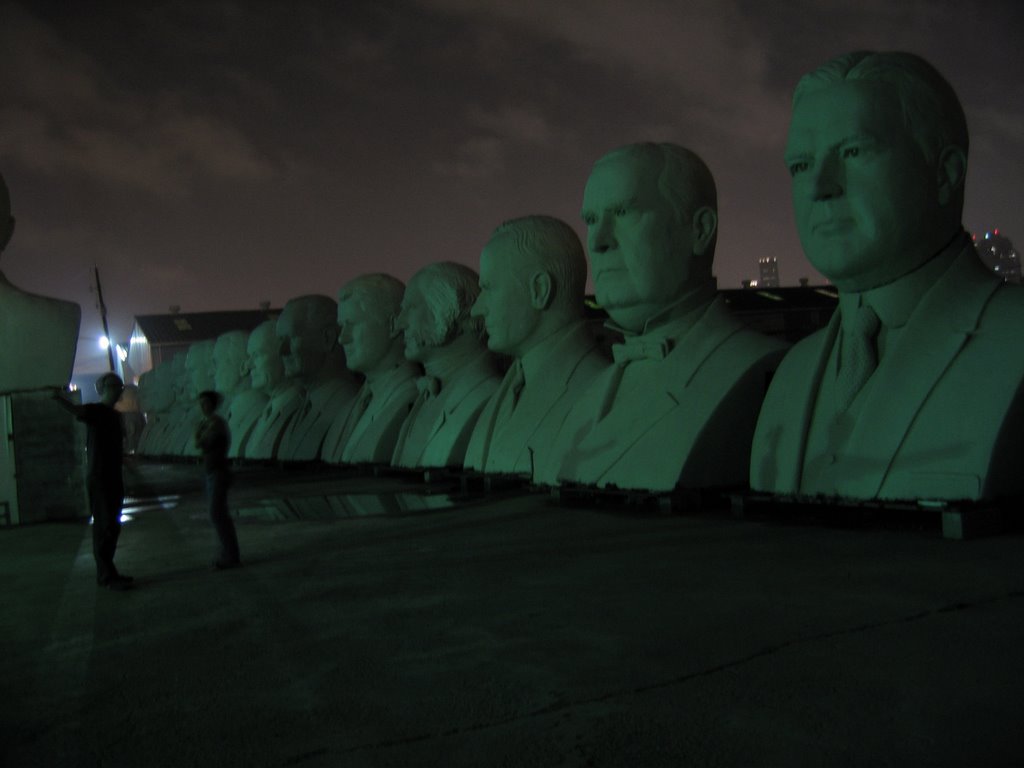
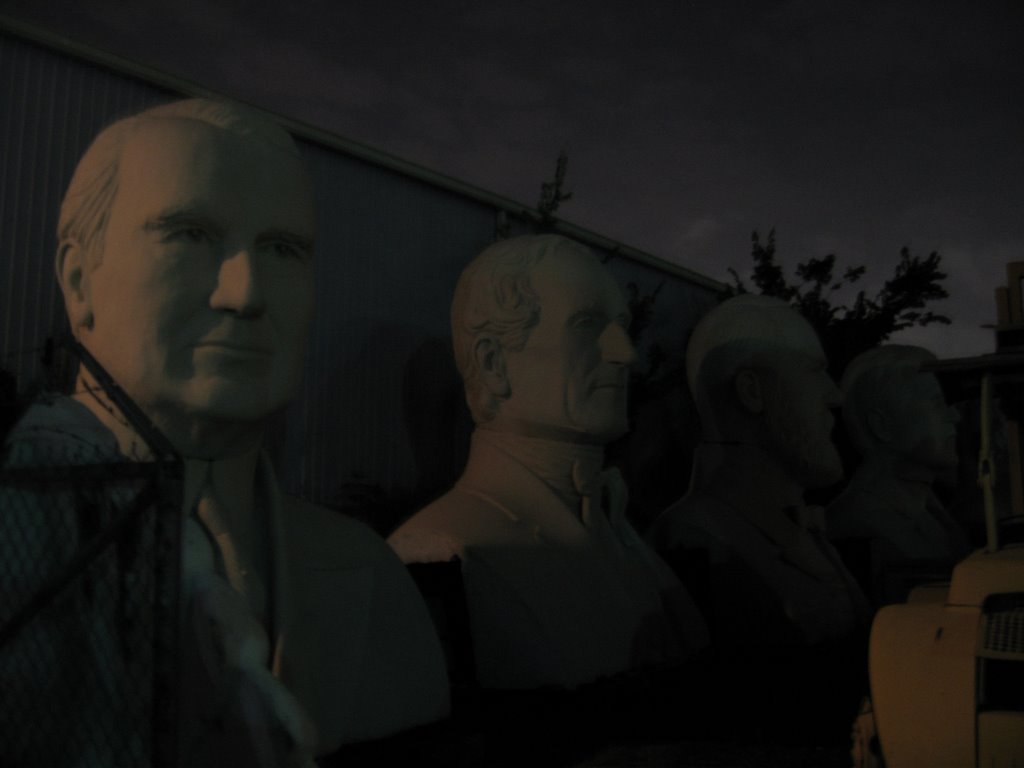
    The man himself is 5 foot 7. David Adickes, that is, the sculptor of the giant Sam Houston sculpture souths of Huntsville and of the giant presidents’ heads in Houston. His sculptures are significantly larger: Sam Houston, in Adickes’s rendering, is something like 67 feet tall.

    No one in Houston really seems to know much about Adickes, at least no one I talked to. Everyone’s seen the heads, but they don’t really know how to get there. His workshop, with the giant concrete casts, is in a part of Houston that’s full of dead ends and non-continuous streets. But no matter: he leaves the gate open at his workshop, and at night, if you want, you can whisper sweet nothings into Martin Van Buren’s ear.

    Houston (II)

    Until I read the chronology at the George H.W. Bush Monument, I had never realized how bad he was at actually being elected. Notable elected offices held:

  • Representative from Texas for the 7th District (November 1966; reelected November 1968);
  • president (November 1988).

    Notable losses:

  • Senator (November 1964);
  • Senator (November 1970);
  • Republican presidential candidate (1980);
  • president (1992).

    In between George (H.W.) was appointed to a great many things:

  • UN Ambassador (1971);
  • U.S. Liaison to China (1974);
  • CIA director (1976);
  • First National Bank (Houston) president (1977).

    And, of course, his elected-appointment as Vice President (1980).

    George (H.W.) was also acting president for 8 hours in 1985, as Reagan underwent colon surgery. Most of this time he spent playing tennis.

    *

    Behind the 8-foot tall George (H.W.) Bush statue at the George Bush Monument are four scenes from George (H.W.)'s life. In the first, he is dashingly donning his aviation gloves while sailors load or unload ammunition next to an airplane. In the second, George (H.W.) meets with some supporters—presumably oilmen, from the derrick in the background—while running for office, with his sleeves rolled and his jacket dapperly over one shoulder. In the third, he shakes Gorbachev's hand as the two of them watch a young German man take a sledgehammer to the Berlin Wall. In the last scene, and older George (H.W.) looks on, Barbara (I) beside him, as George (W.) is sworn in as president.

    In every picture, George H.W. Bush watches someone else do the work.

  • Monday, July 03, 2006

    Waxahachie, Texas

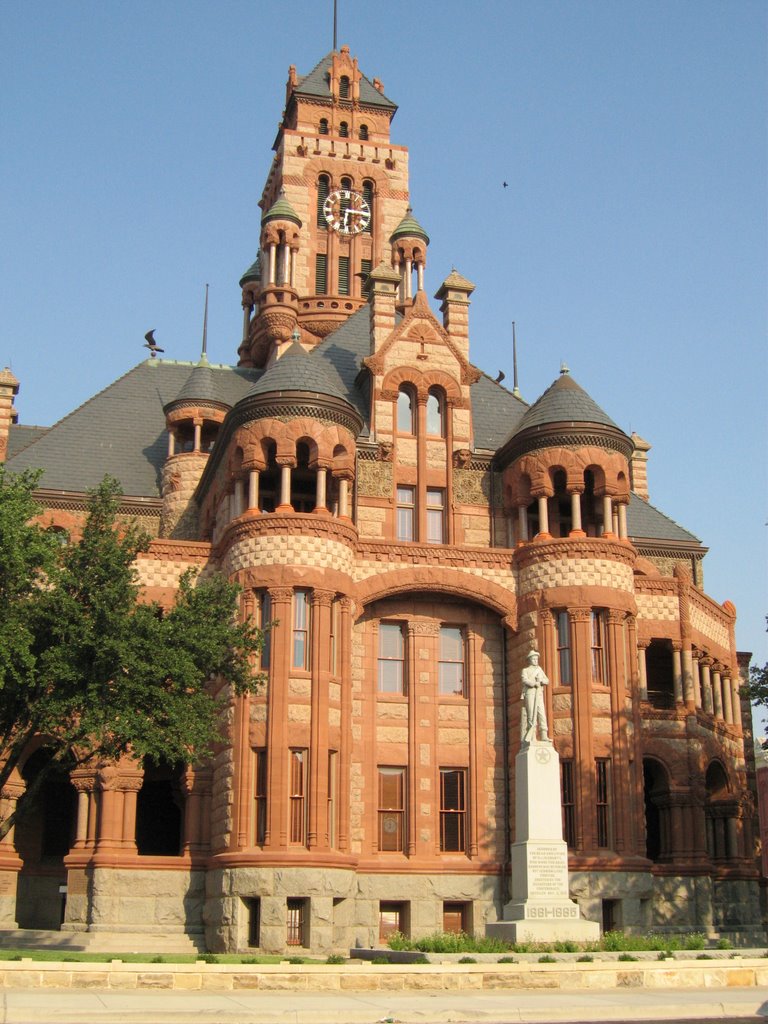
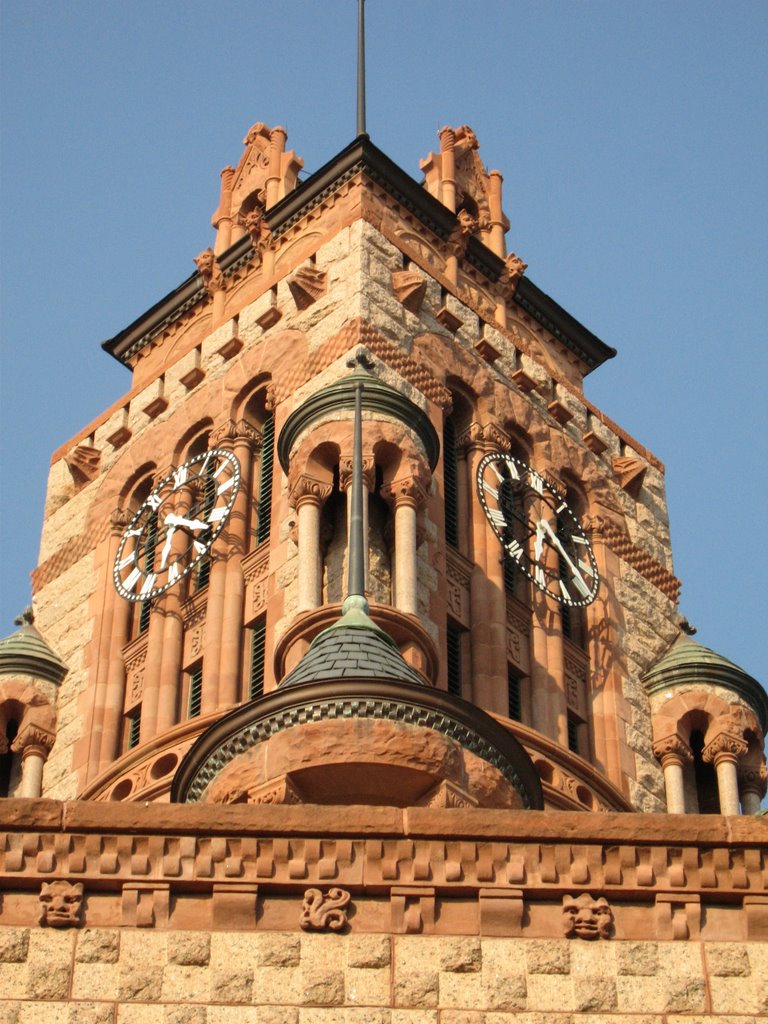
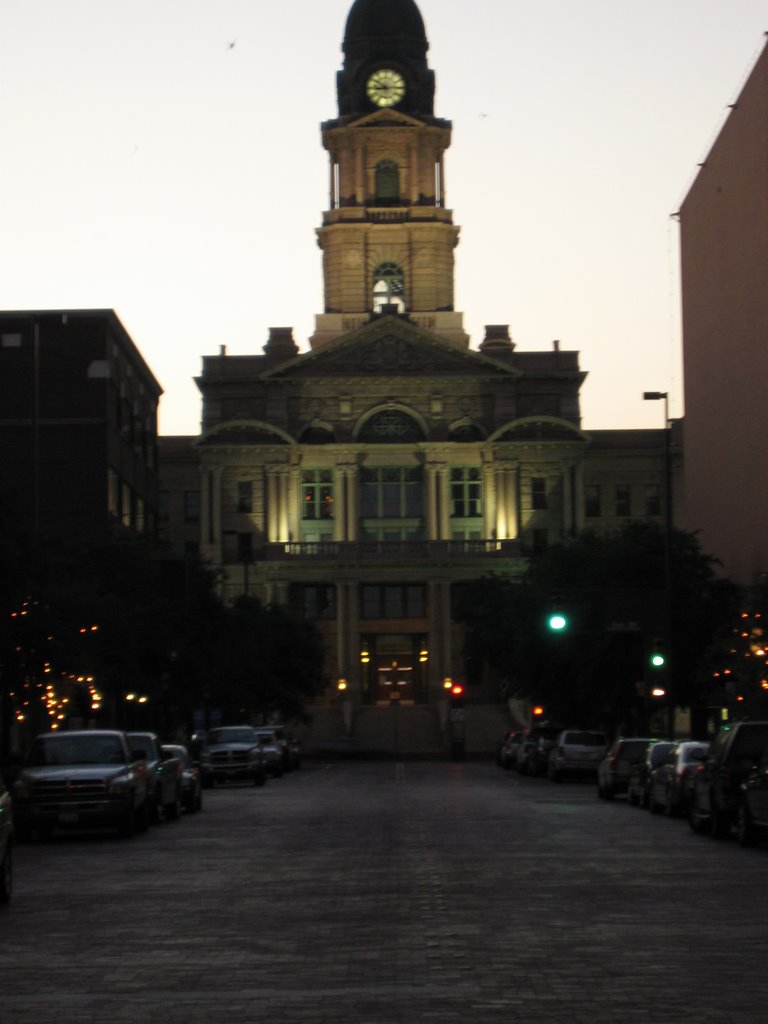
    The reason one comes to Waxahachie, other than necessity, is to see the courthouse. It's a beautiful building, and would be the center of town if anyone other than antique hunters went to the center of town.

    The courthouse has a myth about it, that a German mason named Harry Herley fell in love with Mabel Frame, the daughter of his landlord in town. He began carving her portrait on the building to show his love. In some versions, his love in unrequited; in others, her father prevents them from being together. If you believe the former story, you can walk around the building and see Herley become embittered, and Mabel's face become more and more horrific. It's not true, even if there was a mason named Harry Herley who worked on the building, but it makes a good story, especially for tourists.

    In front of the courthouse is a monument to the Confederate soldiers of Ellis County. A child-soldier stands atop it, his hands clutching a rifle. It reads:

    In honor of
    the dead and living
    of Ellis County
    who wore the gray.
    Banners may be furled
    but heroism lives forever.
    Erected by the
    Daughters of the
    Confederacy,
    unveiled Nov. 2, 1912

    This world view, and the ethos that goes with it, are common in Texas. The Civil War (or, more commonly, the War between the States) wasn't about the "right" to enslave others, but about the nebulous concept of states' rights. And the soldiers weren't fighting on the Confederate side weren't fighting for slavery, but to prove their mettle in battle. The war was a means to an end, then: a means, since heroism lives forever, of earning immortality.

    I don't mean to say that the Daughters of the Confederacy, or any similar organization, are out-and-out racists who want slavery revived. In Texas it may be socially acceptable to stridently vocalize reactionary political views, but the idea of "Southern heritage" is something else. If you measure racism by effect, by consequences rather than intent, you could present a strong argument that monuments like Waxahachie's are racist. But the more time you spend around the monuments, the more clear it becomes that any explicit racist intent is absent. Instead, I think, two desires dovetail into the preoccupations with the Confederate flag and "heritage violations" that one finds today.

    The first is the romanticism—or romanticization—of the antebellum South. This is both a rosy view of crinolines and crinolettes, wool jacket and frock coats, as well as of the nobility of the aristocracy and the Lost Cause. Things were better then, obviously, and the architecture better, the people more noble.

    The idea of the nobler past exists everywhere, for all time, so it's not really surprising here. Hesiod's Works and Days, for example, is basically about how all the men who came before his present day—about 700 BCE—were nobler and better. Homer likewise likes to point out that his heroes toss boulders that would take three modern men just to lift. It's all a myth, and it's all human.

    But even more than this, the celebration of the Confederacy is a 140-year study in denial. By celebrating the past and making venerating Confederate soldiers as valorous heroes, the South never has to face the sobering fact that the Confederacy was an ignoble cause. Make the soldiers into heroes and you don't have to admit that your side, your boys, were wrong. Make the soldiers into heroes and you don't have to face an ancestry of villains. Make the solders into heroes and you don't have to question your own righteousness.

    The South1 has taken a completely different course from, say, postwar Germany. Where Germany looked inward after the war, saw the root cause of their suffering and saw it was themselves, the South looked outward and saw only blue uniforms, only the proximate cause. You still hear the word carpetbagger today, even in Texas, and at the Sam's Food Mart in Waxahachie I got a $5 bill with Lincoln's face punched out.

    But it's that righteousness that gets me, the certitude. It's the same righteousness that makes me uneasy among evangelists, from Hare Krishnas to Pentecostals to atheists. It's a righteousness that is unwilling not to listen to others, but to see life from another position, another station. To perhaps hundreds of thousands of others, the Confederate battle flag is a symbol of pride; to millions of others, it is a symbol of slavery, hatred, oppression. How do you think it is a symbol of rebellion except in the strictest, most literal sense? How can you wear it, in diamonds, on your finger?

    To the Confederate States: Your suffering was all your own.


    1 And yes, I include Texas in the South, no matter what it thinks of itself.


    Friday, June 30, 2006

    Fort Worth

    "All these people, they're all downtowners," Mike says. Mike is a big, mestizo-looking guy, so big, in fact, that people mistake him for "Hawaiian" when he leaves Texas. I think he may mean Samoan by this, but I don't press the issue. When I ask what he does for a living, I think he says "horse breaker," but it's too loud to be sure and I don't press it.

    We are at a cowboy bar in downtown Fort Worth, as much as you can have a cowboy bar in downtown Fort Worth. Mike the Horse Breaker may not like the crowd much, but he's in their territory, not the other way around. Most everyone is drinking Coors or Coors Light even though Shiner Bock is much better, the same price and made in Texas.

    It is here, after Mike leaves, that I first encounter Twang among the Lawman jeans and autographed cowboy hats. Twang comes wrapped like a tiny present in square wax-paper packets, which you open and dump in your mouth, then gargle with beer. It looks, to the uninitiated, like the adult version of Pixie Stix.

    In Fort Worth, all the urban cowboys use Twang somewhat surreptitiously, hiding the packets in the palms of their hands. I text message my friend Sasha in San Francisco, who's far cooler and more worldly than I am, to ask what this crazy cowboy drug is. The way you use it is so weird, I think. Sasha doesn't know, so I am even more perplexed.

    And it's not until I get to Houston that I learn that Twang is just beer salts. It's a part of life so not-worth-mentioning that everyone I ask thinks I'm trying to describe something much more esoteric and obscure. Twang becomes, then, an anti-climax.

    I like this story, but I can't tell it often. It doesn't play very well or, perhaps, just not in the way I like it to. I only repeat it to fellow outsiders, because somehow, in the South, it becomes a story about my ignorance, rather than the space between places.

    Dallas

    You can't see the same line of sight down Elm Street today as Lee Harvey Oswald saw 43 years ago. For one thing, the trees have begun to overgrow the road—not completely, as all three lanes are still visible in part, but enough that imagining the motorcade from up on the 6th Floor Museum is difficult.

    Oswald's spot is at the corner of the building, which has been recreated behind sheets of Plexiglas with period-correct boxes. The rest of the museum tells the story of John F. Kennedy and of his assassination. One of the difficulties for the curators of the 6th Floor Museum is that no one knows exactly how those boxes were arranged, as the police photo-ops after the assassination all showed the boxes in different configurations. This provides even more fodder for the conspracists who stand on the street below, newspaper clips at the ready, ready to charge you to hear their theories.

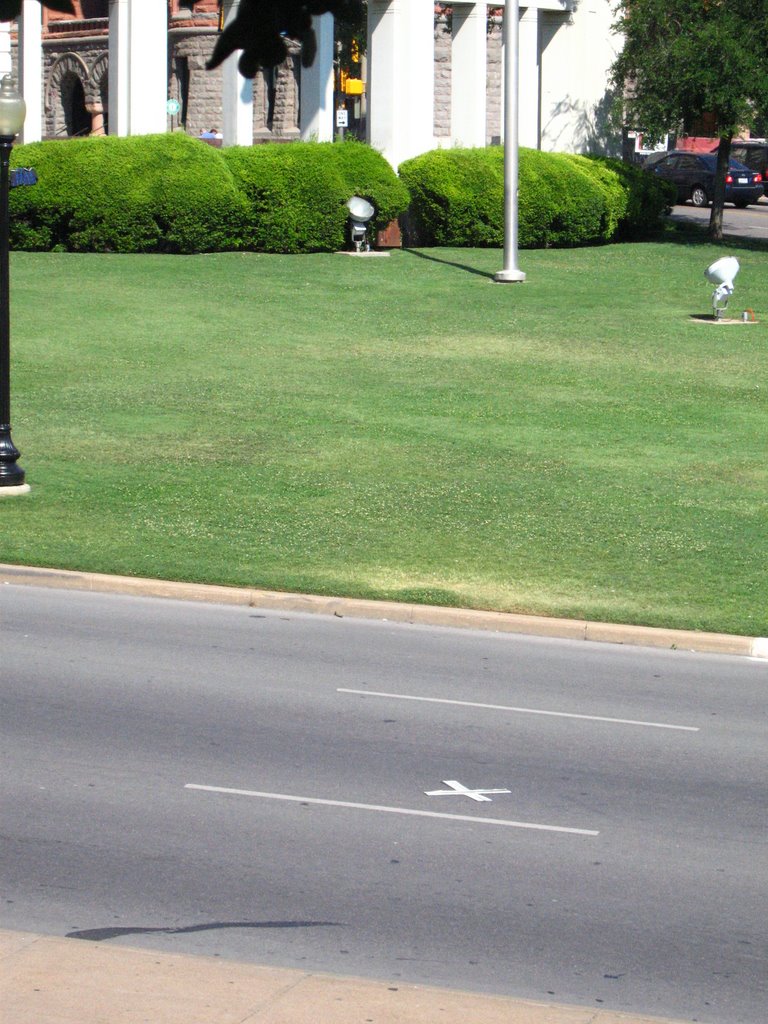
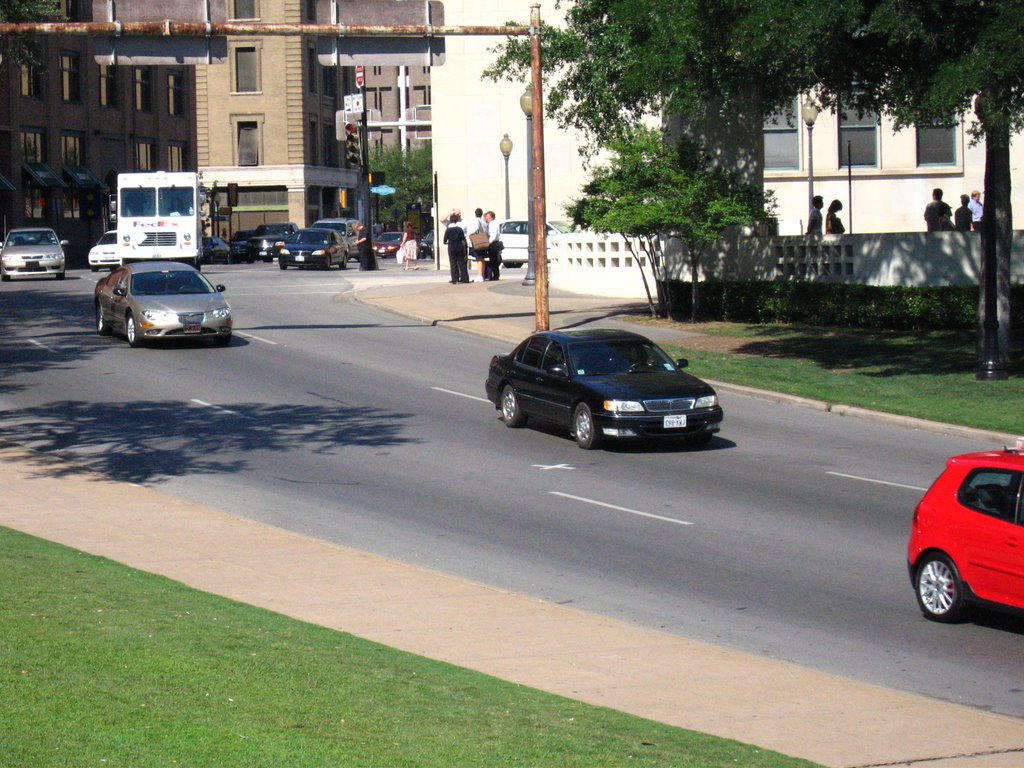
    On the street itself, in the second lane, are two white Xs. These are the two spots where Kennedy was shot, though everyone is quick to point out that they are "approximate." I suppose this means that the actual location might be a foot or two in either direction, which is close enough for me.

    I spend a lot of time in the shade of the WPA shelter on the grassy knoll, watching the traffic pass. Something unusual happens when cars reach those Xs: they move out of the way. Of every hundred cars, maybe five treat Elm like any other road and move straight over the assassination spot. Most merge into other lanes for a moment; some skirt the edge of the middle lane, tires on one dashed line.

    Whether this is respect for the dead or driver's instinct, I can't say.


    Thursday, June 29, 2006

    Glen Rose, Texas

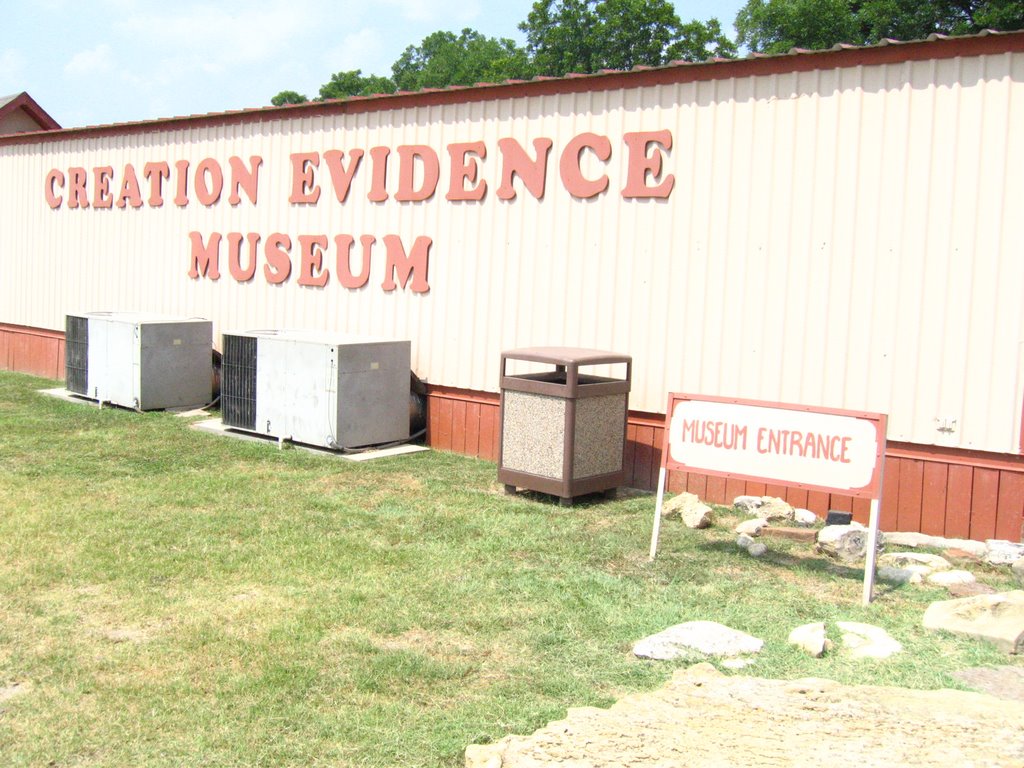
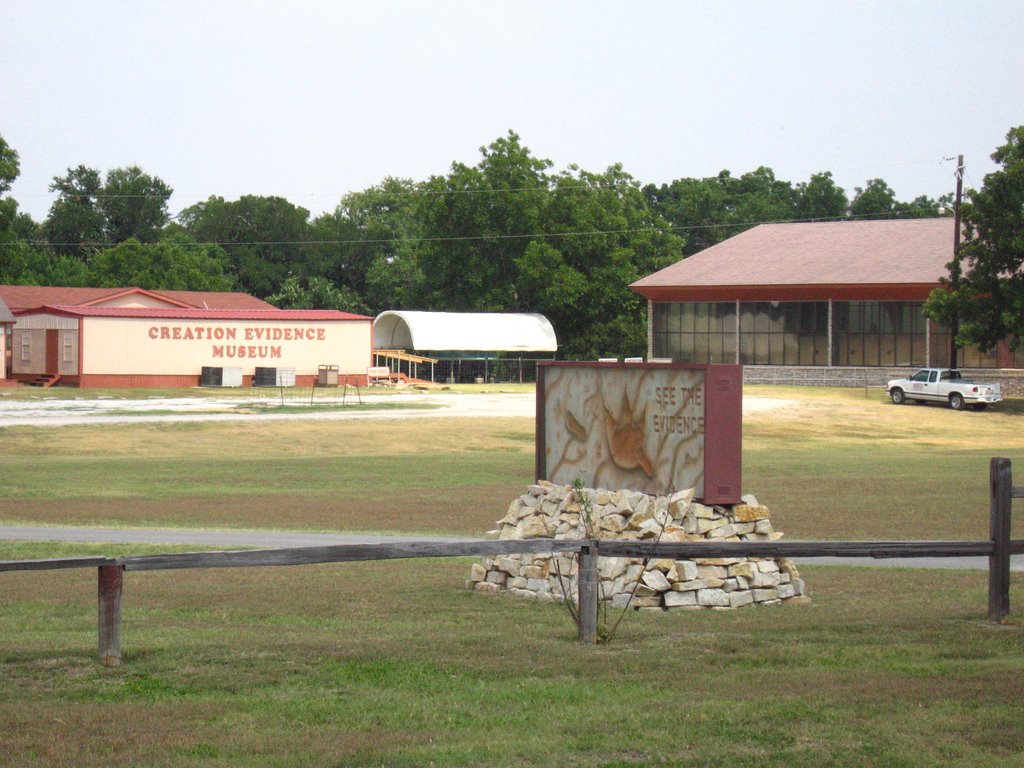
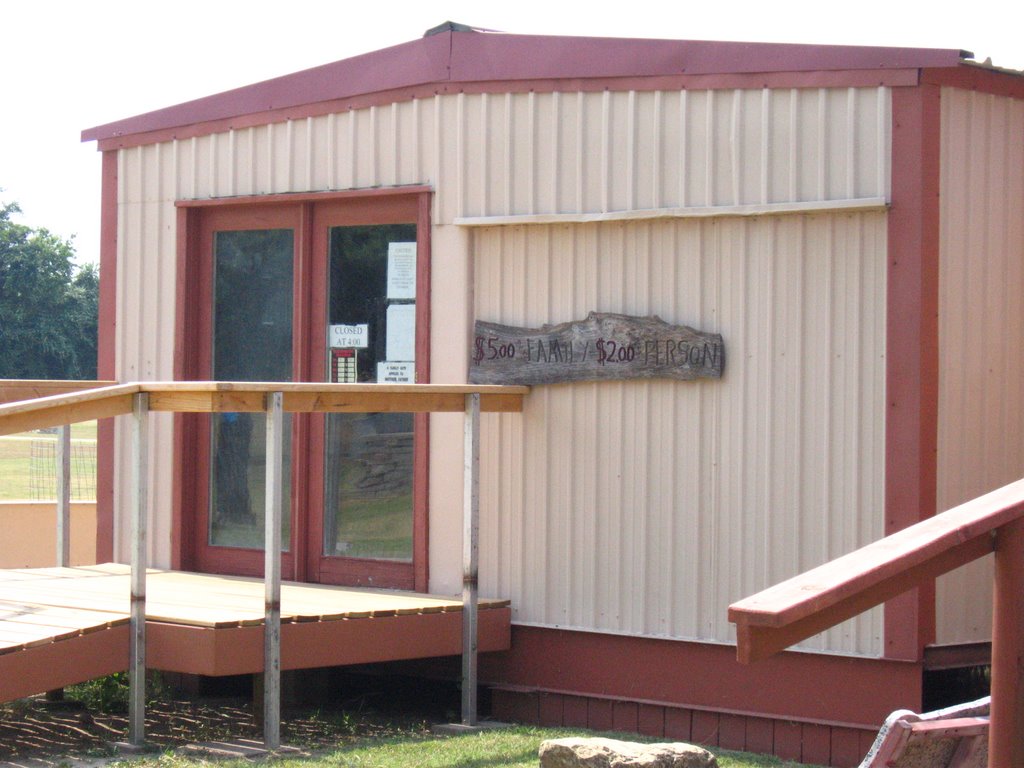
    You should plan to arrive at the Creation Evidence Museum on the hour, because that's when the tour begins. Actually, "tour" would be more accurate, since at the Creation Evidence Museum the word refers not to a physical journey that involves a series of stops and ends at the starting point, but an explanatory video in a single-room trailer home. The narrator of the video is Carl Baugh, founder of the CEM, doctorate in a field that varies from time to time, and tireless researcher of research that only he understands.

    When you get to the museum, you will most likely have your choice of seats, as things haven't been too busy lately. The future looks bright, however, and the construction of the building next door should continue soon. This new building, the permanent home of the Creation Evidence Museum, will contain the world's largest hyperbaric biosphere, since everyone knows that the prediluvian world had an atmospheric pressure much greater than ours today, and that the crystalline matrix that separated the waters of the earth from the waters of heaven—as described in the Book of Genesis—filtered out all wavelengths of light except for magenta. It was this matrix that God punctured (here Baugh gestures with his finger, as if popping a bubble) to cause the world to flood, and bringing us to our modern day.

    Baugh comes off like a slight creepy Mr. Wizard. He's avuncular and didactic, but from his tone of voice it is clear that you have to accept that he's right without question or investigation. He only appears at the museum in public on the first Saturday of every month, to give a lecture on recent developments in creation science and occasionally lecture on the Museum's work, such as sending missionaries to Papua New Guinea, where they observed pterodactyls.

    But the museum has put out a good number of staff publications, available for purchase at the museum. These address questions such as "an DNA matching prove that man did or did not come from primates?" and "Why did God create spiders & vicious animals?" One such publication, authored by David V. Bassett, M.S., CEM Staff Writer, ends

    I do not hear many calls coming from the people talking about global warming to bulldoze the rain forests. If they really believe in global warming, the rain forests, the rotting wood and the insects in those rain forests are the worst contributors.

    If you read Baugh's dissertation—which is either about education and teaching creationism in schools, or about archeological evidence that dinosaurs and man were contemporaries—long enough, you'll come to a section entitled "Darwin's Phobias," in which Baugh psychoanalzes Charles Darwin. He concludes

    It is, then, the conclusion of this author that Darwin experienced unithanatophobia (defined as: an obsession with universal death) and anisotrophobia (defined as: fear of designed structure in nature culminating in man).

    I don't have a dictionary of psychology at hand, but it is worth noting that neither unithanatophobia or anisotrophobia are in the Merriam-Webster dictionary, and that Google, Yahoo, and MSN Search turn up exactly one usage: Baugh's dissertation.

    It's fairly easy to discover that Baugh's credentials are questionable at best. He claims his (first, current) doctorate in education from the Pacific College of Graduate Studies, which does not have a website and is likely a diploma mill. He previously claimed a degree in anthropology from the College of Advanced Education in Irving, Texas, which does not exist. His most recent doctorate is from the Louisiana Baptist University (née Baptist Christian University), an unaccredited correspondence school in Shreveport.

    But if you show up late on a sticky weekday afternoon, you don't know that. The room is air-conditioned and dark, and it contains unlabeled exhibits behind glass cases and Baugh's first hyperbaric chamber, magenta gels over its windows. On tape, Baugh is charismatic and seems to speak the language of science, countering counter-arguments, explaining the mural along one wall, inviting you to understand the truth about the world.

    Ten minutes after the movie stops it begins again.

    Wednesday, June 28, 2006

    Waco, Texas

    On the second floor of the Dr Pepper Museum and "Foots" Clements Free Enterprise Institute, is an exhibit about Dr Pepper's contribution to the war effort. This contribution, near as I can tell, consisted of selling soda to the army and lobbying Congress (successfully) to declare Dr Pepper vital to the war effort and therefore exempt from sugar rationing.

    The museum has the dual charge of commemorating original formula (ie, non corn-syrupy) Dr Pepper and promoting libertarianism among school children. The museum's mission is

    to educate and entertain the general public through the collection, preservation, interpretation, and exhibition of objects relevant to the history of the soft drink industry, and through that example, the free enterprise economic system.

    This plays well in Waco, apparently, as the museum is a popular place for school tours. Like pretty much everything associated with the museum, as a child I would have been ecstatic to come, but now the whole thing makes me leery. It's one big paean to the Dr Pepper-7-Up-Cadbury Schweppes Company, and doesn't seem particularly educational. There are televisions with repeating loops of Dr Pepper commercials. But what most encapsulates this is the museum's summer camp, for kids aged 8 to 13, where they can learn the ancient art of soda jerking, create a soda, and generally eat sugar and business all day. All the cool kids are there, though, I'm sure.

    Up on the third floor is the WW "Foots" Clements Free Enterprise Institute and, for me, the main event, the BeverageWorld Soft Drink Hall of Fame. Think of it: little shrines to each aluminum can, a short history of the drink, perhaps all of this on a bronze plaque, like Cooperstown. Would RC Cola make the cut? What about Dr. Brown's Cel-Ray? Or Crush?

    I have set myself up for disappointment. The Hall of Fame is for soft drink executives, and has small brass plaques that read

    Harry E. Korab
    Society of Soft Drinks
    Technologists and
    Operational Persons
    Inducted in 1990

    James B. "Bud" Lindsey, Sr.
    Pepsi-Cola
    Bottling Company
    Bakersfield, California
    Inducted in 1988

    Myron E. Weil
    Royal Crown Cola
    Bottling Company, Inc.
    Inducted in 1990

    Kenneth E Kingsley
    Alpac Corporation
    National Soft Drink Association
    Inducted in 1983

    and so on, with colored pencil pictures of the executives beside them. It is, perhaps the worst Hall of Fame I have ever been to. There are no stories, nothing of interest, really, unless you are one of the inductees. Even then, I can't imagine that you'd make a trip to Waco to show, well, anyone.

    The letters of the entrance sign aren't even applied straight.

    Tuesday, June 27, 2006

    Austin (III)

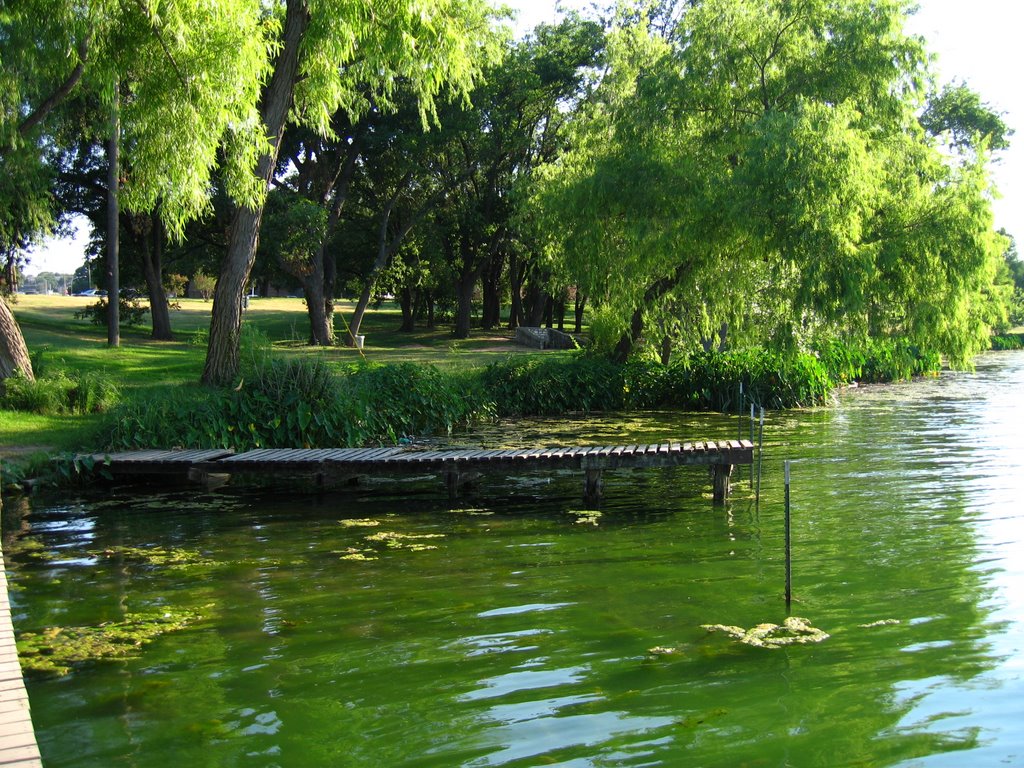
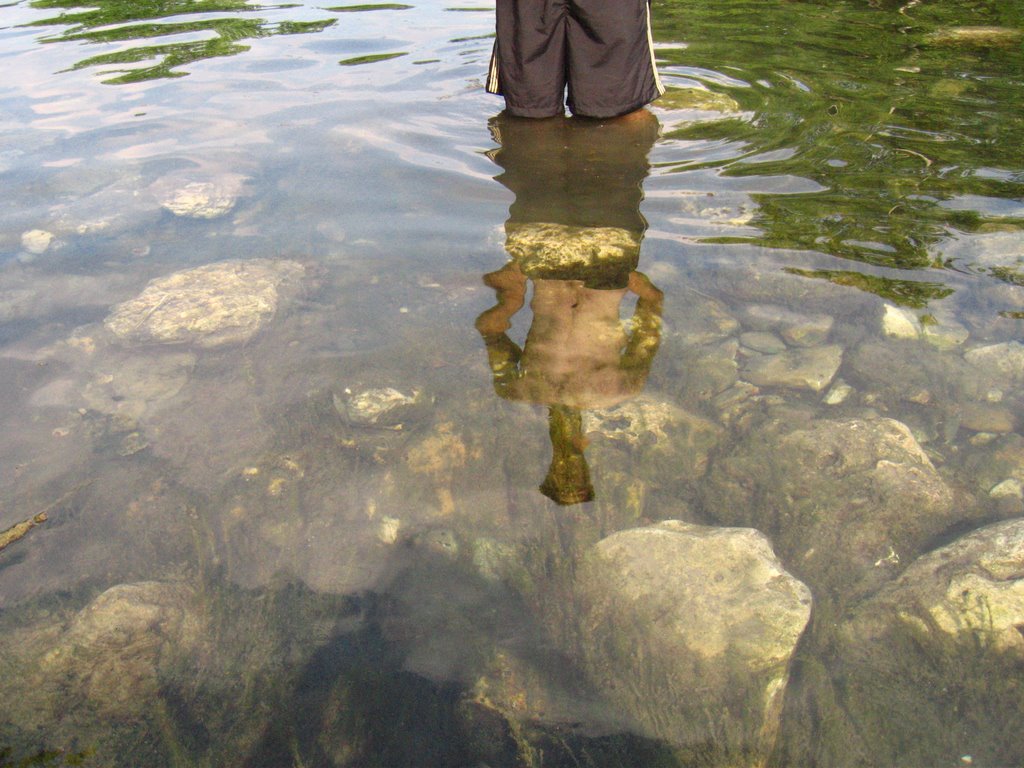
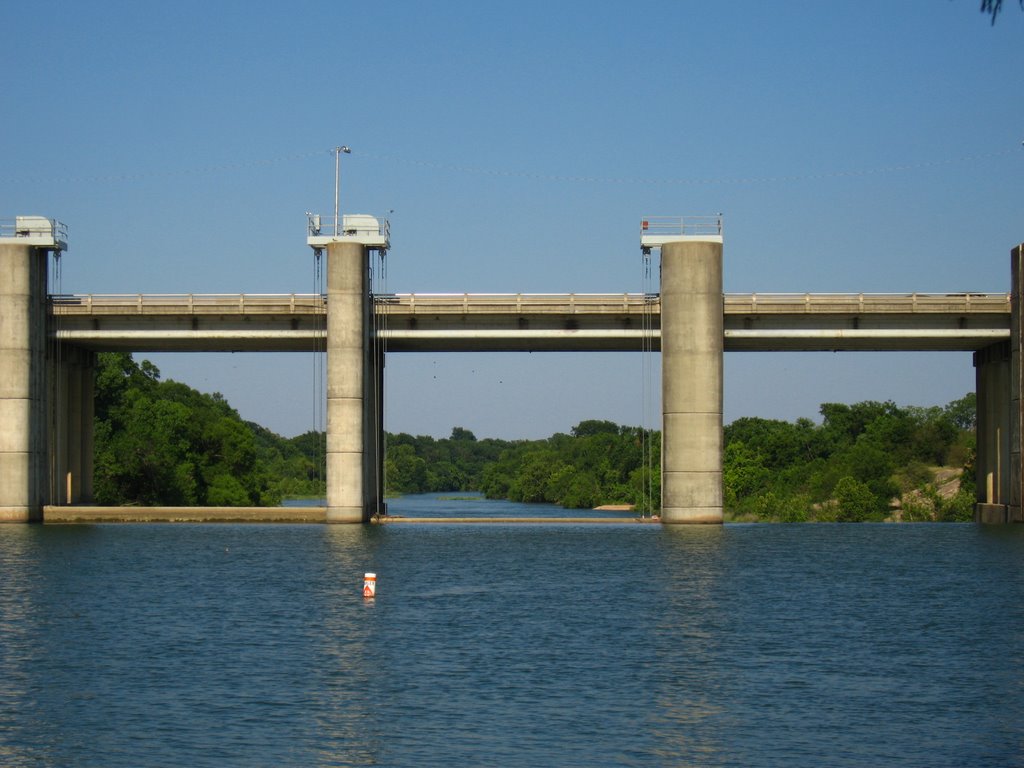
    The other thing to do in Austin—other than a promenade along 6th Street—is a visit to Barton Springs. Barton Springs is a swimming hole, not far from the center of Austin and recommended by, well, everyone. The water is 68 degrees Fahrenheit year-round, and while the Austinites tell say that that's cold, you have to realize they live in a place where it's normal for the temperature to be 85 degrees and humid at 2:30 am.

    The 900 foot long pool costs $3, but cheapskates and fellow travelers can swim for free in the rapids or the stream just past it (and in front of unenforced "no swimming" stencils). The pool was actually closed for three months in 2003, after the Austin American-Statesman reported high levels of arsenic and benzene in the water, but government scientists found no true hazards.

    Still, the city closes the pool on Thursdays for cleaning, which makes Fridays the best day to go. That is, unless you visit downstream, which is where they push the algae.

    Jocelyn—my friend-for-a-day in Austin—and I both agree that the water in Austin tastes funny.

    "It's like the water's moldy," Jocelyn says, and she's right.

    "It's like the water gets moldy from the heat," I say.

    "Maybe," Jocelyn says.

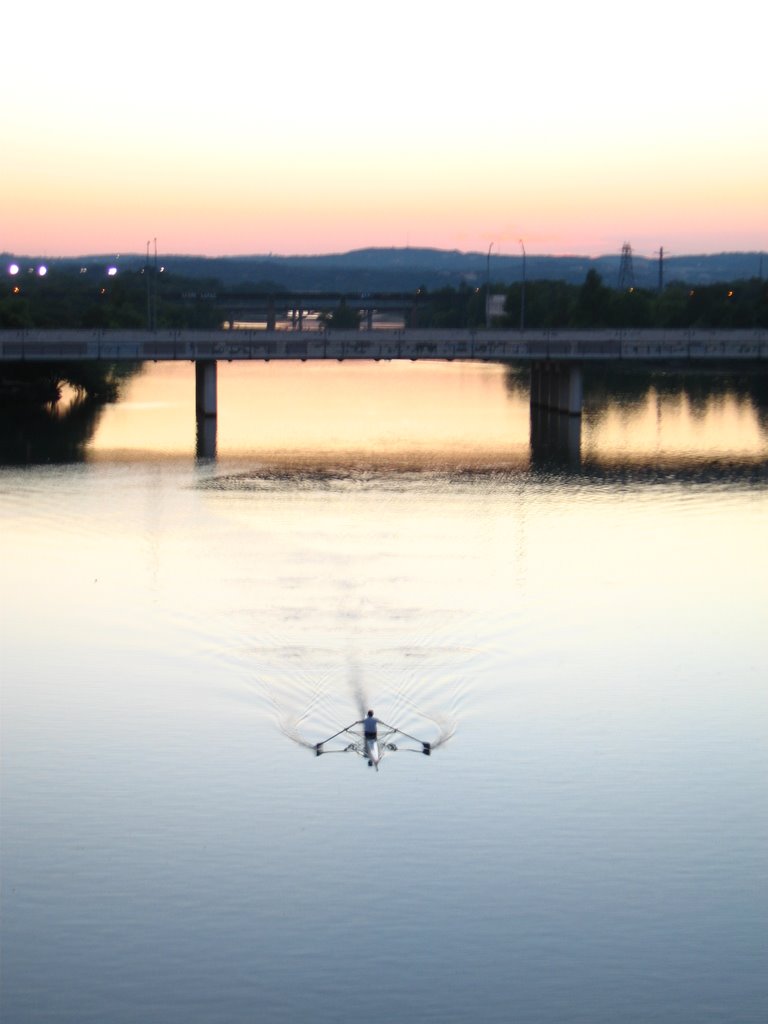
    The Colorado River runs through Austin, which doesn't make any sense. The Colorado has its mouth in the Gulf of California. The Rio Grande outlets into the Gulf of Mexico. So, we outlanders ask, do the Colorado and the Rio Grande cross? How is it possible that the Colorado is here?

    Just as Nashville has a second Parthenon, Austin has a second Colorado River. It flows for 600 miles from Lamesa, Texas (more or less) to the Gulf of Mexico, and is the longest river solely in Texas. No canyons, grand or otherwise, though I suspect that this Colorado River always reaches the sea.

    Monday, June 26, 2006

    Austin (II)

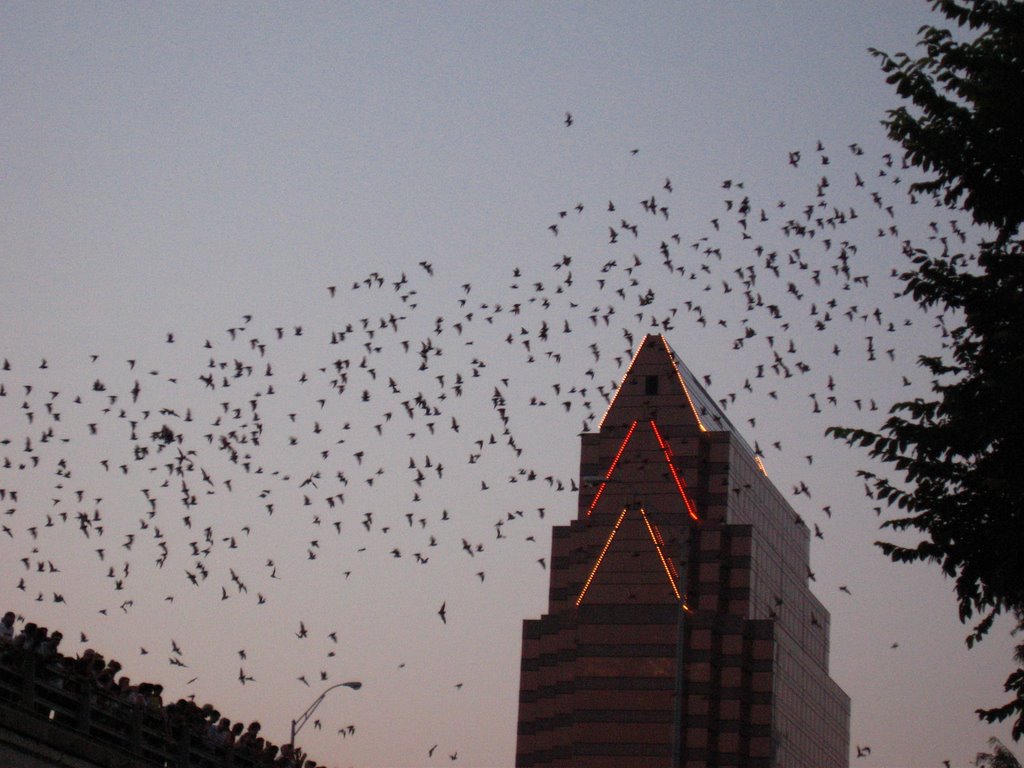
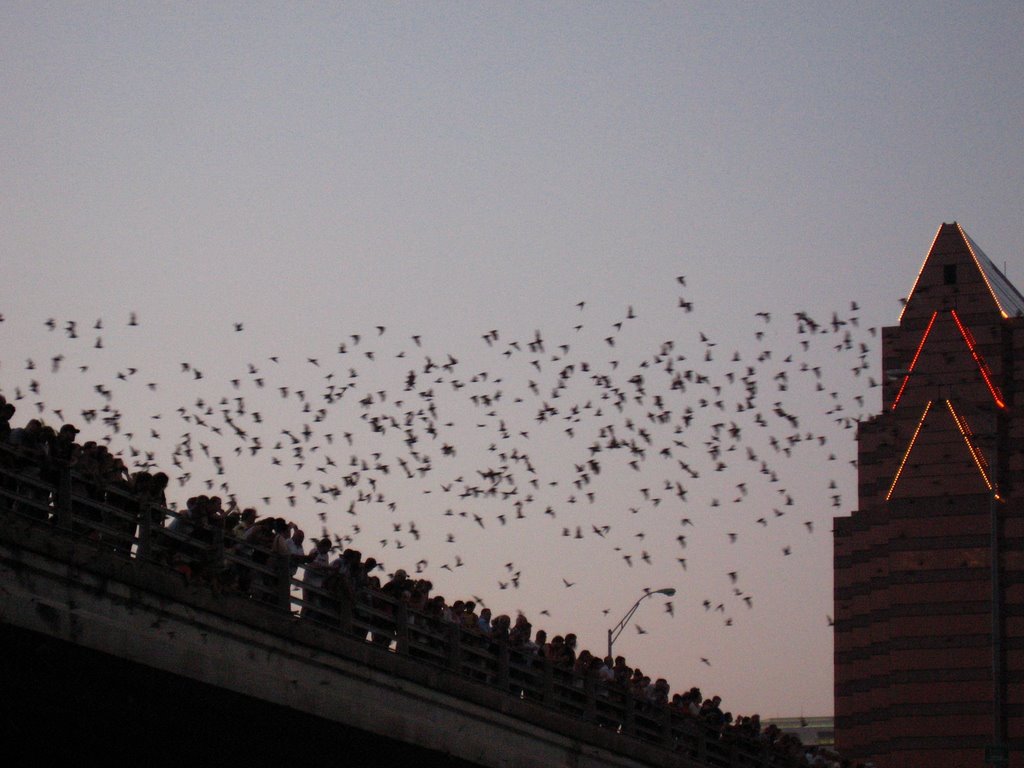
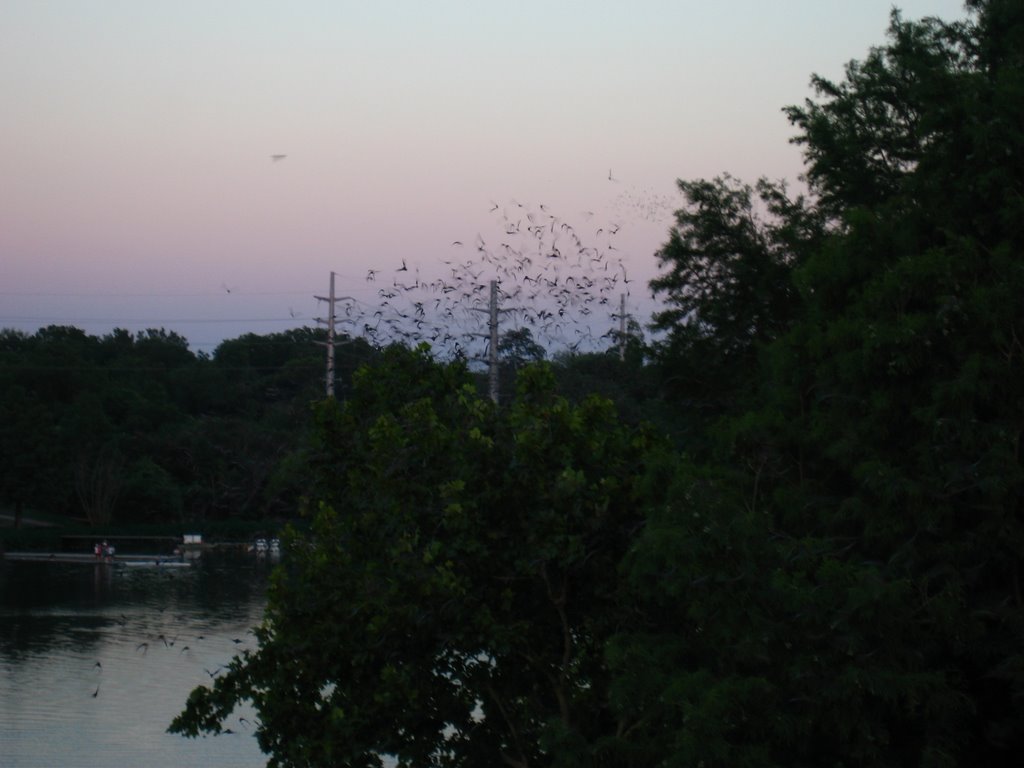
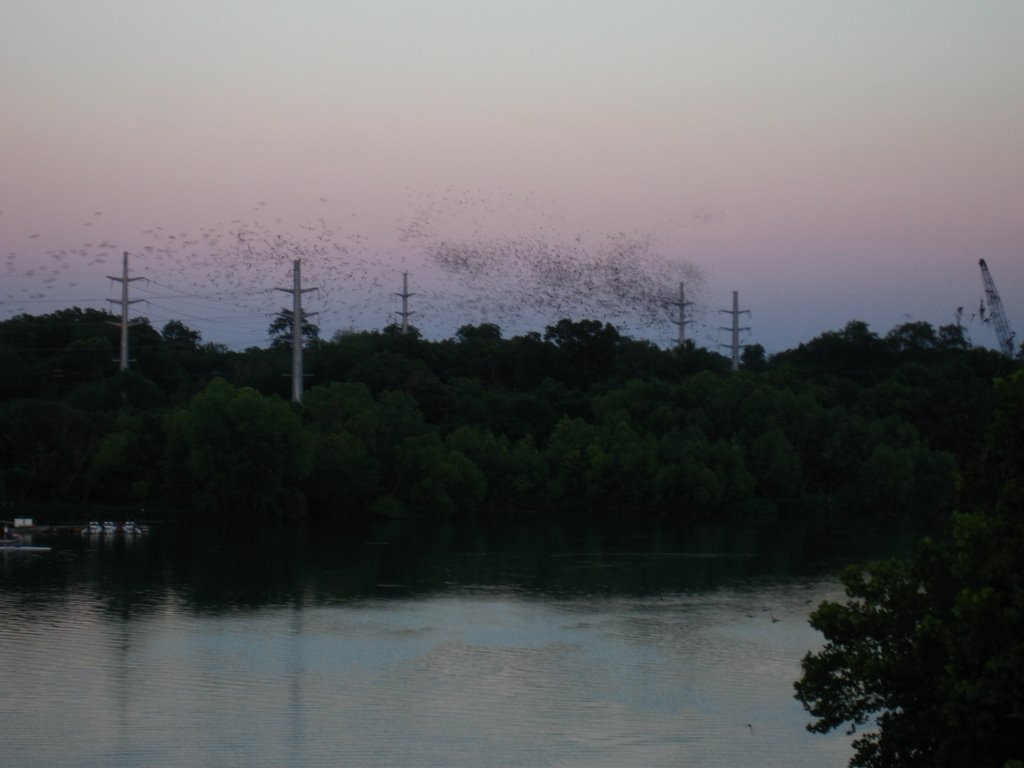
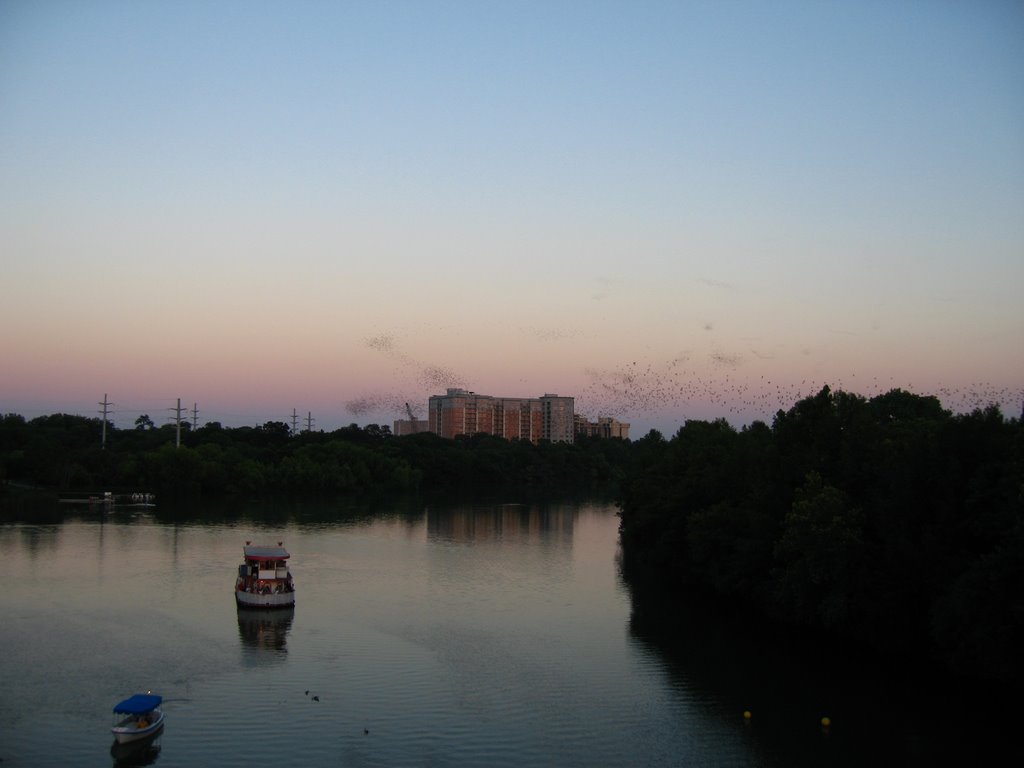
    At nightfall, the bats appear from the Congress Avenue Bridge. In the air, flying in schools, they seem frantic and twitchy, darting every which way. But individually they are all graceful arcs and quick turns, dives and swoops and long spirals. And fragile: they are Mexican free-tail bats, with bodies no longer than my index finger.

    The bats, I learn, aren't blind, which helps them navigate their close-quarters emergence. On Fridays and Saturdays nights in summer the area around the bridge is packed, hundreds of people in the parking lot of the Austin American-Statesman, above the lake, and in kayaks and paddleboats along the water. The best place to watch the bats emerge, according to the weekend tablers from Bat Conservation International, is atop the bridge. From there you can see the bats as they stream out over Town Lake, the reflected light left in the sky mirrored in the water below.
    The Austin colony is the largest urban colony in the country and, perhaps the world. (The world is a big place, and Texans like biggest.) Between 500,000 and 700,000 bats live in the expansion joints of the Congress Avenue Bridge, exclusively females and babies; a similarly sized colony of males lives nearby. They eat somewhere between 10,000 and 30,000 pounds of insects every night, depending on whose numbers you trust. In October the bats will migrate south for the winter, and the viewings will end, to resume in the spring of next year.

    Farther south is a colony of 20 to 40 million bats, and according to Bat Conservation International, the emergence is even more spectacular.

    The Austinites love the bats now—or the bulk of them, anyway—but it wasn't always so. In the mid-80s, when the bats moved in, the American-Statesman unilaterally declared a public health crisis, mostly because everyone knows that bats carry disease, drink blood, and are really blood-sucking vampires. In reality, of course, bats tend to inhibit the spread of disease by eating insects, but facts have rarely inhibited good yellow journalism.

    Today the colony is, well, an attraction. All the tourists I met had gone or were planning to go, and you can buy postcards of the bats at the convenience stores nearby. The American-Statesman has come around as well, and now provides free parking in the evenings for bat-watchers.

    Best of all, there's a bat statue at the corner of South Congress and Barton Springs Road. It may look more like the bat of the Batsignal than an actual living, flying bat, but still, it's easier to find—and more recognizable—than the statue of Stevie Ray Vaughan.


    Saturday, June 24, 2006

    Austin (I)

    Operation Keep You Safe

    Violent crime is on the increase in South Central Austin. The safety of the public is the Austin Police Department's number one priority. To keep individuals from being a victim of robbery or aggravated assault, we are launching Operation "Keep You Safe."

    The East Riverside area is home to a large concentration of bars establishments that sell alcoholic beverages. As a result, violent criminals have been drawn to the area to prey on intoxicated patrons after they leave these establishments.

    To combat violent crime, a zero tolerance approach for public intoxication for the East Riverside area will be taken by the APD. By arresting intoxicated individuals, APD hopes to significantly reduce the opportunity for violent crime.

    APD hopes that responsible drinkers will rely on moderate consumption of alcohol, designated drivers, or public transportation to arrive home safely. Information on outreach programs for substance or alcohol abuse problems can be found by calling the hotline number, (512) 472-HELP.

    Thursday, June 22, 2006

    Fredericksburg, Texas

    The most famous son of Fredericksburg, Texas is Chester W. Nimitz, the hero of the Pacific theater in World War II, and the United States' last 5-star admiral. The Pioneer Museum has a small display on Nimitz; Nimitz's house is now a museum; and Fredericksburg is home to the National Museum of the Pacific War.

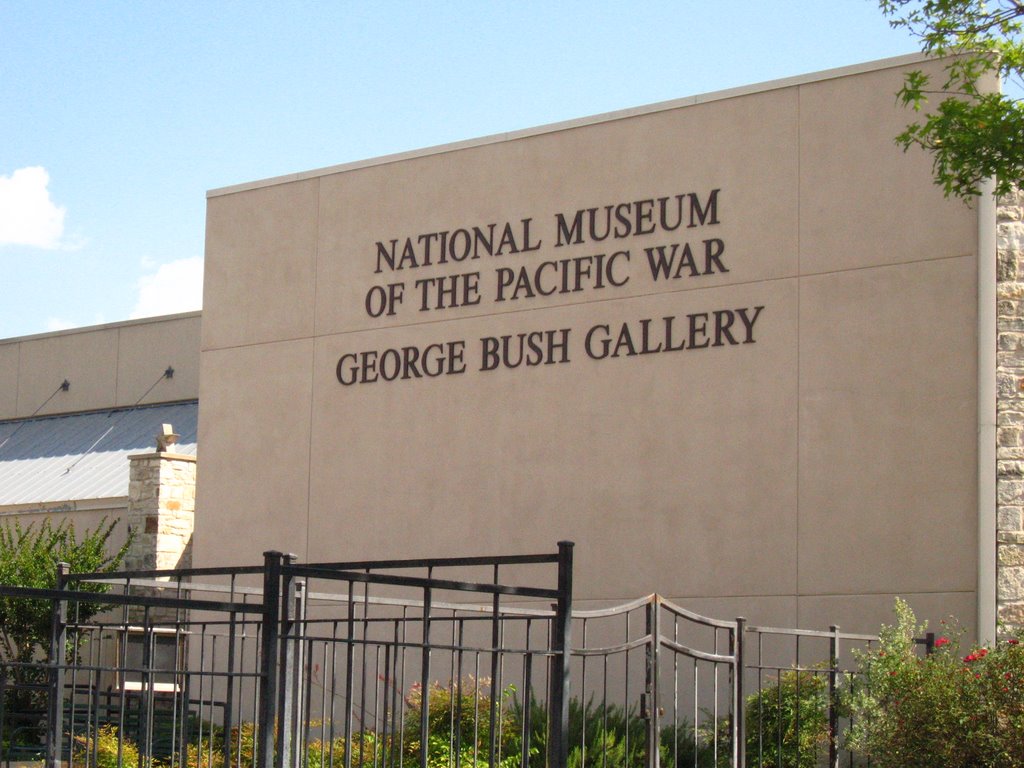
    But by signage alone, you'd never know the the Nimitz Foundation runs the museum. Indeed, you'd never know that the museum is about Nimitz at all, because everywhere in Fredericksburg the signs read

    National Museum of the Pacific War
    George Bush Gallery

    "Oh no, he's not from here," the woman in the Fredericksburg Visitor Center tells me of Bush. She's so earnest about telling me what a hero he was that I don't have the heart to point out that Fredericksburg already has a bigger, more important, and more interesting war hero of its own. When I ask the Museum security guard why there is so much emphasis on Bush, she brushes me off.

    The only place that actually reads Nimitz Museum is the museum gift shop, on Main Street. The "National Museum" is the entire collection and gardens; the museum itself is the Chester Nimitz museum.

    Or was, since it's now closed, and only the George Bush Gallery, and the gardens, are open.


    Wednesday, June 21, 2006

    San Antonio

    At the Alamo I forget where I am and ask one of the "Alamo Rangers"—essentially a glorified security guard—why he has a handgun. He's perplexed by the question. In California, a gun generally means you can arrest me or write me a ticket. Not in Texas. In Texas, a gun means you went to the store and bought one (or someone went out and bought one for you). Sitting outside the Alamo as it closes and all the visitors file out, I realize that a significant number of shoulder bags and bulging pockets carry machines made for effectively killing a person.

    Gun culture runs deep, and people here tend to glorify it. Texas celebrates its outlaws and extrajudicial heritage like no place I know of. Every museum has an exhibit on the lawmen and outlaws of the old west, and often there are exhibits on men with little or no connection to Texas, like Billy the Kid. In the Buckhorn Saloon and Museum, among the Texas history wax sculptures, are sculptures of tens of Texas killers, with labels that read:

    John Wesley Hardin
    Killed more than 40 men

    Billy the Kid
    aka Henry Antrim
    Killed 21 men

    California has an outlaw past as well, with bandits like Black Bart and Joaquin Murrieta, but we tend not to celebrate it. The outlaws are a sidebar in the 4th grade history book; they are not glorious reminders of the good old days, and they are not, even Murrieta, heroes.

    Inside the walls of the Alamo, I am struck by how pointless the whole battle of the Alamo was. While San Antonio de Bexar was certainly a strategic location, and the Texian rebels were going to engage Santa Anna at some point, the siege and battle at the Alamo didn't serve any strategic purpose. There were about 200 Texians at the Alamo; Santa Anna had 6,000 Mexicans. Instead, the Alamo defenders—called "heroes" everywhere at the site—died at the Alamo for no reason except their own stubbornness, a stubbornness to prove themselves, to prove that they were men unafraid of death, a stubbornness that shows to what extent they value a life, any life, including their own.


    Tuesday, June 20, 2006

    Ozona, Texas (I)

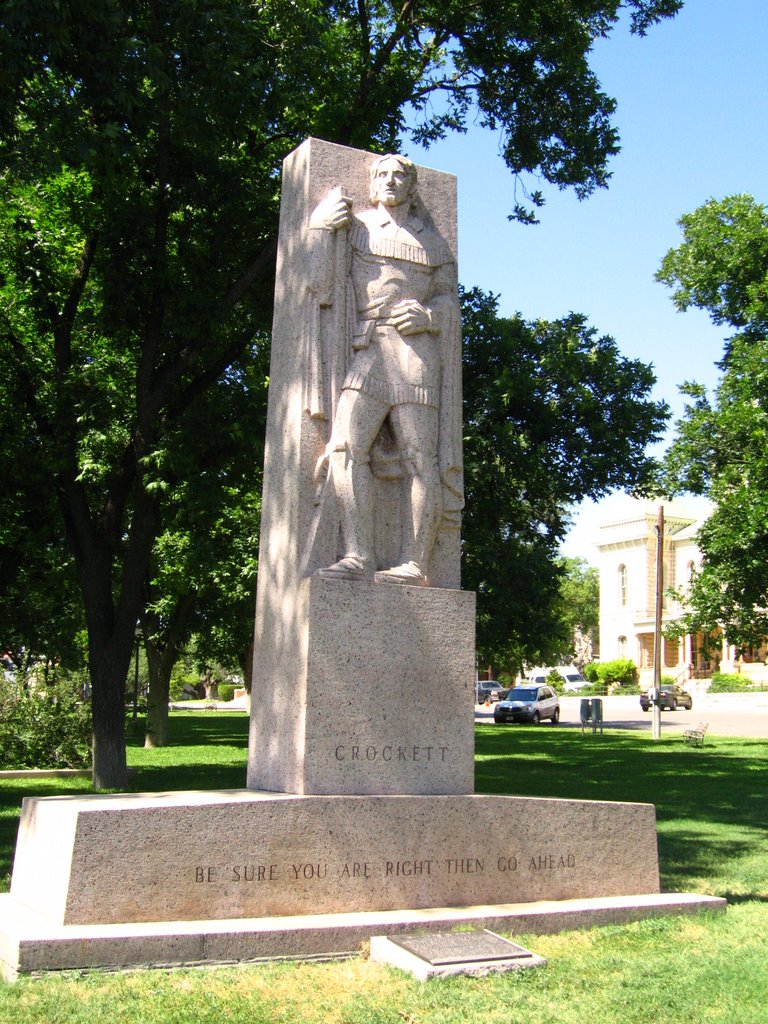
    Roberta, the woman who runs the Crockett County Museum, is a very patient person, judging from my plethora of questions regarding Davy Crockett, former Senator from Tennessee and King of the Wild Frontiertm, who is not even in the Crockett County Museum. This is because Davy Crockett had nothing to do with Crockett County.

    —Maybe he camped here once.

    —Not as far as we know.
    —Nothing?

    —No connection whatsoever.
    However, Roberta tells me, the Davy Crockett Memorial across the street does have an interesting story. The statue was originally commissioned by the town of Crockett, near Nacogdoches and 400 miles from Ozona and Crockett County. Unfortunately when the artist delivered the statue, Crockett, it turned out, didn't have the money to pay him.

    It's not a bad work, and so the fathers of Ozona offered a better-than-nothing price. Being better than nothing, the artist accepted, and soon Ozona became the proud home of a brown highway sign and a Davy Crockett Monument.

    Ozona, Texas (II)

    Fort Lancaster

    by Alex Herring

    Because there was no protection on the road from Texas to California, it was easy for natives to attack the travelers. To solve this problem camp Lancaster was upgraded to Fort Lancaster in 1856. Fort Lancaster was located in the western part of Texas right below Live Oak Creek. Not many soldiers were stationed there until 1857. 1857 was when Fort Lancaster was really busy because there were many battles there. By the time it was 1860 things weren't looking so good at Fort Lancaster and by the time of the Civil war, the fort was abandoned. Today you can see the fort in ruins.

    Monday, June 19, 2006

    Fort Stockton, Texas

    A

    s I walk across East Dickenson to the Mi Casita restaurant—which I have chosen because its parking lot has pickup trucks blocking in other pickup trucks, next to still more pickup trucks—a junk dealer looks up at me from his plastic lawn chair. He doesn't look happy to see me. He's missing a tooth, and his "shop" is a rolling door with an unsorted blob of used consumer items oozing out.

    "What happened to your car?" he sneers.

    Inside the restaurant, I wait in the "foyer" between the inner and outer doors, until there are no more regulars left to sit. The head waitress is back from Odessa, where she goes to college, and lots of "Where ya been?"s echo across the dining room. She knows most everyone by name. Periodically, the other waitress brings a small paper cup of rainbow sherbet, for free, to patrons who look like they've finished.

    The Mi Casita menu lists both dishes and their ingredients, and the chile relleno is one of the two dishes without meat. It comes reasonably quickly; and when it does, next to the spot of rice and the spot of beans is a pyramid of ground beef. The chile is underneath.

    I scrape the meat away, eat, and tell the waitress that everything is really excellent.

    Sunday, June 18, 2006

    Big Bend National Park


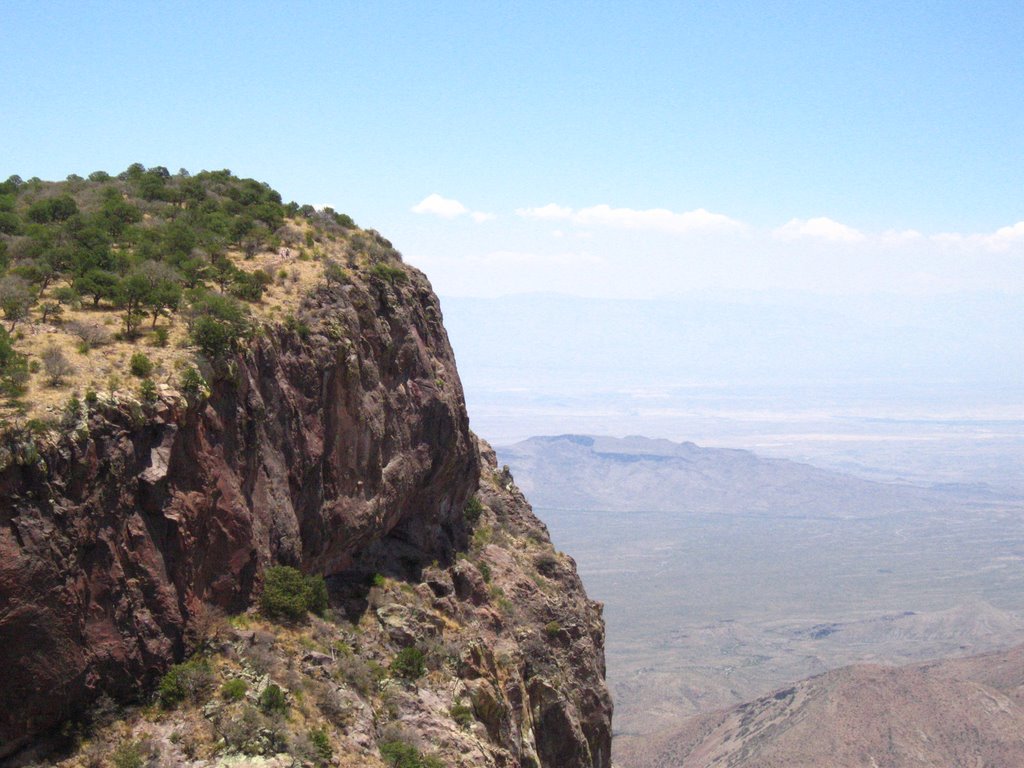
    (For scale, look at the picture above the picture of me very closely. There are two tiny people on the cliff.)