Friday, June 30, 2006

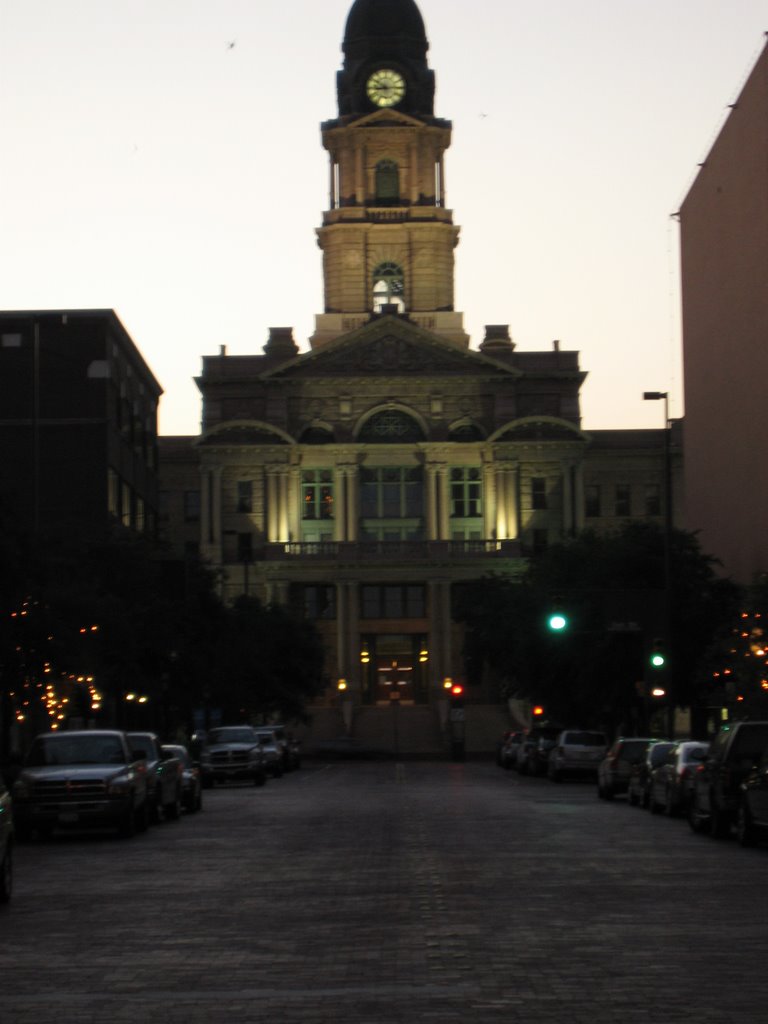
Fort Worth

"All these people, they're all downtowners," Mike says. Mike is a big, mestizo-looking guy, so big, in fact, that people mistake him for "Hawaiian" when he leaves Texas. I think he may mean Samoan by this, but I don't press the issue. When I ask what he does for a living, I think he says "horse breaker," but it's too loud to be sure and I don't press it.

We are at a cowboy bar in downtown Fort Worth, as much as you can have a cowboy bar in downtown Fort Worth. Mike the Horse Breaker may not like the crowd much, but he's in their territory, not the other way around. Most everyone is drinking Coors or Coors Light even though Shiner Bock is much better, the same price and made in Texas.

It is here, after Mike leaves, that I first encounter Twang among the Lawman jeans and autographed cowboy hats. Twang comes wrapped like a tiny present in square wax-paper packets, which you open and dump in your mouth, then gargle with beer. It looks, to the uninitiated, like the adult version of Pixie Stix.

In Fort Worth, all the urban cowboys use Twang somewhat surreptitiously, hiding the packets in the palms of their hands. I text message my friend Sasha in San Francisco, who's far cooler and more worldly than I am, to ask what this crazy cowboy drug is. The way you use it is so weird, I think. Sasha doesn't know, so I am even more perplexed.

And it's not until I get to Houston that I learn that Twang is just beer salts. It's a part of life so not-worth-mentioning that everyone I ask thinks I'm trying to describe something much more esoteric and obscure. Twang becomes, then, an anti-climax.

I like this story, but I can't tell it often. It doesn't play very well or, perhaps, just not in the way I like it to. I only repeat it to fellow outsiders, because somehow, in the South, it becomes a story about my ignorance, rather than the space between places.

Dallas

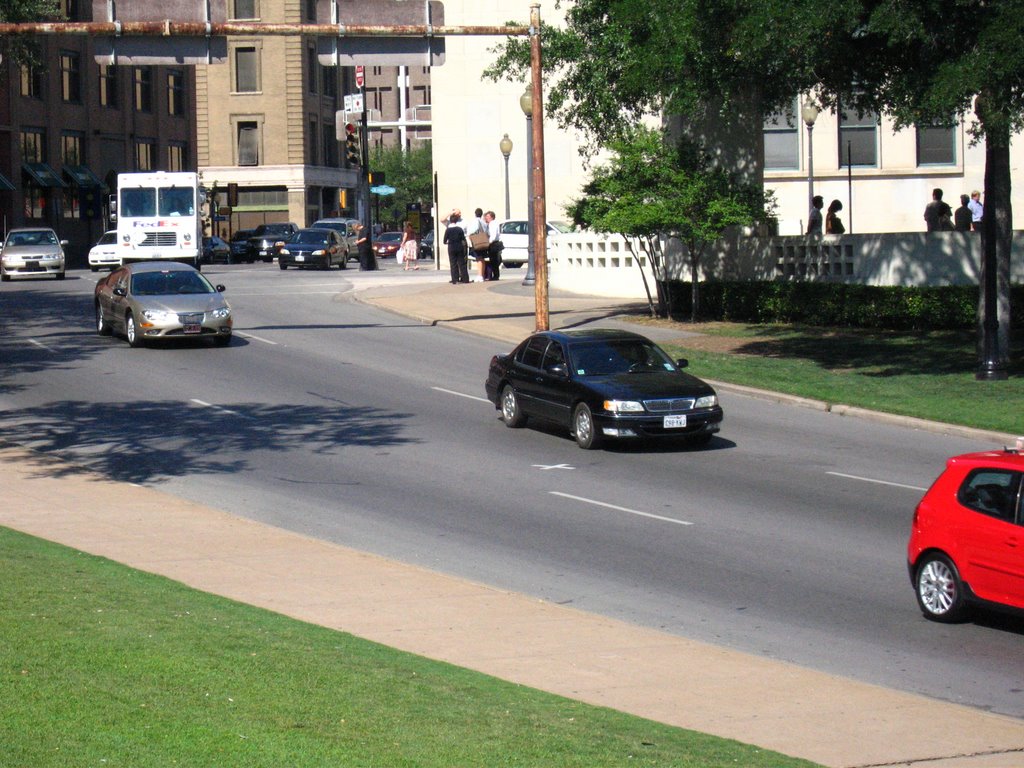
You can't see the same line of sight down Elm Street today as Lee Harvey Oswald saw 43 years ago. For one thing, the trees have begun to overgrow the road—not completely, as all three lanes are still visible in part, but enough that imagining the motorcade from up on the 6th Floor Museum is difficult.

Oswald's spot is at the corner of the building, which has been recreated behind sheets of Plexiglas with period-correct boxes. The rest of the museum tells the story of John F. Kennedy and of his assassination. One of the difficulties for the curators of the 6th Floor Museum is that no one knows exactly how those boxes were arranged, as the police photo-ops after the assassination all showed the boxes in different configurations. This provides even more fodder for the conspracists who stand on the street below, newspaper clips at the ready, ready to charge you to hear their theories.

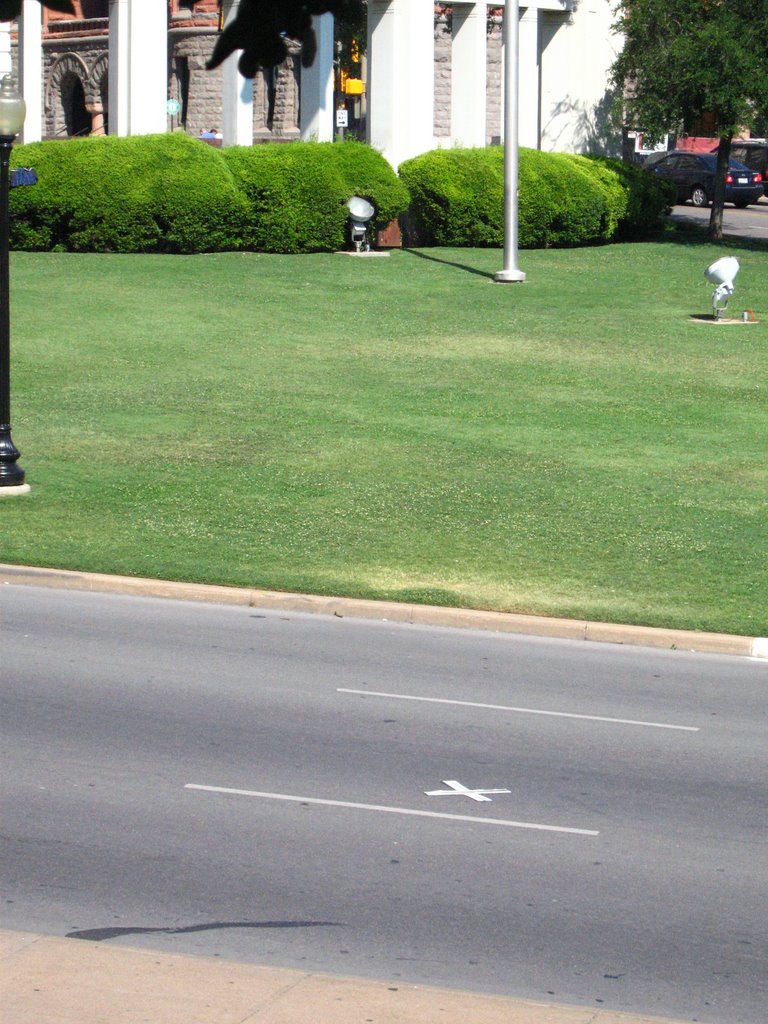
On the street itself, in the second lane, are two white Xs. These are the two spots where Kennedy was shot, though everyone is quick to point out that they are "approximate." I suppose this means that the actual location might be a foot or two in either direction, which is close enough for me.

I spend a lot of time in the shade of the WPA shelter on the grassy knoll, watching the traffic pass. Something unusual happens when cars reach those Xs: they move out of the way. Of every hundred cars, maybe five treat Elm like any other road and move straight over the assassination spot. Most merge into other lanes for a moment; some skirt the edge of the middle lane, tires on one dashed line.

Whether this is respect for the dead or driver's instinct, I can't say.


Thursday, June 29, 2006

Glen Rose, Texas

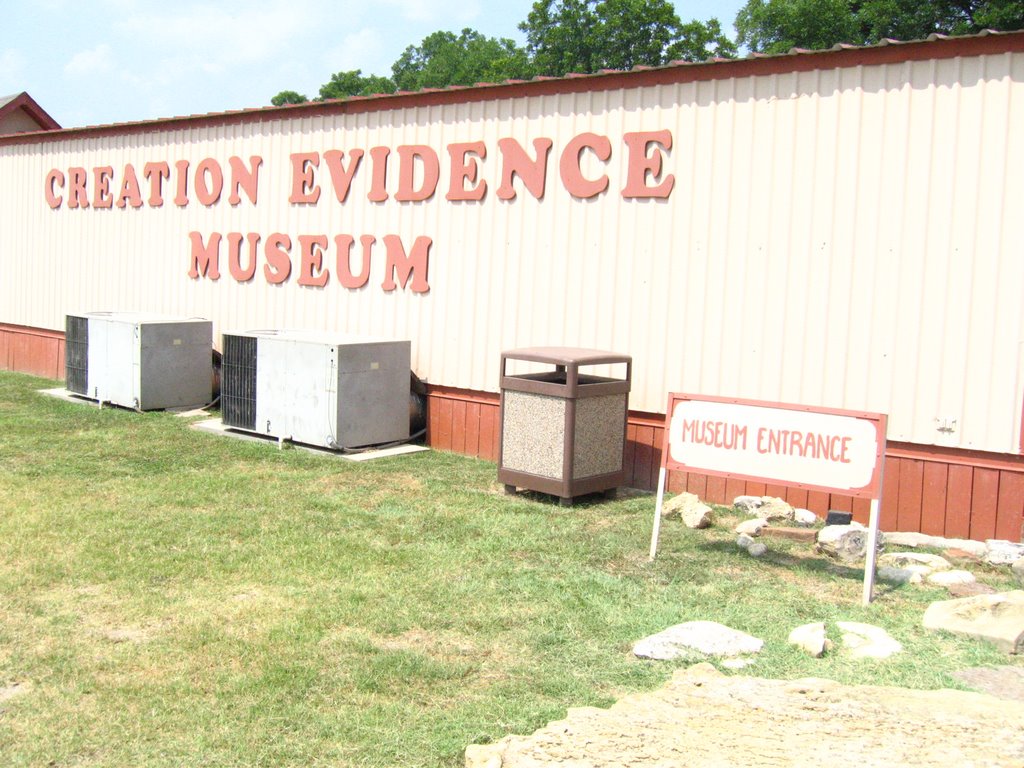
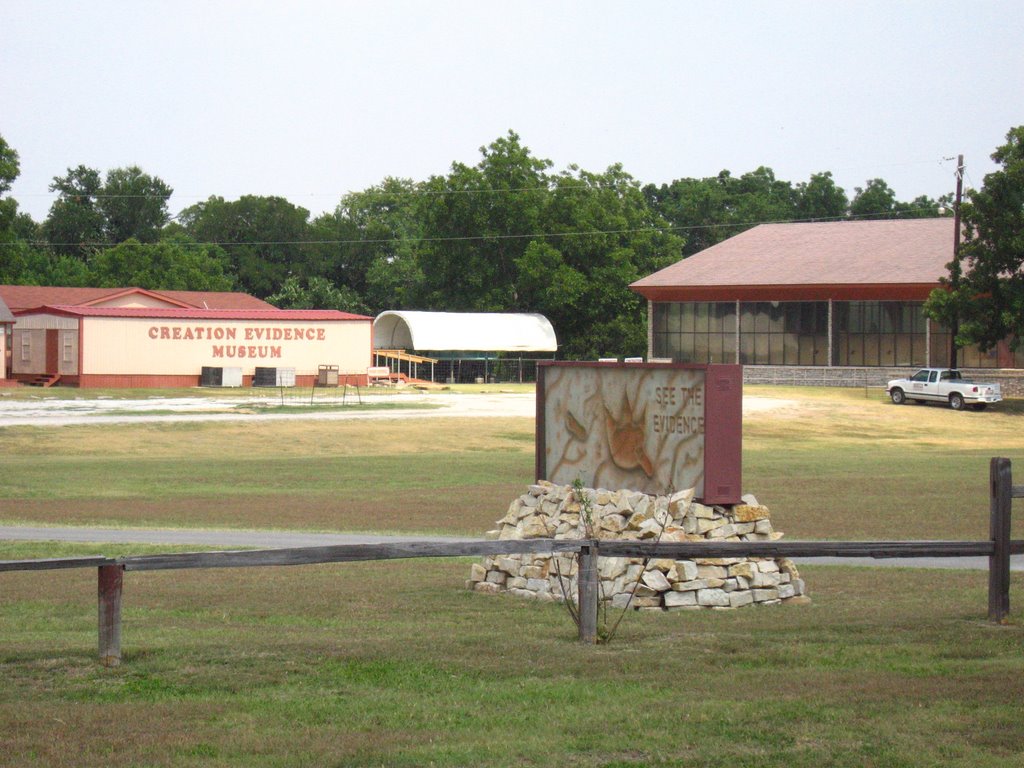
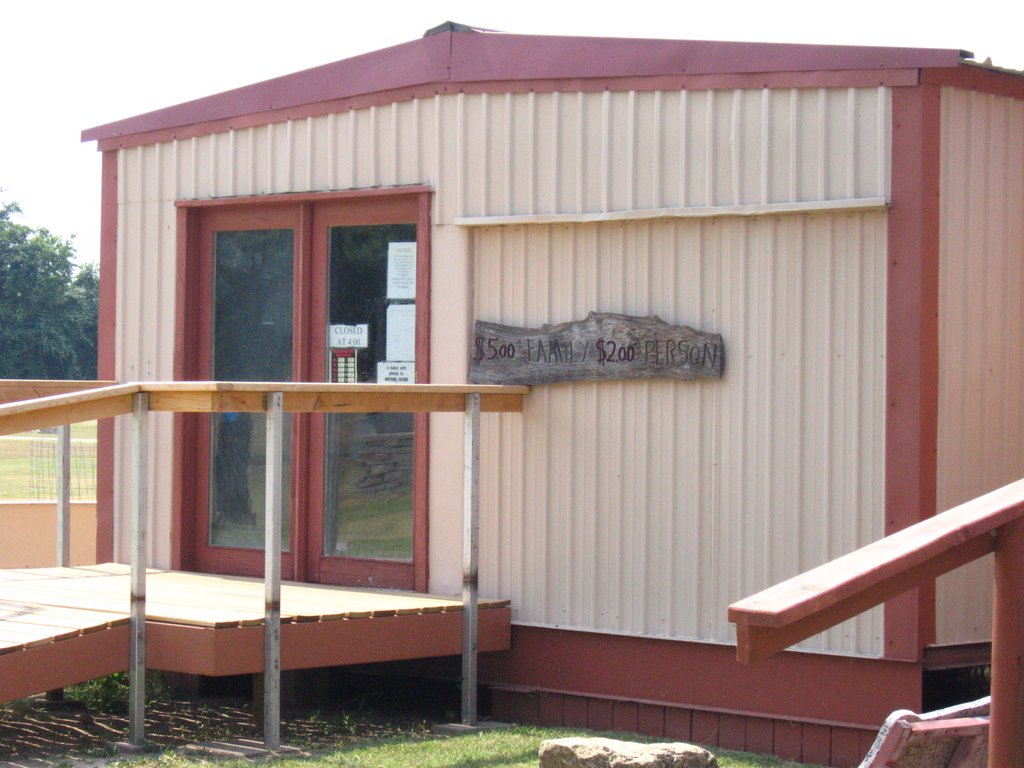
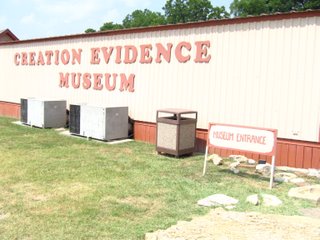
You should plan to arrive at the Creation Evidence Museum on the hour, because that's when the tour begins. Actually, "tour" would be more accurate, since at the Creation Evidence Museum the word refers not to a physical journey that involves a series of stops and ends at the starting point, but an explanatory video in a single-room trailer home. The narrator of the video is Carl Baugh, founder of the CEM, doctorate in a field that varies from time to time, and tireless researcher of research that only he understands.

When you get to the museum, you will most likely have your choice of seats, as things haven't been too busy lately. The future looks bright, however, and the construction of the building next door should continue soon. This new building, the permanent home of the Creation Evidence Museum, will contain the world's largest hyperbaric biosphere, since everyone knows that the prediluvian world had an atmospheric pressure much greater than ours today, and that the crystalline matrix that separated the waters of the earth from the waters of heaven—as described in the Book of Genesis—filtered out all wavelengths of light except for magenta. It was this matrix that God punctured (here Baugh gestures with his finger, as if popping a bubble) to cause the world to flood, and bringing us to our modern day.

Baugh comes off like a slight creepy Mr. Wizard. He's avuncular and didactic, but from his tone of voice it is clear that you have to accept that he's right without question or investigation. He only appears at the museum in public on the first Saturday of every month, to give a lecture on recent developments in creation science and occasionally lecture on the Museum's work, such as sending missionaries to Papua New Guinea, where they observed pterodactyls.

But the museum has put out a good number of staff publications, available for purchase at the museum. These address questions such as "an DNA matching prove that man did or did not come from primates?" and "Why did God create spiders & vicious animals?" One such publication, authored by David V. Bassett, M.S., CEM Staff Writer, ends

I do not hear many calls coming from the people talking about global warming to bulldoze the rain forests. If they really believe in global warming, the rain forests, the rotting wood and the insects in those rain forests are the worst contributors.
If you read Baugh's dissertation—which is either about education and teaching creationism in schools, or about archeological evidence that dinosaurs and man were contemporaries—long enough, you'll come to a section entitled "Darwin's Phobias," in which Baugh psychoanalzes Charles Darwin. He concludes

It is, then, the conclusion of this author that Darwin experienced unithanatophobia (defined as: an obsession with universal death) and anisotrophobia (defined as: fear of designed structure in nature culminating in man).

I don't have a dictionary of psychology at hand, but it is worth noting that neither unithanatophobia or anisotrophobia are in the Merriam-Webster dictionary, and that Google, Yahoo, and MSN Search turn up exactly one usage: Baugh's dissertation.
It's fairly easy to discover that Baugh's credentials are questionable at best. He claims his (first, current) doctorate in education from the Pacific College of Graduate Studies, which does not have a website and is likely a diploma mill. He previously claimed a degree in anthropology from the College of Advanced Education in Irving, Texas, which does not exist. His most recent doctorate is from the Louisiana Baptist University (née Baptist Christian University), an unaccredited correspondence school in Shreveport.

But if you show up late on a sticky weekday afternoon, you don't know that. The room is air-conditioned and dark, and it contains unlabeled exhibits behind glass cases and Baugh's first hyperbaric chamber, magenta gels over its windows. On tape, Baugh is charismatic and seems to speak the language of science, countering counter-arguments, explaining the mural along one wall, inviting you to understand the truth about the world.

Ten minutes after the movie stops it begins again.
Wednesday, June 28, 2006

Waco, Texas

On the second floor of the Dr Pepper Museum and "Foots" Clements Free Enterprise Institute, is an exhibit about Dr Pepper's contribution to the war effort. This contribution, near as I can tell, consisted of selling soda to the army and lobbying Congress (successfully) to declare Dr Pepper vital to the war effort and therefore exempt from sugar rationing.

The museum has the dual charge of commemorating original formula (ie, non corn-syrupy) Dr Pepper and promoting libertarianism among school children. The museum's mission is

to educate and entertain the general public through the collection, preservation, interpretation, and exhibition of objects relevant to the history of the soft drink industry, and through that example, the free enterprise economic system.

This plays well in Waco, apparently, as the museum is a popular place for school tours. Like pretty much everything associated with the museum, as a child I would have been ecstatic to come, but now the whole thing makes me leery. It's one big paean to the Dr Pepper-7-Up-Cadbury Schweppes Company, and doesn't seem particularly educational. There are televisions with repeating loops of Dr Pepper commercials. But what most encapsulates this is the museum's summer camp, for kids aged 8 to 13, where they can learn the ancient art of soda jerking, create a soda, and generally eat sugar and business all day. All the cool kids are there, though, I'm sure.

Up on the third floor is the WW "Foots" Clements Free Enterprise Institute and, for me, the main event, the BeverageWorld Soft Drink Hall of Fame. Think of it: little shrines to each aluminum can, a short history of the drink, perhaps all of this on a bronze plaque, like Cooperstown. Would RC Cola make the cut? What about Dr. Brown's Cel-Ray? Or Crush?

I have set myself up for disappointment. The Hall of Fame is for soft drink executives, and has small brass plaques that read

Harry E. Korab
Society of Soft Drinks
Technologists and
Operational Persons
Inducted in 1990

James B. "Bud" Lindsey, Sr.
Pepsi-Cola
Bottling Company
Bakersfield, California
Inducted in 1988

Myron E. Weil
Royal Crown Cola
Bottling Company, Inc.
Inducted in 1990

Kenneth E Kingsley
Alpac Corporation
National Soft Drink Association
Inducted in 1983

and so on, with colored pencil pictures of the executives beside them. It is, perhaps the worst Hall of Fame I have ever been to. There are no stories, nothing of interest, really, unless you are one of the inductees. Even then, I can't imagine that you'd make a trip to Waco to show, well, anyone.

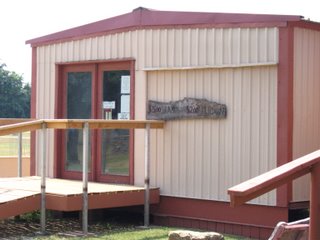
The letters of the entrance sign aren't even applied straight.

Tuesday, June 27, 2006

Austin (III)

The other thing to do in Austin—other than a promenade along 6th Street—is a visit to Barton Springs. Barton Springs is a swimming hole, not far from the center of Austin and recommended by, well, everyone. The water is 68 degrees Fahrenheit year-round, and while the Austinites tell say that that's cold, you have to realize they live in a place where it's normal for the temperature to be 85 degrees and humid at 2:30 am.

The 900 foot long pool costs $3, but cheapskates and fellow travelers can swim for free in the rapids or the stream just past it (and in front of unenforced "no swimming" stencils). The pool was actually closed for three months in 2003, after the Austin American-Statesman reported high levels of arsenic and benzene in the water, but government scientists found no true hazards.

Still, the city closes the pool on Thursdays for cleaning, which makes Fridays the best day to go. That is, unless you visit downstream, which is where they push the algae.

Jocelyn—my friend-for-a-day in Austin—and I both agree that the water in Austin tastes funny.

"It's like the water's moldy," Jocelyn says, and she's right.

"It's like the water gets moldy from the heat," I say.

"Maybe," Jocelyn says.

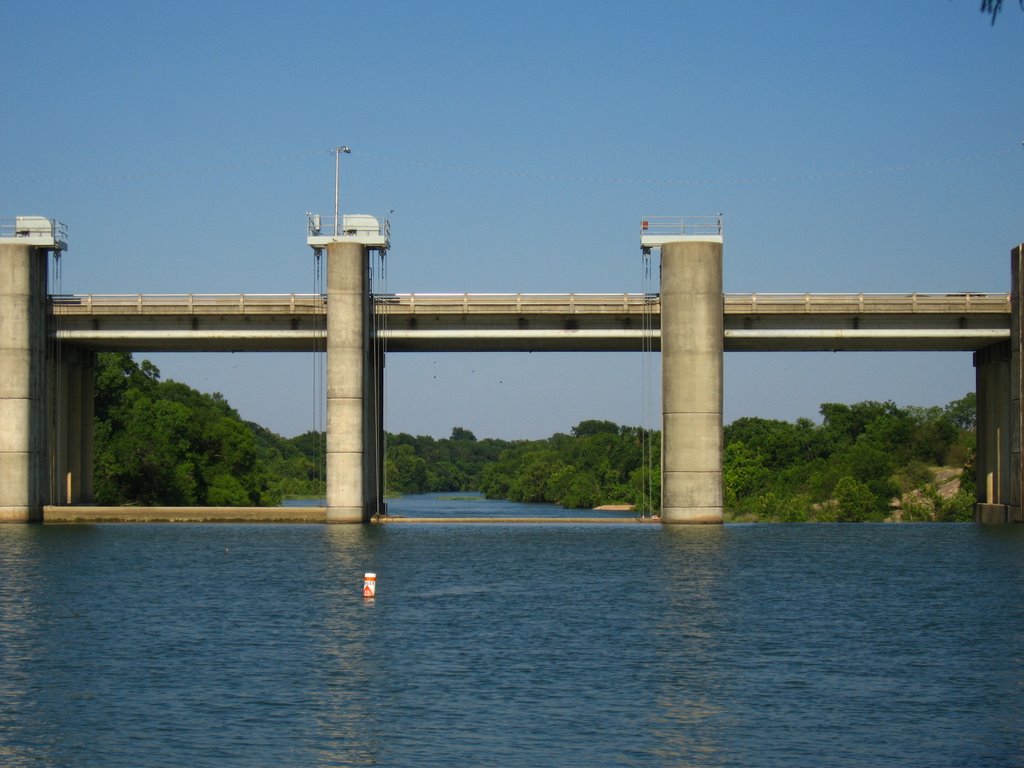
The Colorado River runs through Austin, which doesn't make any sense. The Colorado has its mouth in the Gulf of California. The Rio Grande outlets into the Gulf of Mexico. So, we outlanders ask, do the Colorado and the Rio Grande cross? How is it possible that the Colorado is here?

Just as Nashville has a second Parthenon, Austin has a second Colorado River. It flows for 600 miles from Lamesa, Texas (more or less) to the Gulf of Mexico, and is the longest river solely in Texas. No canyons, grand or otherwise, though I suspect that this Colorado River always reaches the sea.

Monday, June 26, 2006

Austin (II)

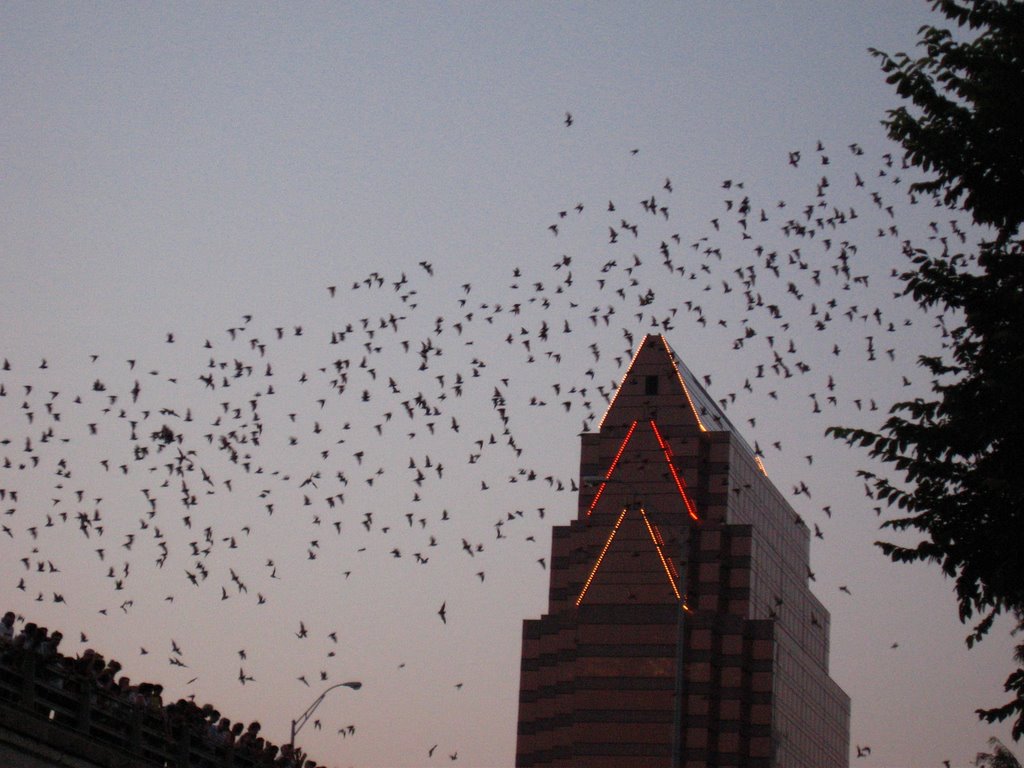
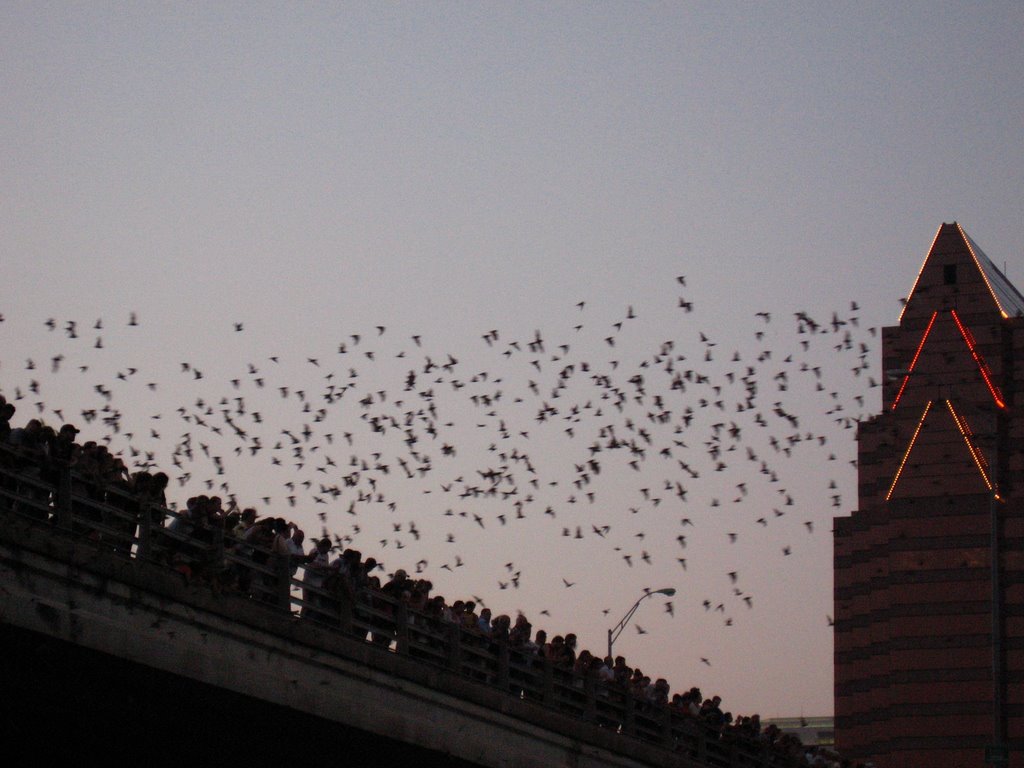
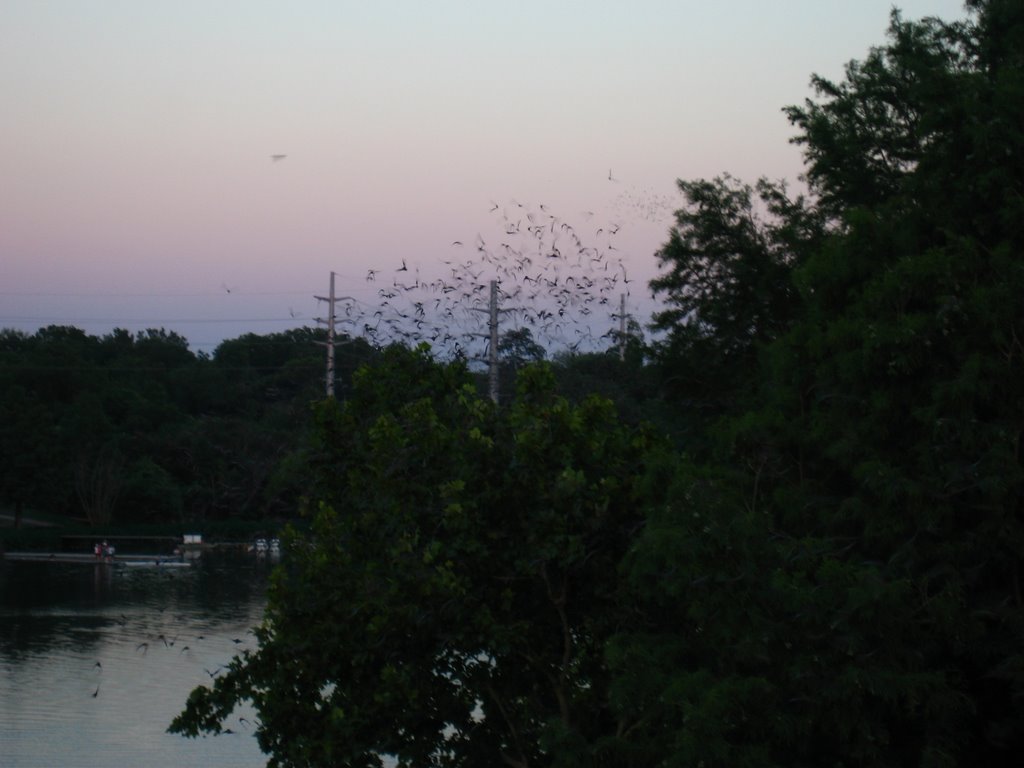
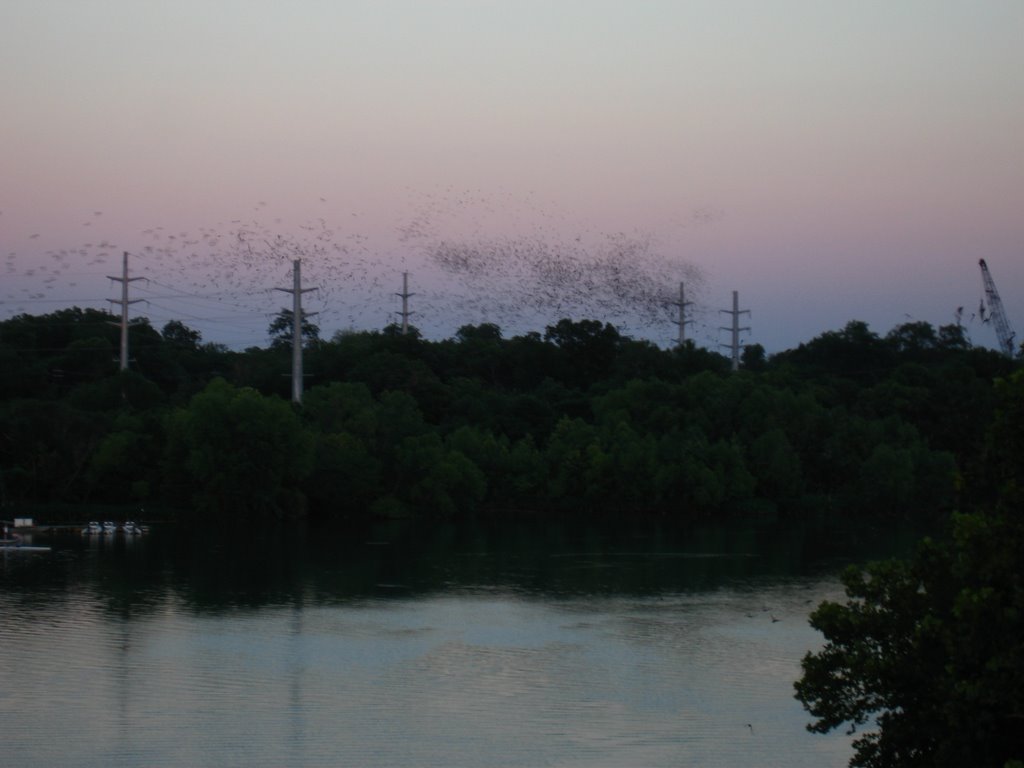
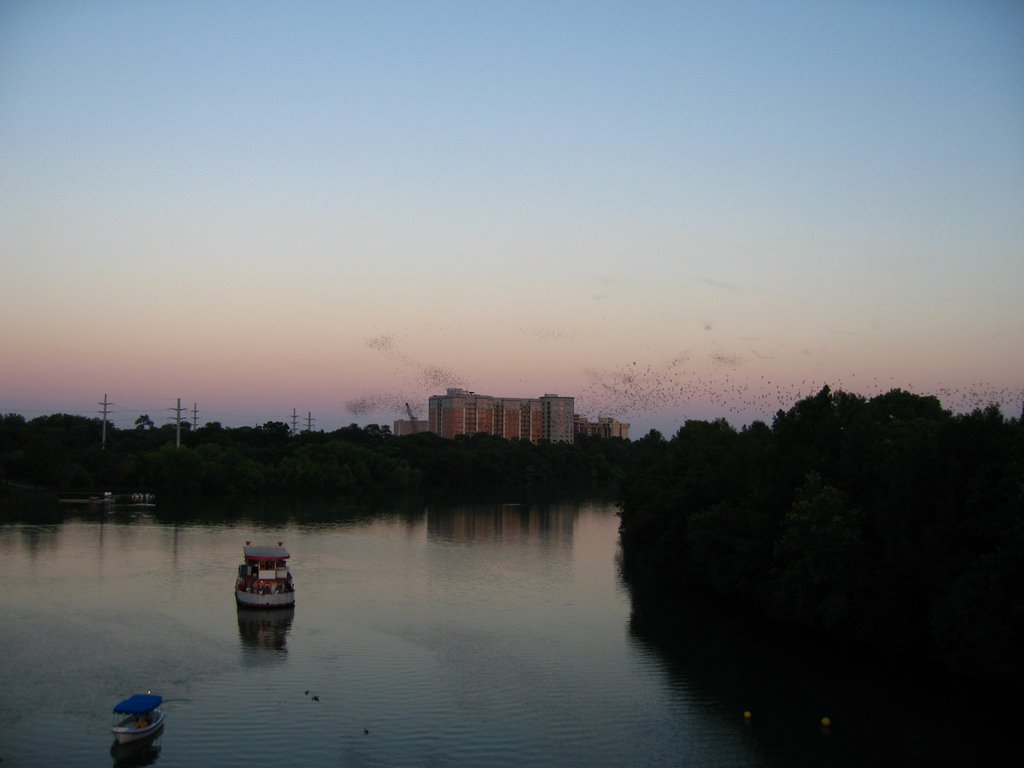
At nightfall, the bats appear from the Congress Avenue Bridge. In the air, flying in schools, they seem frantic and twitchy, darting every which way. But individually they are all graceful arcs and quick turns, dives and swoops and long spirals. And fragile: they are Mexican free-tail bats, with bodies no longer than my index finger.

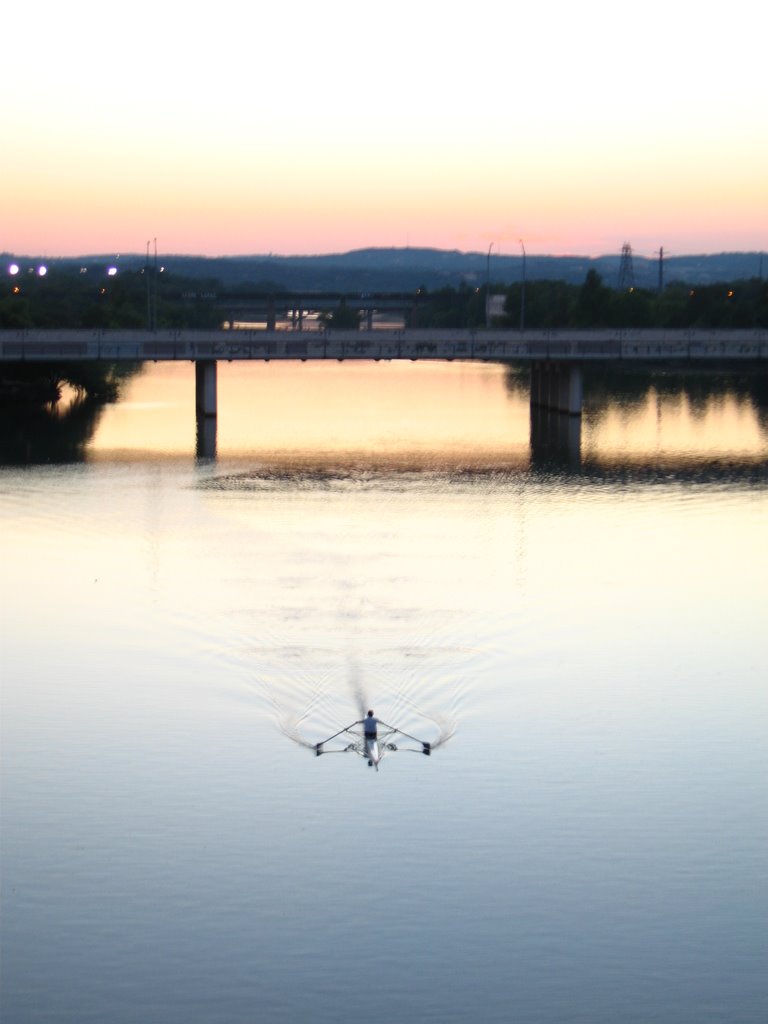
The bats, I learn, aren't blind, which helps them navigate their close-quarters emergence. On Fridays and Saturdays nights in summer the area around the bridge is packed, hundreds of people in the parking lot of the Austin American-Statesman, above the lake, and in kayaks and paddleboats along the water. The best place to watch the bats emerge, according to the weekend tablers from Bat Conservation International, is atop the bridge. From there you can see the bats as they stream out over Town Lake, the reflected light left in the sky mirrored in the water below.

The Austin colony is the largest urban colony in the country and, perhaps the world. (The world is a big place, and Texans like biggest.) Between 500,000 and 700,000 bats live in the expansion joints of the Congress Avenue Bridge, exclusively females and babies; a similarly sized colony of males lives nearby. They eat somewhere between 10,000 and 30,000 pounds of insects every night, depending on whose numbers you trust. In October the bats will migrate south for the winter, and the viewings will end, to resume in the spring of next year.

Farther south is a colony of 20 to 40 million bats, and according to Bat Conservation International, the emergence is even more spectacular.

The Austinites love the bats now—or the bulk of them, anyway—but it wasn't always so. In the mid-80s, when the bats moved in, the American-Statesman unilaterally declared a public health crisis, mostly because everyone knows that bats carry disease, drink blood, and are really blood-sucking vampires. In reality, of course, bats tend to inhibit the spread of disease by eating insects, but facts have rarely inhibited good yellow journalism.

Today the colony is, well, an attraction. All the tourists I met had gone or were planning to go, and you can buy postcards of the bats at the convenience stores nearby. The American-Statesman has come around as well, and now provides free parking in the evenings for bat-watchers.

Best of all, there's a bat statue at the corner of South Congress and Barton Springs Road. It may look more like the bat of the Batsignal than an actual living, flying bat, but still, it's easier to find—and more recognizable—than the statue of Stevie Ray Vaughan.


Saturday, June 24, 2006

Austin (I)

Operation Keep You Safe

Violent crime is on the increase in South Central Austin. The safety of the public is the Austin Police Department's number one priority. To keep individuals from being a victim of robbery or aggravated assault, we are launching Operation "Keep You Safe."
The East Riverside area is home to a large concentration of bars establishments that sell alcoholic beverages. As a result, violent criminals have been drawn to the area to prey on intoxicated patrons after they leave these establishments.

To combat violent crime, a zero tolerance approach for public intoxication for the East Riverside area will be taken by the APD. By arresting intoxicated individuals, APD hopes to significantly reduce the opportunity for violent crime.

APD hopes that responsible drinkers will rely on moderate consumption of alcohol, designated drivers, or public transportation to arrive home safely. Information on outreach programs for substance or alcohol abuse problems can be found by calling the hotline number, (512) 472-HELP.

Thursday, June 22, 2006

Fredericksburg, Texas

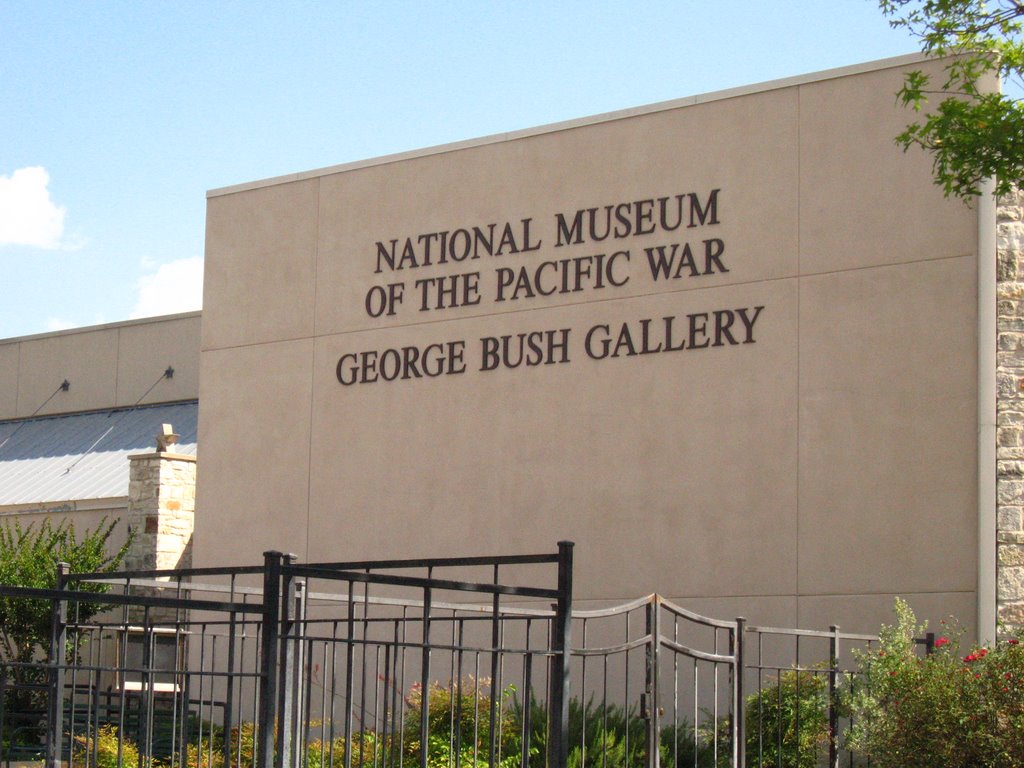
The most famous son of Fredericksburg, Texas is Chester W. Nimitz, the hero of the Pacific theater in World War II, and the United States' last 5-star admiral. The Pioneer Museum has a small display on Nimitz; Nimitz's house is now a museum; and Fredericksburg is home to the National Museum of the Pacific War.

But by signage alone, you'd never know the the Nimitz Foundation runs the museum. Indeed, you'd never know that the museum is about Nimitz at all, because everywhere in Fredericksburg the signs read

National Museum of the Pacific War
George Bush Gallery

"Oh no, he's not from here," the woman in the Fredericksburg Visitor Center tells me of Bush. She's so earnest about telling me what a hero he was that I don't have the heart to point out that Fredericksburg already has a bigger, more important, and more interesting war hero of its own. When I ask the Museum security guard why there is so much emphasis on Bush, she brushes me off.

The only place that actually reads Nimitz Museum is the museum gift shop, on Main Street. The "National Museum" is the entire collection and gardens; the museum itself is the Chester Nimitz museum.

Or was, since it's now closed, and only the George Bush Gallery, and the gardens, are open.


Wednesday, June 21, 2006

San Antonio

At the Alamo I forget where I am and ask one of the "Alamo Rangers"—essentially a glorified security guard—why he has a handgun. He's perplexed by the question. In California, a gun generally means you can arrest me or write me a ticket. Not in Texas. In Texas, a gun means you went to the store and bought one (or someone went out and bought one for you). Sitting outside the Alamo as it closes and all the visitors file out, I realize that a significant number of shoulder bags and bulging pockets carry machines made for effectively killing a person.

Gun culture runs deep, and people here tend to glorify it. Texas celebrates its outlaws and extrajudicial heritage like no place I know of. Every museum has an exhibit on the lawmen and outlaws of the old west, and often there are exhibits on men with little or no connection to Texas, like Billy the Kid. In the Buckhorn Saloon and Museum, among the Texas history wax sculptures, are sculptures of tens of Texas killers, with labels that read:

John Wesley Hardin
Killed more than 40 men

Billy the Kid
aka Henry Antrim
Killed 21 men

California has an outlaw past as well, with bandits like Black Bart and Joaquin Murrieta, but we tend not to celebrate it. The outlaws are a sidebar in the 4th grade history book; they are not glorious reminders of the good old days, and they are not, even Murrieta, heroes.

Inside the walls of the Alamo, I am struck by how pointless the whole battle of the Alamo was. While San Antonio de Bexar was certainly a strategic location, and the Texian rebels were going to engage Santa Anna at some point, the siege and battle at the Alamo didn't serve any strategic purpose. There were about 200 Texians at the Alamo; Santa Anna had 6,000 Mexicans. Instead, the Alamo defenders—called "heroes" everywhere at the site—died at the Alamo for no reason except their own stubbornness, a stubbornness to prove themselves, to prove that they were men unafraid of death, a stubbornness that shows to what extent they value a life, any life, including their own.


Tuesday, June 20, 2006

Ozona, Texas (I)

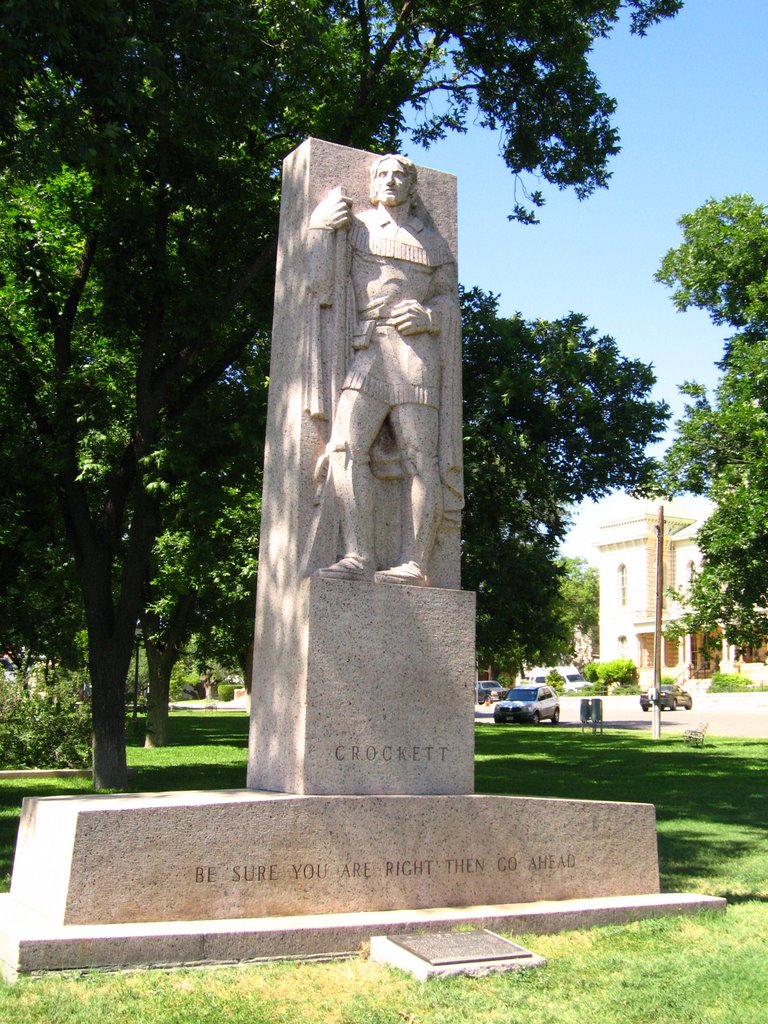
Roberta, the woman who runs the Crockett County Museum, is a very patient person, judging from my plethora of questions regarding Davy Crockett, former Senator from Tennessee and King of the Wild Frontiertm, who is not even in the Crockett County Museum. This is because Davy Crockett had nothing to do with Crockett County.

—Maybe he camped here once.

—Not as far as we know.

—Nothing?

—No connection whatsoever.

However, Roberta tells me, the Davy Crockett Memorial across the street does have an interesting story. The statue was originally commissioned by the town of Crockett, near Nacogdoches and 400 miles from Ozona and Crockett County. Unfortunately when the artist delivered the statue, Crockett, it turned out, didn't have the money to pay him.

It's not a bad work, and so the fathers of Ozona offered a better-than-nothing price. Being better than nothing, the artist accepted, and soon Ozona became the proud home of a brown highway sign and a Davy Crockett Monument.

Ozona, Texas (II)

Fort Lancaster

by Alex Herring

Because there was no protection on the road from Texas to California, it was easy for natives to attack the travelers. To solve this problem camp Lancaster was upgraded to Fort Lancaster in 1856. Fort Lancaster was located in the western part of Texas right below Live Oak Creek. Not many soldiers were stationed there until 1857. 1857 was when Fort Lancaster was really busy because there were many battles there. By the time it was 1860 things weren't looking so good at Fort Lancaster and by the time of the Civil war, the fort was abandoned. Today you can see the fort in ruins.

Monday, June 19, 2006

Fort Stockton, Texas

A

s I walk across East Dickenson to the Mi Casita restaurant—which I have chosen because its parking lot has pickup trucks blocking in other pickup trucks, next to still more pickup trucks—a junk dealer looks up at me from his plastic lawn chair. He doesn't look happy to see me. He's missing a tooth, and his "shop" is a rolling door with an unsorted blob of used consumer items oozing out.

"What happened to your car?" he sneers.

Inside the restaurant, I wait in the "foyer" between the inner and outer doors, until there are no more regulars left to sit. The head waitress is back from Odessa, where she goes to college, and lots of "Where ya been?"s echo across the dining room. She knows most everyone by name. Periodically, the other waitress brings a small paper cup of rainbow sherbet, for free, to patrons who look like they've finished.

The Mi Casita menu lists both dishes and their ingredients, and the chile relleno is one of the two dishes without meat. It comes reasonably quickly; and when it does, next to the spot of rice and the spot of beans is a pyramid of ground beef. The chile is underneath.

I scrape the meat away, eat, and tell the waitress that everything is really excellent.

Sunday, June 18, 2006

Big Bend National Park


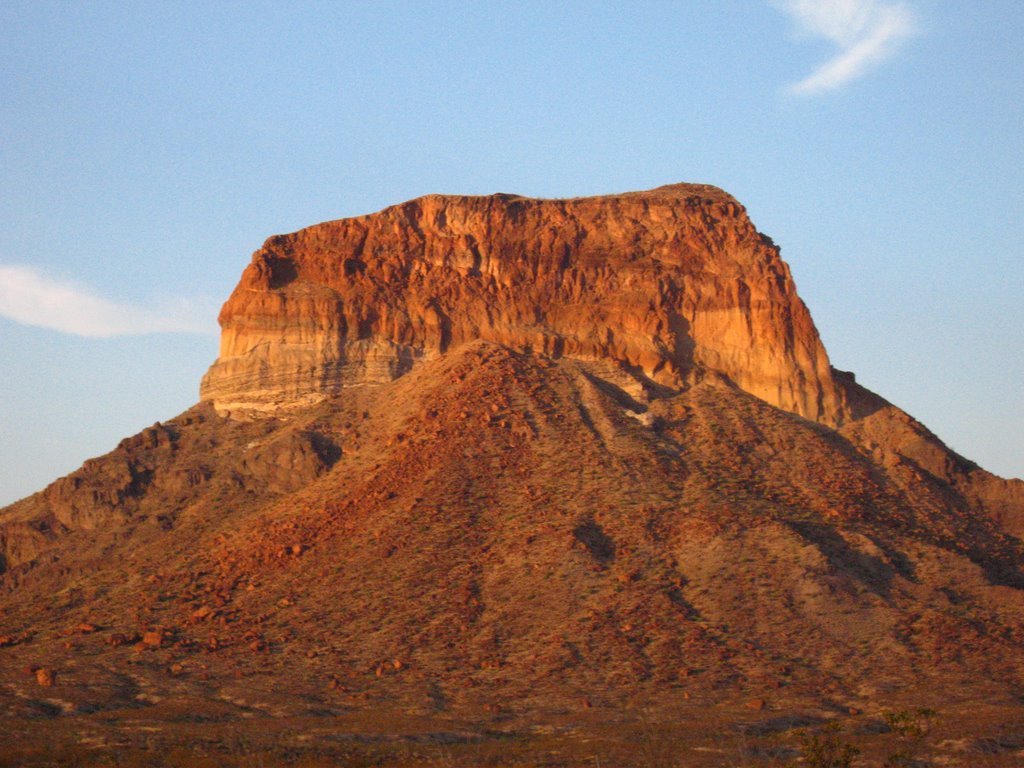
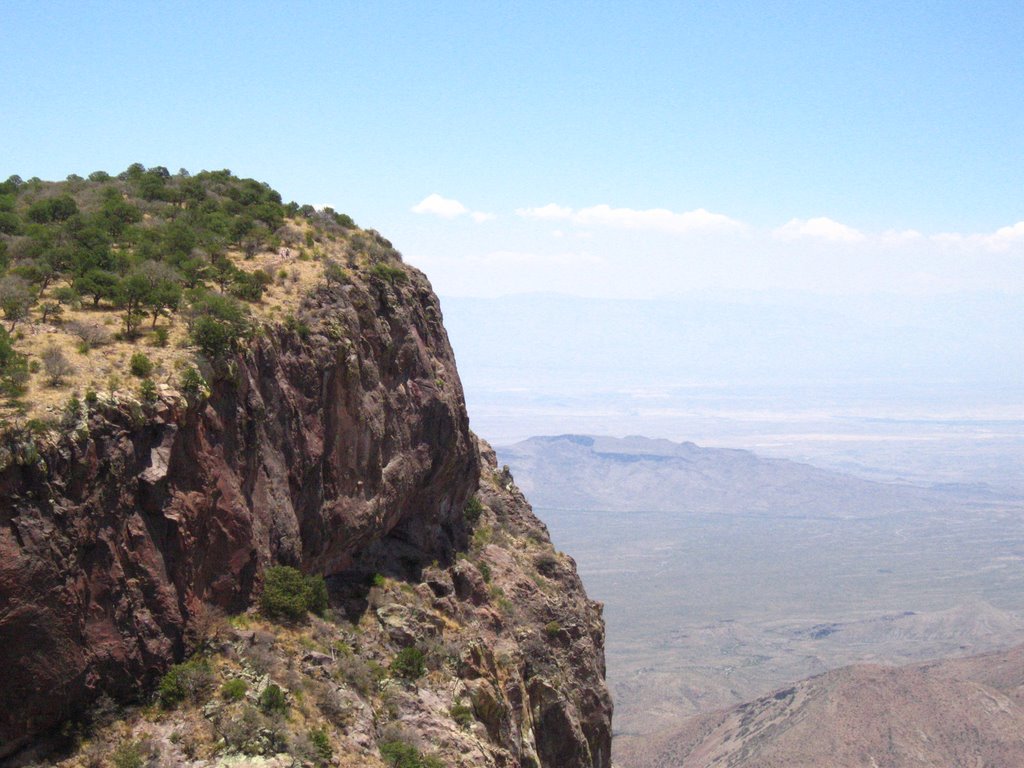
(For scale, look at the picture above the picture of me very closely. There are two tiny people on the cliff.)

Saturday, June 17, 2006

Marfa, Texas

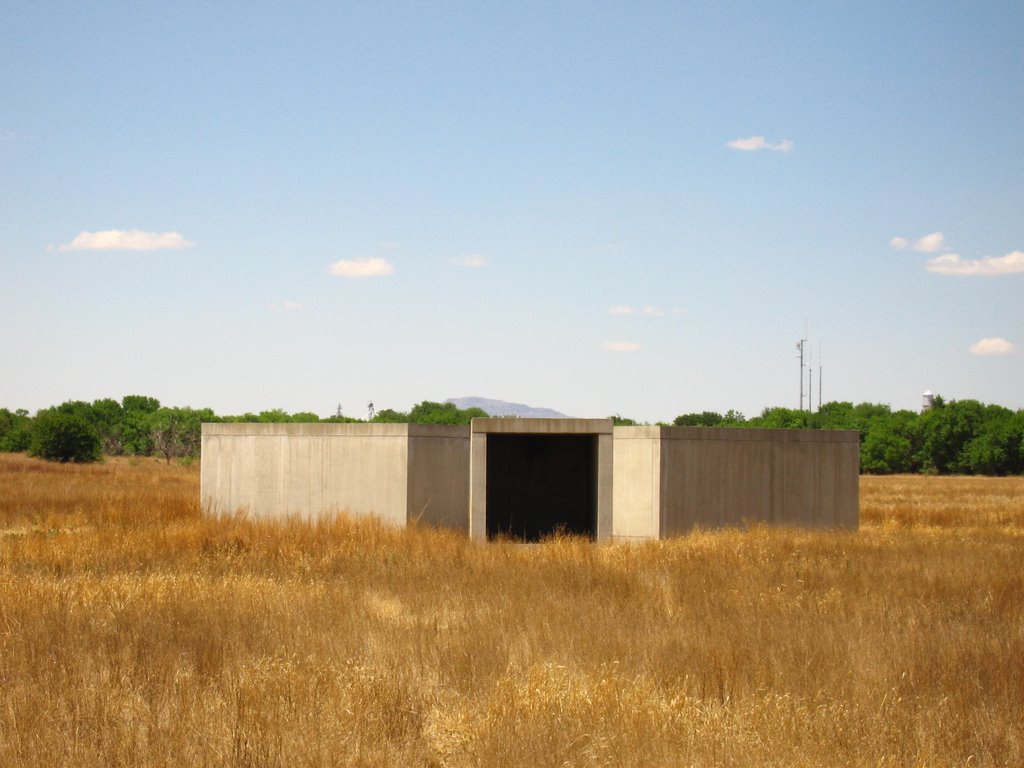
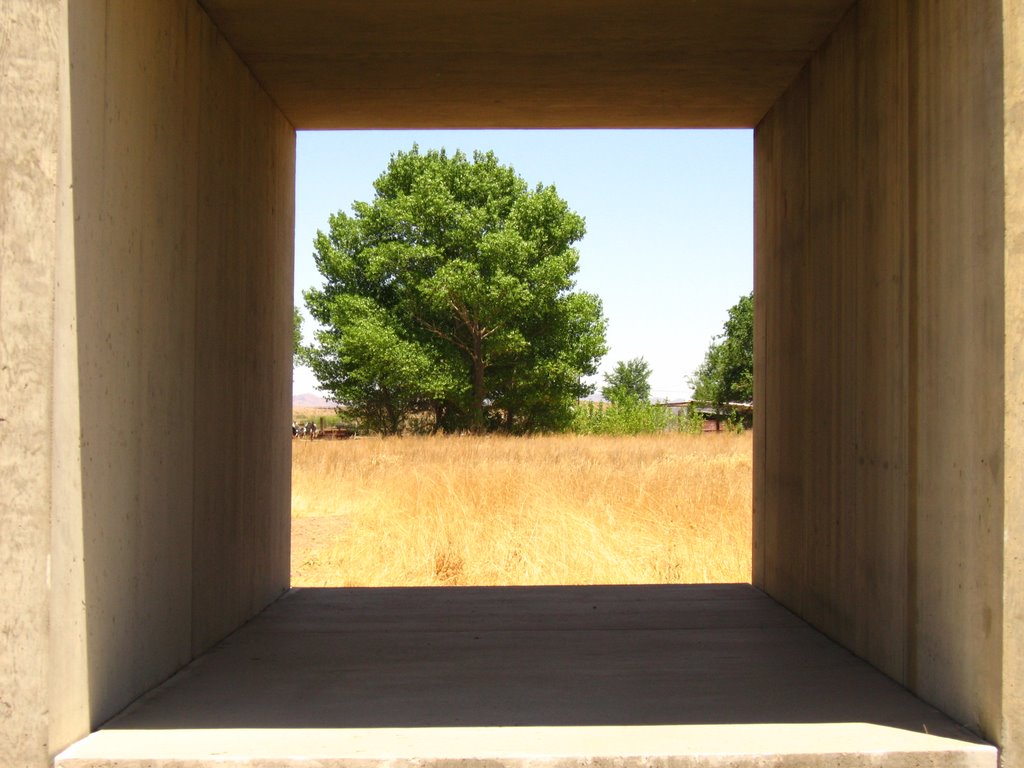
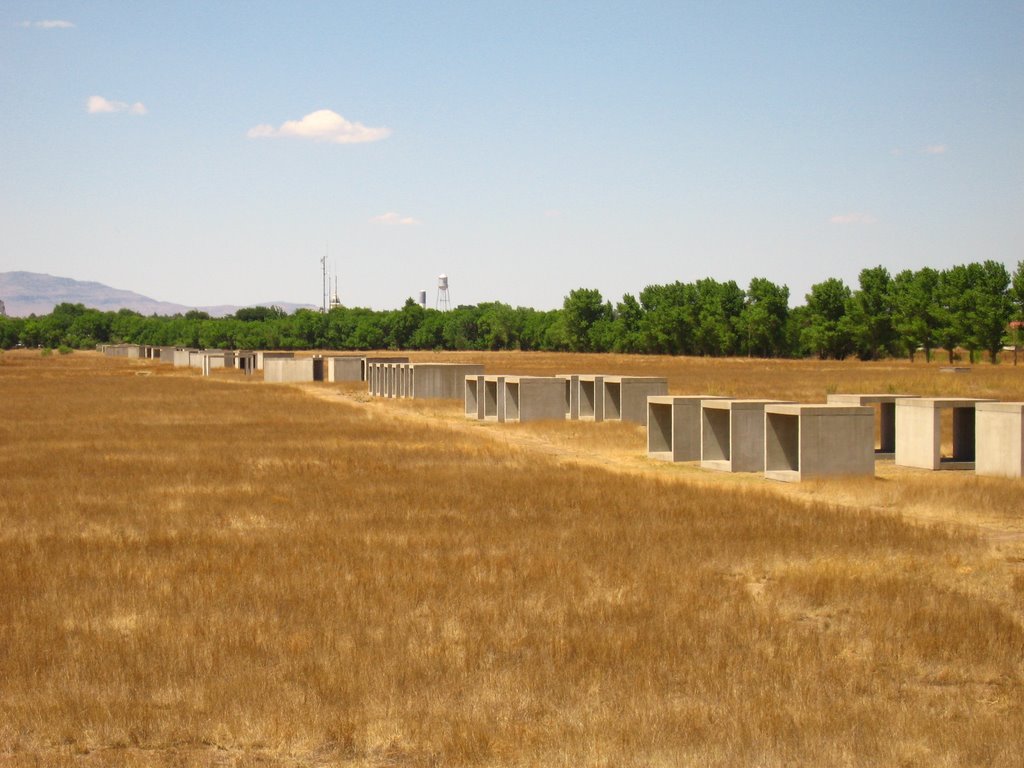
Donald Judd, the New York sculptor, fell in love with Marfa, and it is his contributions that make the town more worth a stop than Carmel or Bisbee or any of a hundred other art towns. It's everything that New York is not: open, lonesome, starry. In summer a sea of yellow grass encircles the town. There's only one stop light, and the library is open Monday to Friday, 9 to 5. Nothing gets delivered on the weekends.

Judd also relocated his children, Flavin and Rainer, to Marfa. It'd difficult to parse this decision, to decide whether it was selfish. (Judd ex-wife, Julie Finch, remained in New York City.) There's nothing to do in Marfa. Pecos is 125 miles away; El Paso 200; San Antonio about 400. Moving the children away changes who they are, takes them from a wealth of influences to a place with very few.

For what it's worth, in a recent article in the New York Times, the Flavin Judd calls New York their childhood home, and both Judd children are on the Board of Directors of the Judd Foundation.

Judd's house in Marfa still contains all of his books, even 12 years after his death. Among these is the full collection of the Loeb Classical Library, hundreds of volumes of Greek and Latin texts, which Judd purchased, the guide reports, off a television commercial. Judd knew no Greek or Latin—no foreign languages of any kind, in fact. He liked the way the books looked.

On the door of Flavin's room, there's a decal for the Marfa High School Shorthorns foorball team. It seems incongruous that a son of Donald Judd would play such an dirty and plebian sport. It seems the type of thing that Judd as a father would discourage.

From the son's perspective, however, it makes perfect sense. It's social, something to be proud of (the pizza parlor keeps yearly photos of the team on the wall), a way to make a life in Marfa.


Friday, June 16, 2006

Pecos, Texas

Money Reward


For DEAD Bank Robbers

A cash reward will be paid for each Bank Robber legally killed while Robbing this bank


The Texas Bankers Association, a'corporation, offers a standing reward for each bank robber legally killed while robbing and holding up a reward subscribing member bank in Texas with firearms during the daytime. Limits of the place and time of such killing are: in the banking house, or as the robbers and holdups leave the bank, while the robbery and holdup threats are being committed within the bank; and as they flee from the bank with the property taken, and are resisting legal pursuit and arrest, within five miles of the bank robbed and within one hour after the robbery and holdup.

  • The amount of the reward for each dead robber will be the total collected from subscribing member banks at $5 per subscriber, but the total amount, in any event, shall not exceed $5,000.00.
  • This reward does not apply to night attacks on Texas banks.
  • The Association will not give one cent for live bank robbers. They are rarely identified, more rarely convicted, and most rarely stay in the penitentiary when sent there--all of which operations are troublesome, burdensome, and costly to our government.
  • In order to protect the lives of people in such banks and to protect the property of such banks, the Association is prepared to pay for any number of such robbers and holdups so killed, while they are robbing and holding up its reward subscribing member banks with firearms in the daytime.
  • It is expressly provided that only the Texas Bankers Association shall determine whether or not payment of this reward shall be made hereunder, and to whom (if anyone) such payment shall be made, and such determination and judgement final, conclusive and not reviewable.
  • This reward is effective January 15th, 1933, and all other rewards, offers and statements are cancelled and superseded hereby.


    THE TEXAS BANKERS ASSOCIATION

  • Thursday, June 15, 2006

    Orla, Texas

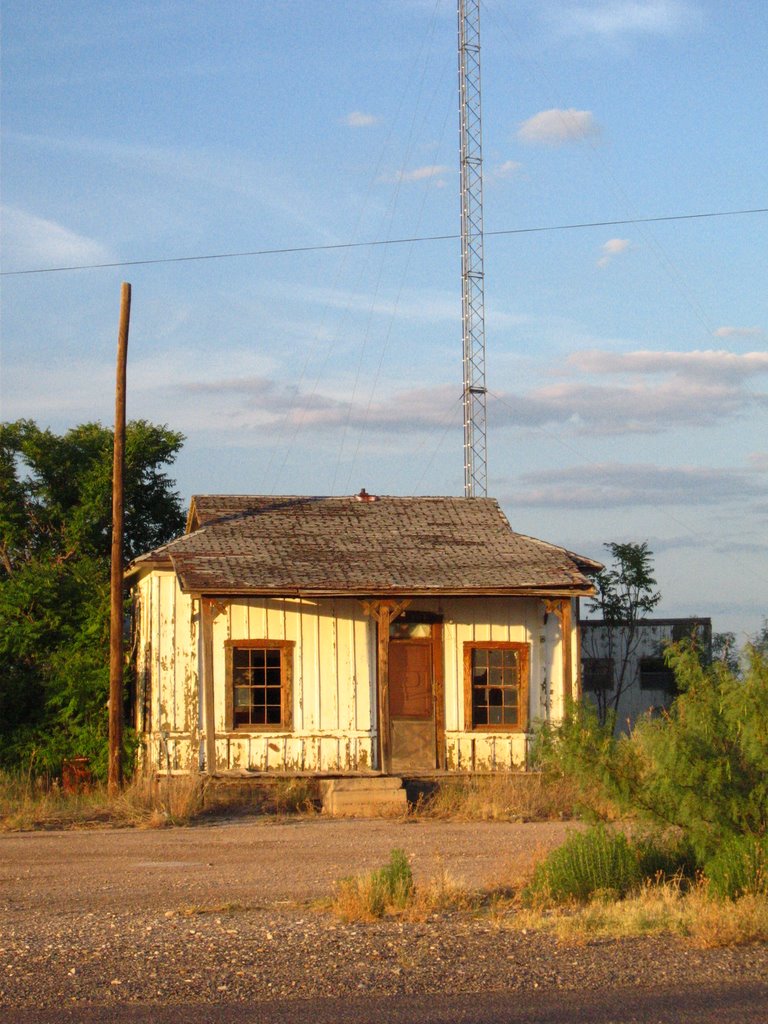
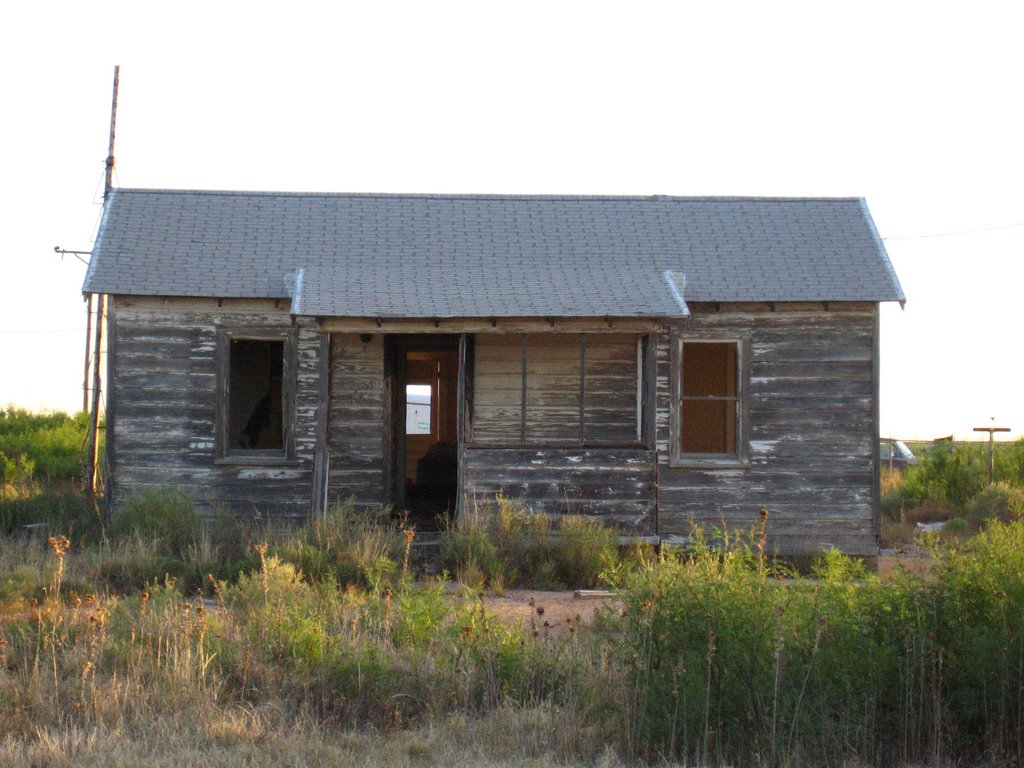
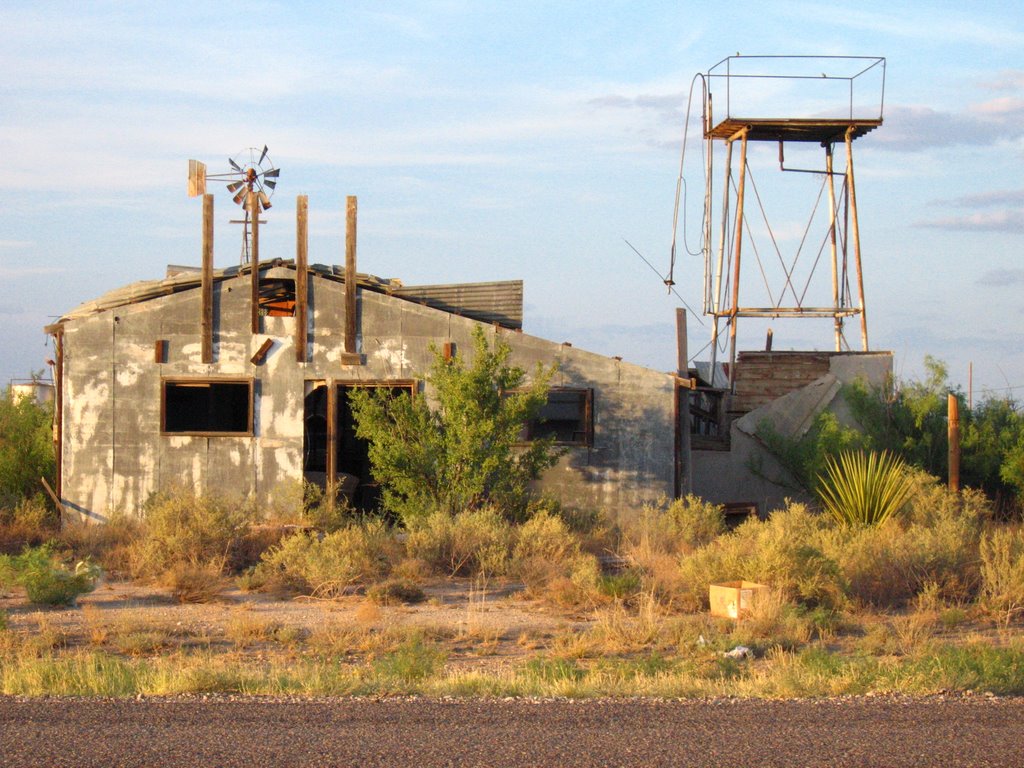
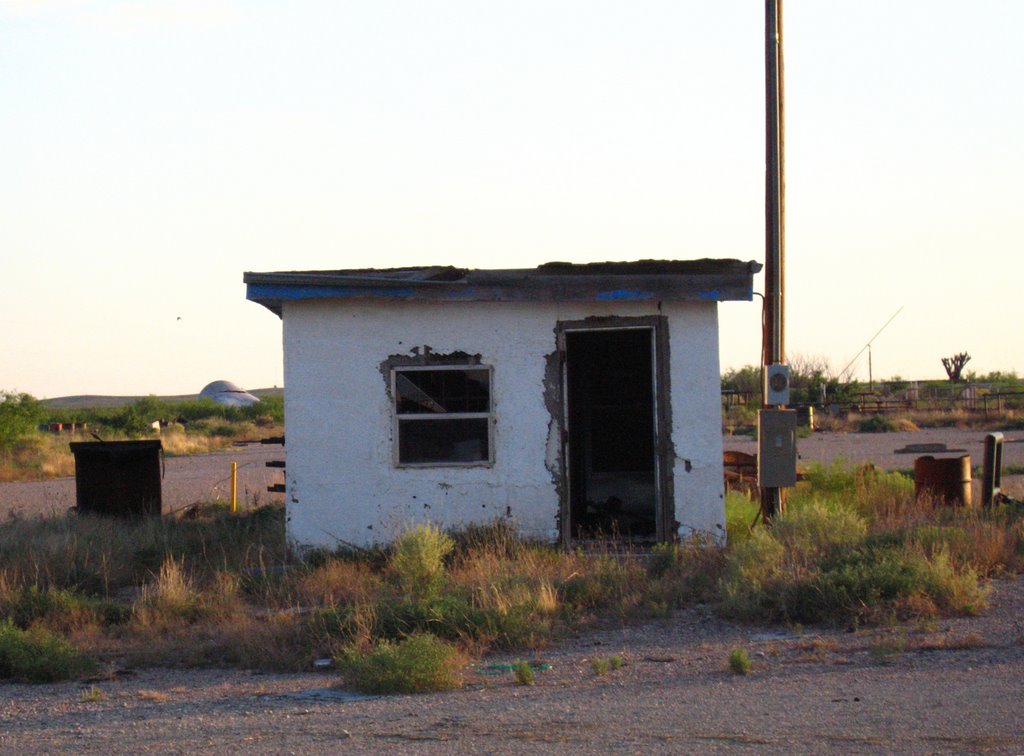
    A couple I met at Brantley Lake State Park in New Mexico prepared me for Orla. "It's like a ghost town," one said. "The only thing left is the gas station."

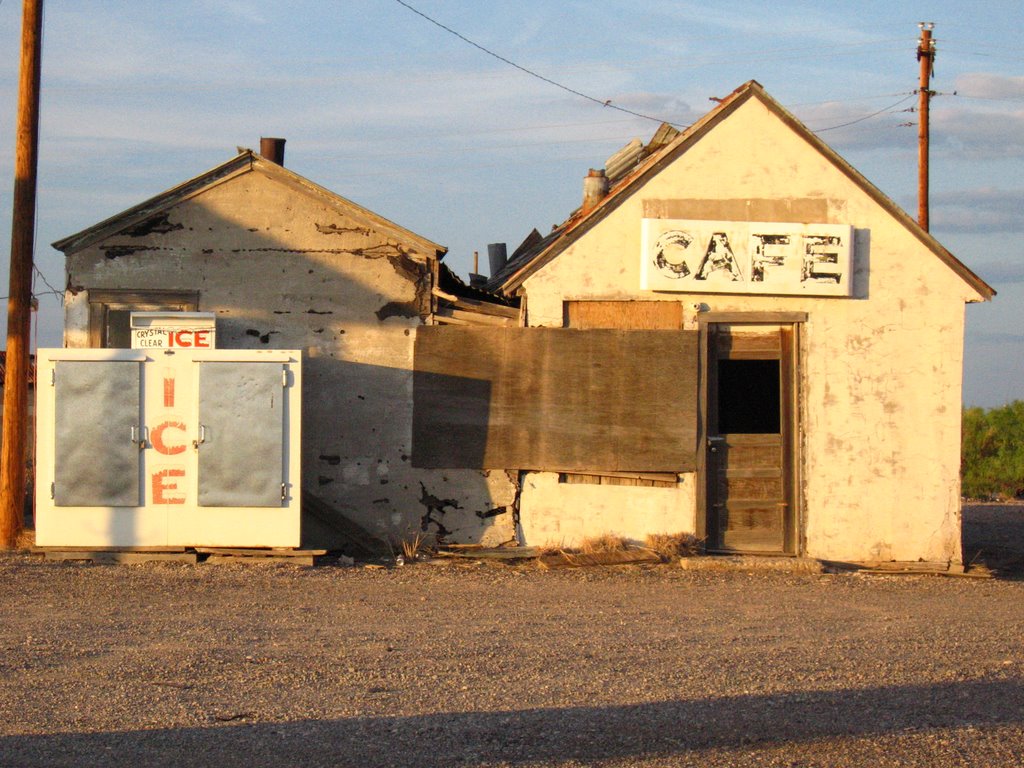
    What I wasn't prepared for: how typical Orla is. Orla's only notable for its concentration of empty buildings.

    Abandoned, collapsing buildings pop up everywhere along the rural roads of west Texas. Perhaps they were abandoned, then collapsed; perhaps they collapsed and then were abandoned. The only ones who can say are no longer here.